

 Trade W
IPO: The First Step for a Company Entering the Capital Market
An IPO, or Initial Public Offering, refers to the process in which a corporation is offering shares to the public for the first time. This can be likened to a corporation stepping away from a private party and now performing on a public stage – it has now opened ownership to everyone who would like a piece of the business, rather than just the small group of founders or early investors who formed it in the first place.
Why should this be important? A corporation can raise huge amounts of capital without taking on debt. For an investor, it is the ability to get in at the very earliest stage of what could be spectacular growth. Also in general for the market, IPO’s pump new life, energy and innovation into the economy.
You don't have to be a seasoned wall street trader to partake in this anymore. Regular investors have an option to benefit from public offerings through their brokers, or also can trade all the volatility around the IPO through new instruments like CFDs. Over the last few years, there have been record breaking IPOs like Airbnb in 2020, or Arm Holdings in 2023, and depending on what side you were on or how you traded it, you either did very well and made some money on the first day, or you sat there perplexed watching your mark to market value fall away in front of your eyes when the dust settled on the fanfare.
This guide will guide you through everything you want to know about IPOs. We will explain the complicated process in an easy manner, look at what makes an IPO a success or failure, and show you different ways to participate in these stock market moving events. So whether you are thinking about subscribing to an IPO allocation, or want to trade the price movements using CFDs, understanding the basics will help you make better decisions.
What Is an IPO? Definition and Core Concepts
The term IPO refers to Initial Public Offering, which occurs when a privately held corporation sells stock to the public for the first time. The business is usually owned by the founders, employees, and some private investors (such as venture capitalists) prior to the IPO. After the IPO, any person with a brokerage account can become a shareholder in the company.
To help illustrate, let's consider a simple example. You and three friends own a successful bubble tea shop. Business is good, and you want to expand to 20 more locations across the country. However, you need to raise $5 million to do this and your savings and bank loans are simply not sufficient. You decide to sell ownership of the business to the public. So you breakdown your business into shares - and sell them to the public. An IPO is very similar to this concept.
Companies have many compelling reasons for pursuing an IPO. The most obvious reason is to raise capital. For example, when Google went public in 2004, it raised $1.67 billion. That $1.67 billion was invested in expanding Google's products in different markets to where it is now one of the biggest tech companies. Money is not the only motivation for going public, however. When a private company goes public, the company obtains significantly more visibility and credibility. Becoming a public enterprise is prestigious and makes it easier to recruit employees and negotiate partnerships.
There is an exit strategy component to consider, too. Original investors who took a risk on a company in its early days now have the chance to cash out and realize their investor gains. Employees with stock options now have the opportunity to turn their sweat equity into actual wealth.
Making the transition to a public enterprise is complicated and not as simple as saying "we're going public." The company needs to orchestrate the IPO process involving dozens of people, primarily investment banks (also known as underwriters), lawyers, accountants, and regulatory agencies. The company needs to create a detailed prospectus; that is a document that lays out everything that an investor needs to know, including financials, risks, business model, and management structure.
The Securities and Exchange Commission (SEC) in the United States, or a similar agency in a different country, must approve the prospectus before trading can begin. The SEC or statutory agency serves to protect the public from fraud and requirements for full disclosure.
What's significant about IPOs, such as that of Spotify in 2018, is that it is different than simply buying shares on a stock exchange like the NYSE or NASDAQ. When you buy shares from the stock exchange, you are buying shares that someone else sold or offered. When you are taking part in an IPO, you are purchasing shares that the company has created and are directly supporting the company with your money.
Take Netflix as an example. If Netflix had allowed viewers to purchase shares in the 90's, investors would see a huge return today based on the premise that Netflix is changing how we consume entertainment. This is the excitement with IPOs, you want to buy shares of the next great idea.
The main idea is that an IPO is the event that allows a private organization to go public and invite others to be a part of their growth and financial success. Everything an organization does will change, including its approach to corporate endpoints, their financial reporting, and even their relationships with their shareholders.
The IPO Process Explained: From Filing to Public Listing
Going public is not a sprint - but, a marathon with many stops. The initial public offering process usually takes approximately six months to one year, sometimes more. Once again, let's take each step.
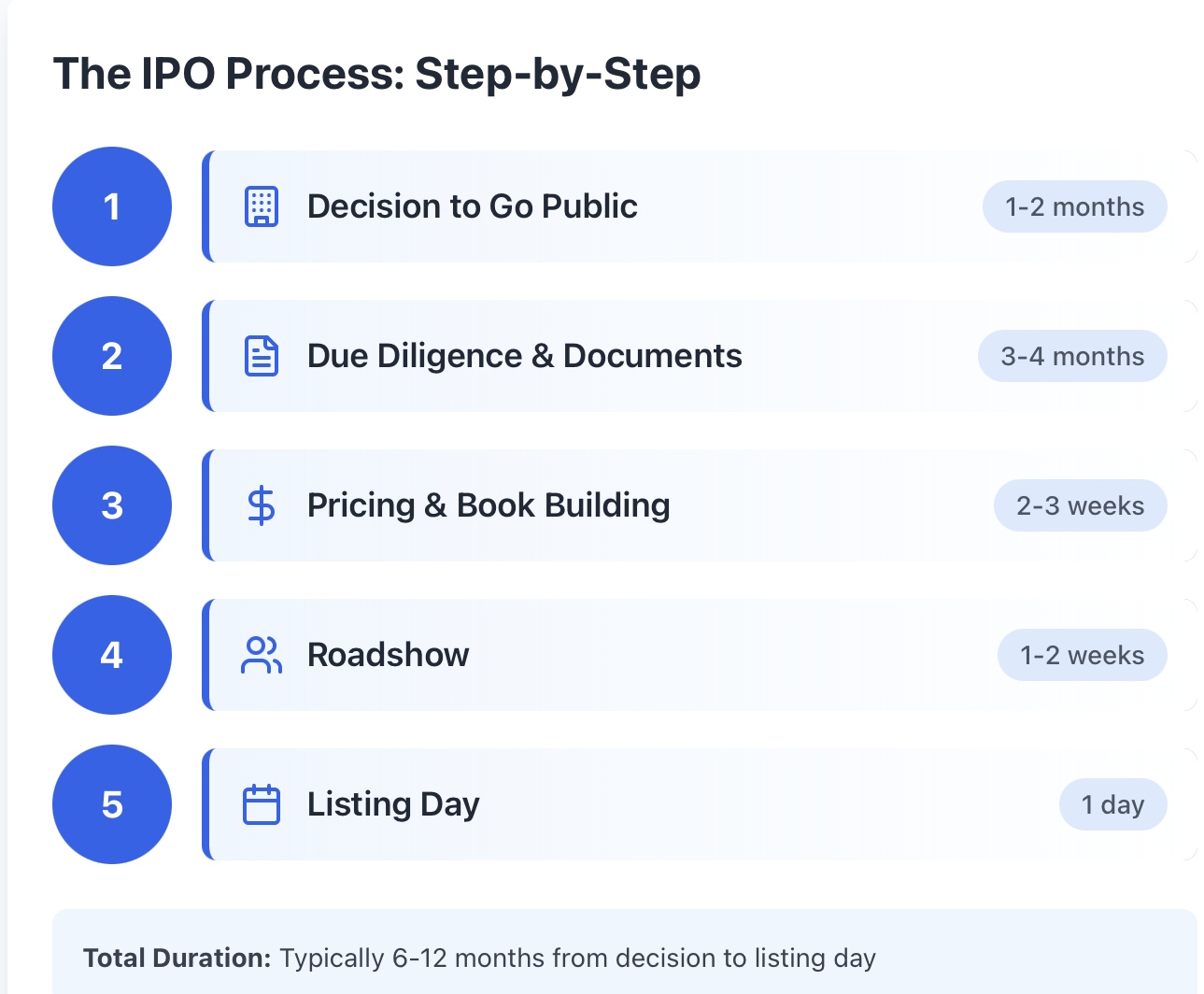
Step 1: The Decision to Go Public
It all starts with a board meeting. The leaders discuss the topic and decide that an IPO makes the most strategic sense. They look at the current market conditions, evaluate their readiness financially, and select the underwriters, which are typically high esteem investment banks such as Goldman Sachs, Morgan Stanley, or JPMorgan Chase. The lead underwriter serves as the quarterback who manages all of it.
Step 2: Due Diligence and Document Preparation
This is where the work is done. Lawyers, accountants, and bankers comb through all areas of the business operations. The financial statements are audited several times. The team puts together the prospectus, or in the case of the US market, this is referred to as the S-1 filing. This document may be hundreds of pages long and consists of everything from executive compensation to possible negatives such as pending lawsuits or emerging competition.
Step 3: Pricing and Book Building
How do you price shares for a company that has never traded publicly? As with other things, it is partially an art and partially a science. Underwriters build a "book" by soliciting interests from institutional investors. They may suggest a price range, for example, $15 to $18 per share, and collect orders. If they get strong demand, they price at the higher end or above. Essentially, if the book is oversubscribed, it shows there are more people trying to buy shares than there are shares available.
Step 4: The Roadshow
Then, management goes on the road to share their vision with potential investors in major financial hubs. They will meet with pension funds, hedge funds, and mutual funds. The presentations are to generate excitement and bookings. Finally, it gives management the opportunity to test the market and identify investor concerns to refine management's pertinent messaging.
Step 5: Listing Day
Then, the big day arrives. Trading begins on an exchange, such as the New York Stock Exchange or NASDAQ. Company executives will even ring the bell to mark the occasion of their initial listing. The stock may have a very large first trade that is significantly different from the IPO price. After a very strong demand, a stock could be priced at 50% more, or more, on the first day, or sell off immediately if the demand is weak.
Throughout this process, we dive into some technical terminology. When demand exceeds the available shares, this is called oversubscription. Generally, oversubscription is viewed as a positive. A greenshoe option is a process that allows underwriters to place additional shares (typically 15% more) in the event of excessively oversubscription demand in order to stabilize the stock price.
For comparison, think about the IPO process as if it were prepping for a grand concert. You wouldn't simply walk on stage and begin to play. It is suggested that the stages include rehearsals, sound checks, ticket sales, advertising the concert, and ultimately the opening night. All of these details matter because the audience is watching closely.
Arm Holdings filing to list on NASDAQ (2023), is one case study from an institutional perspective. The chip designer went through months crafting the prospectus, organizing multiple roadshows in the US and Europe, and carefully considering pricing of shares. In the end, the company experienced and successful debut, affirming the companies valuation.
To help you start thinking like a beginner, consider the process of starting a clothing line. You initially financed the startup using your own savings and potentially few trusted friends who are willing to support you in the private financing stage. However, when you decide to utilize a crowdfunding platform that allows you to reach thousands of potential supporters at once, you would at best be analogous to going public. If you reach a level of success with the clothing line, you can introduce ownership to a much larger group of individuals who are willing to invest in the founder through this platform in exchange for funds needed to develop and grow your brand.
The IPO process remains highly regulated and complicated for a good reason. It is often a major event in the life of a company when it moves from a privately controlled company to a publicly accountable corporation.
Investor's Perspective: Opportunities and Risks in IPO Investing
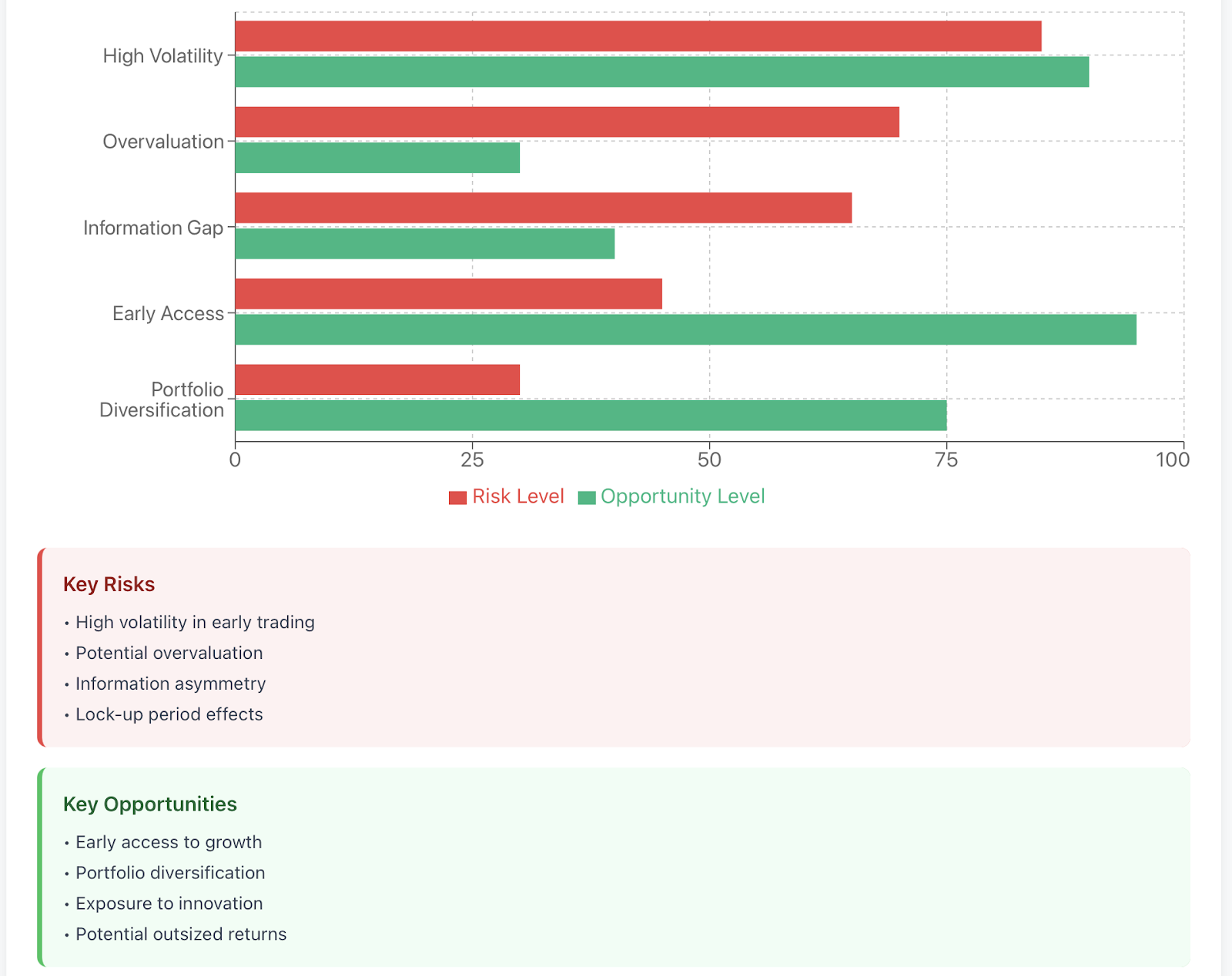
Investors are enticed by IPOs for only one reason: they can provide outsized returns. Getting in early on the next Amazon or Google would be a dream come true. However, investing in IPOs leads to considerable risks that can wipe out capital just as fast.
The Draw
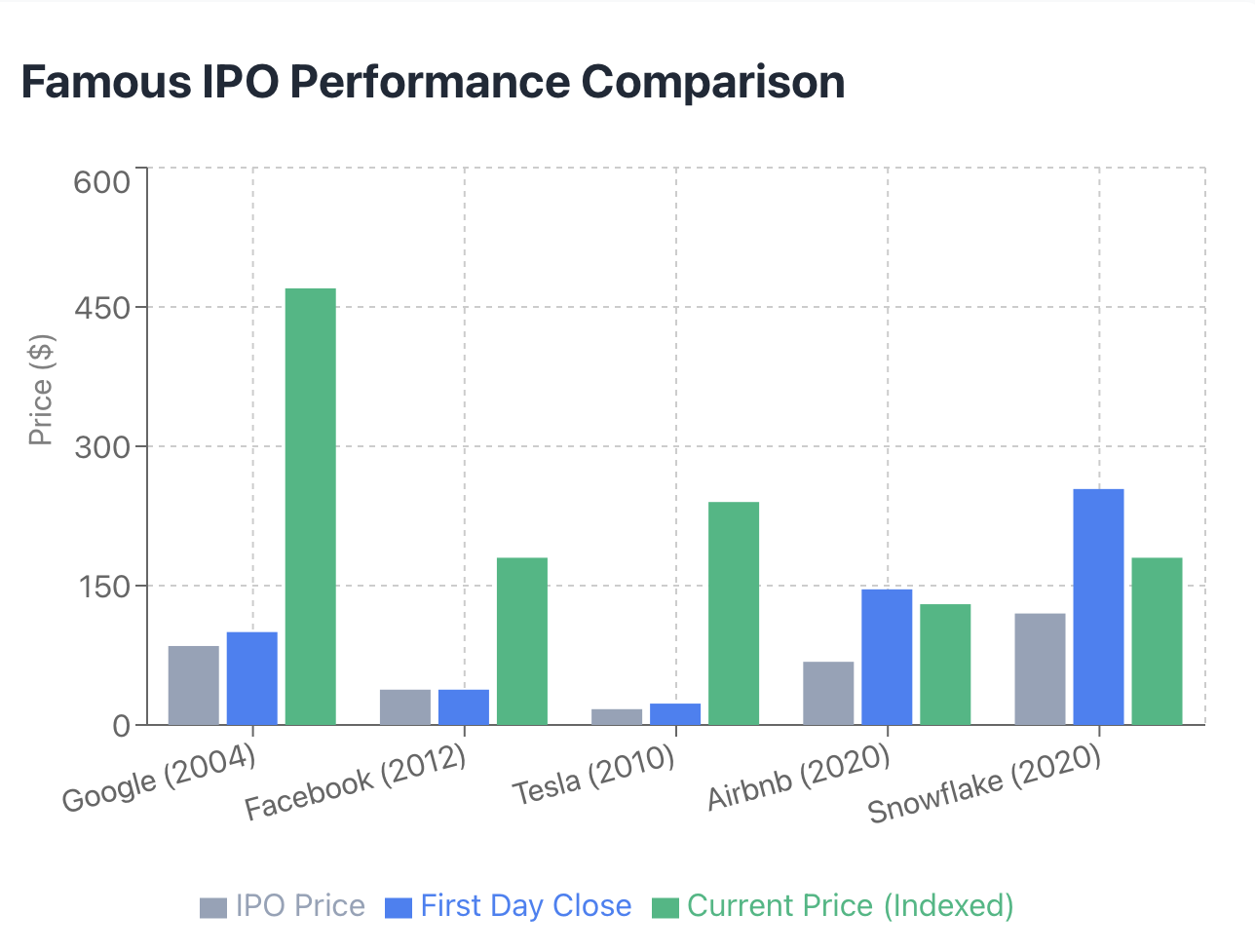
Early access is the main draw. When Facebook went public in 2012, the offering price was $38 and opened down to $25 on its first day of trading. However, early investors that remained invested saw their investments increase multiple times. In 2010, when Tesla went public, the share price was $17. At its height, adjusted for splits, shares exceeded $400. This is the kind of wealth creation a person can read about today.
In addition to early access, IPOs offer portfolio diversification. IPOs give investors exposure to new industries and innovative business models before they become mainstream. For example, investors that invested in the early IPOs of cloud computing companies had investments in a sector that completely dominated the next decade of technology growth.

The Dangers
High volatility is nearly guaranteed. When Snowflake went public in 2020, it gained 112% on the first day of trading, which is great, right? But imagine if you bought it at the high of the day, and then it just started trending downward over the days and weeks following the IPO. Plenty of IPOs will have wildly fluctuating prices as the market figures out what the company can reasonably be priced at.
Overvaluation can be a risk. There are always incentives for companies and underwriters to overly inflate the price of every IPO. Sometimes the speculation ie the hype are worse than the reality of the company. Think about it like you would with a new product release. Remember all that hype for Google Glass? Initial excitement has little to do with the future of the product.
Information asymmetry puts retail investors at a disadvantage. During an IPO's roadshow process, institutional investors have significantly better access to the company's management. Institutional investors can ask good follow-up questions and are often allocated shares of the IPO ahead of retail investors. By the time retail investors can buy shares in the open market, the "smart money" might be selling those shares.
Lock-up periods add more complexity. Company insiders and pre-IPO investors usually not allowed to sell their shares from 90 to 180 days after the IPO. After the lock-up period ends, when the floodgates are opened and the hold/sell anything that they have had to wait for the right moment, the price might very well go down.
The unsuccessful IPO attempt by WeWork in 2019 is a perfect example of when things can go wrong. The company's valuation practically evaporated in the IPO process as investors dug deeper into the company's business model and governance issues. Investors who were otherwise enthusiastic early on, would have potentially lost a lot of money had they actually been able to invest at the original proposed valuation.
As for how retail investors can participate, the conventional IPO process generally requires opening an account with a broker-dealer that obtains allocations. Sometime major retail brokerage firms such as Fidelity Investments, Charles Schwab, and TD Ameritrade, offer retail access to IPO allocations, albeit the retail allocations are usually small and very selective.
But investors can still gain indirect exposure through exchange-traded funds. Funds like the Renaissance IPO ETF provide the latest IPOs in a basket form, convenient for investors who wish to gain exposure to the performance of IPOs without having the stress of investing in a single stock.
Lastly, CFD traders do have a totally other option. Instead of owning shares, CFD traders move price movement surrounding the IPO event. This approach provides flexibility to supplement their potential profit from rising or falling price movement without obtaining an allocation. Trading platforms including Tradewill provide CFD positions on major IPO stocks providing traders an opportunity to profit from the volatility without the commitment of wanting to still hold the stock long-term.
IPO investing offers high risk and high reward. Rational analysis beats blind speculation every time. Do your homework, understand the business model, and never invest more than you can afford to lose.
The Relationship Between IPOs and CFD Trading
Corporate finance directors and investors are subject to an entirely different mindset regarding IPOs than traditional buy-and-hold investors would have. They do not care or want a long-term holding in a piece of a company, but the price volatility of what the IPO creates.
Contracts for Difference allow among other things, to speculate on the price movement with the benefit of not being an owner of the underlying company. When there is a major IPO on the market, volatility increases. Prices can move 20%, 30%, or higher all in a single trading day! In this regard, with that price movement represented potential opportunity for the CFD investor.
As an illustration, the 2019 Uber IPO, opened below the IPO price and continued lower a day or so after trading. The traditional investor who bought the stock at the IPO price had lost. But the CFD trader, who speculated appropriately, with a short position would have profited at least partially by that same price motion.
CFD trading has some general benefits in the context of an IPO: For example, leverage allows you to control a larger position size with less cash; second, the flexibility of going long or short means you can profit on the price motion, either direction; finally, you do not need to worry about getting customer IPO allocation - meaning after the IPO has been issued, you just trade the stock as one would normally would.
The Renaissance IPO ETF includes recently listed companies and offers a diversified basket of IPO stocks. CSF traders can take positions on the ETF that do not rely on the performance of a single IPO but expose them to the movement in the IPO market.
There are significant differences between participating in an IPO and trading the IPO with CFDs. When an investor participates in an IPO, they are investing capital, receiving shares of the new company's stock, and becoming a part owner of that company. The investor in an IPO is entitled to any declared dividend, and will also benefit from long-term price appreciation if all goes well, but they are also exposed to the downside in price. CFD traders, again, take a short-term view, believing prices will move either higher or lower based on their analysis. A CFD trader will open a position capable of entering or exiting positions fairly quickly using a stop-loss and take-profit system to mitigate risk.
Additionally, demo accounts enable the beginner to practice trading CFDs without risk to their trading capital. Features such as exposure to demo trading on listing day and volatility will test real-world strategies without risking actual capital. The experience of demo trading can be a great resource for understanding the price movement of public companies for the first time.
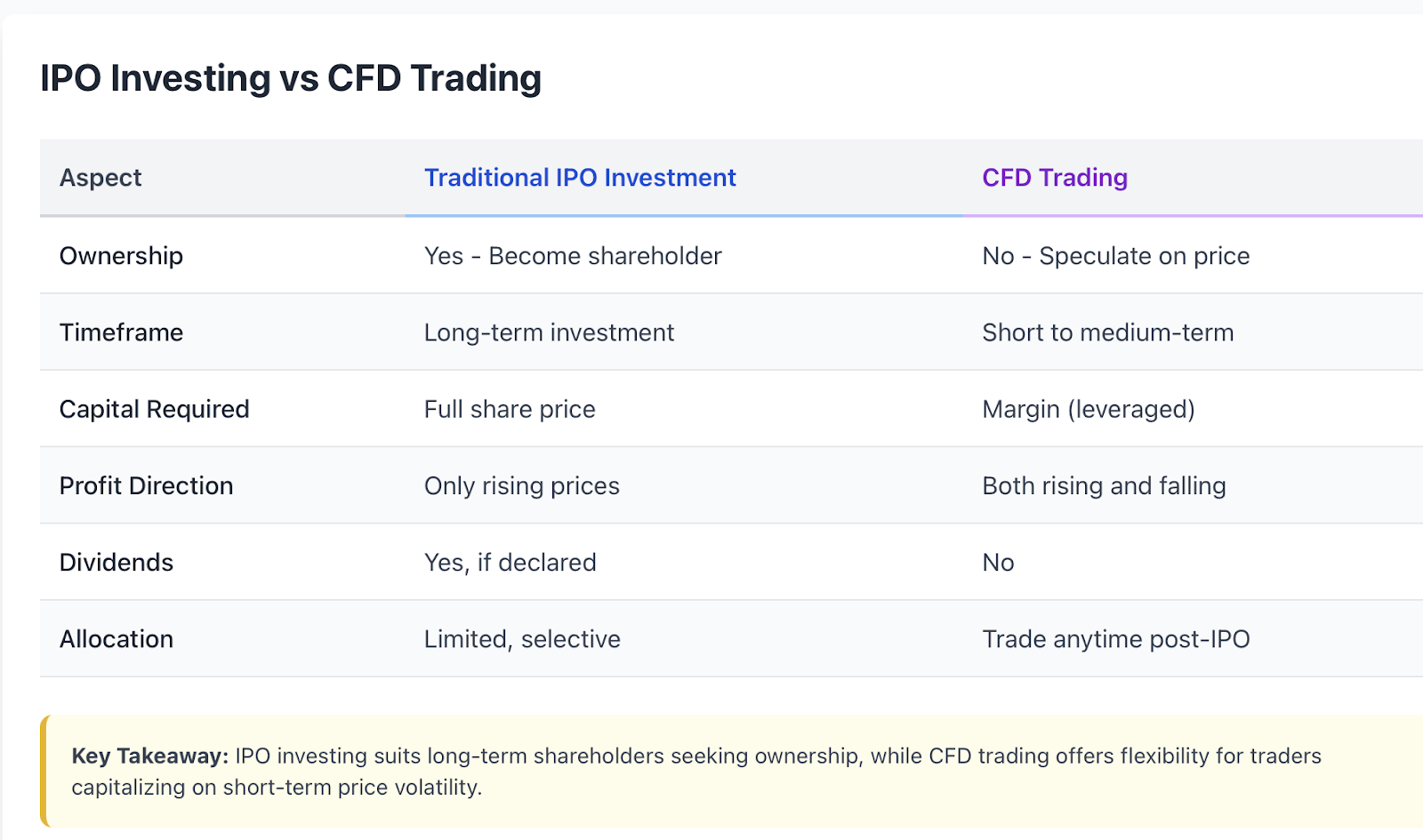
The important takeaway here is that CFDs provide flexible trading opportunities with a focused connection to the overall price dynamics of the IPO market without the restrictions of equity investing. Whether a trader is bullish on the first-day price surge of a technology IPO or bearish on a stock they believe is overvalued, trading CFDs will provide the tools for taking advantage of their analysis.
Post-IPO Performance: From First-Day Surge to Long-Term Growth
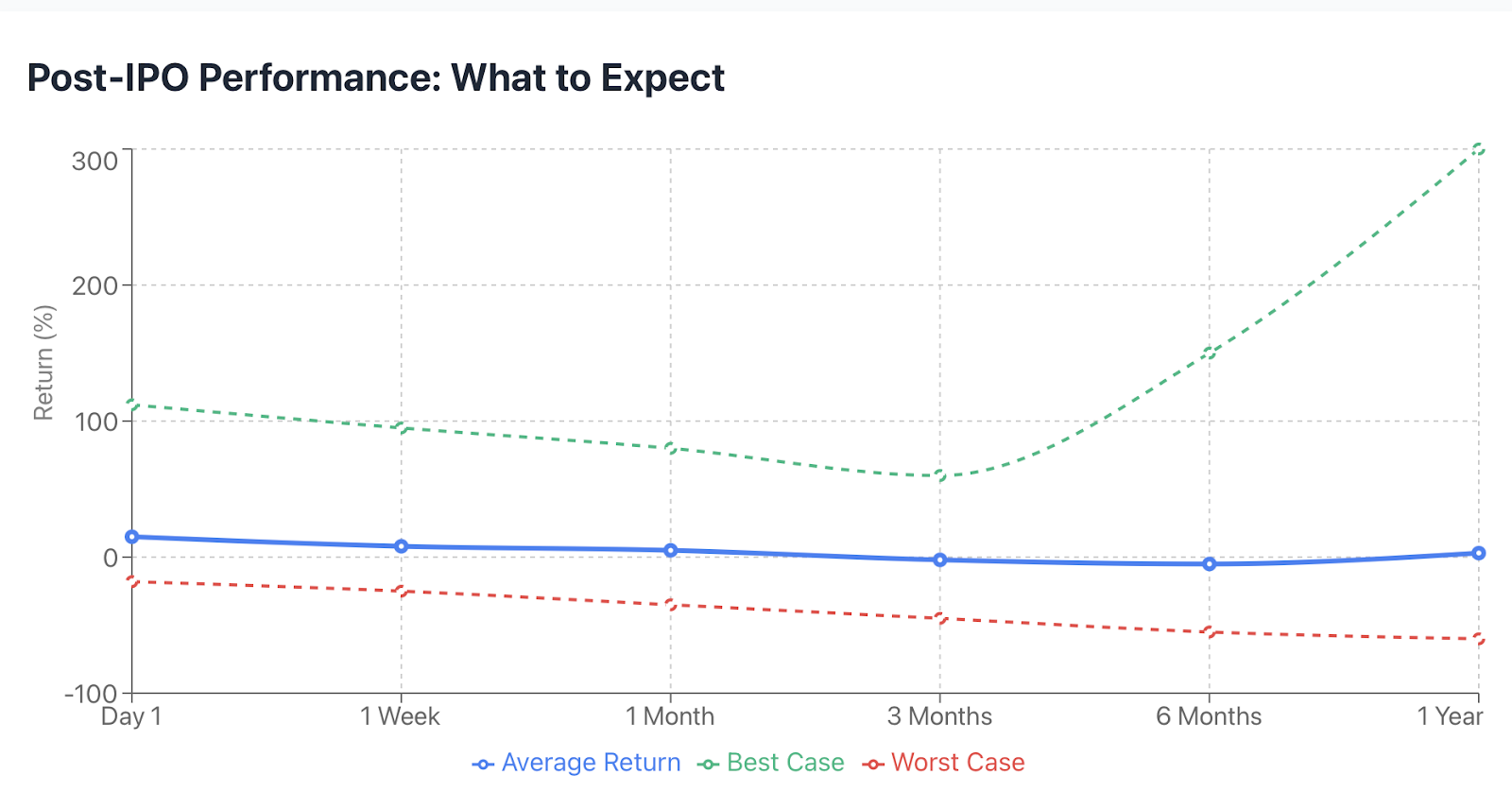

The day of the initial public offering makes for great headlines, but what matters is what happens after that. First-day returns can be exhilarating or deflating; however, they seldom fully convey the story. Research indicates that most IPOs will lag the market for the first year of trading. The euphoria from the opening day subsides, and the reality of an emerging company comes into effect. A case study in this phenomenon is Facebook's IPO in 2012.
Although its IPO day was accompanied by enormous hype, the stock price fell immediately after it debuted, spending much of the next year below its IPO price. Investors who bought the stock at the IPO price saw diminished value during that year. However, those who either bought the stock after the fall or held their shares into the future saw their investment multiply as the company focused on its mobile strategy. Expansion into new markets, whether geographical political, economic, or social, is another possible factor.
There are many possibilities that will affect the performance of the stock post-IPO. One possibility is industry momentum. Tech IPOs with high expectations perform at a higher rate during favorable conditions than if they were IPO'd during a downturn. Appropriately, market sentiment also affects IPO performance. If investors are optimistic and risk-averse, IPO stocks will perform better.
If fear is more prevalent, there will be risks that progressively outperform more classic equities. And of course, interest rates add another layer of complexity. If rates are rising, future earnings will have less present day value and growth stocks can be particularly vulnerable. Most recent IPO's have focused on the growth side of these financial risks and generally less pushed majority into the constituent portion of the return, which may continue turn even worse.
Company fundamentals, at some point, will govern all action. Will the company meet its professed business model? Does it have a sustainable competitive advantage? Is management executing? These concerns will govern long-term results far more than initial day trades.
Think of it as a movie opening on a weekend. It could report major followings, but one massive box office won't equal long-term results, or vice versa. It's about the story, and the trends will eventually be revealed.
Looking over the previous decade, and comparing six-month returns from major IPOs shows fascinating outcomes. explosive returns and sustained upside. Consecutive weeks of horrendous declines, and a stock that never recovers. Other stocks go sideways or gap to balance to true value until the market accepts the value. The lesson is clear, first-day trading will be the first act.
For those doing the trade, this would open up more opportunities down the road. Every earnings report, new product launch, change in management can create turmoil. It gives CFD traders opportunities to take advantage of movement without emotional long operation.
Ready to Experience IPO Market Dynamics?
IPOs are the meeting point of entrepreneurial ambition and investor opportunity, as private companies become public entities- where founders dreams meet capital markets, and informed investors chase absolute returns.
A grasp of IPOs requires a an understanding of both the promise and the risks these offerings present. The IPO process is complicated, highly regulated, and full jargon. But conceptually, it is simple: a company obtains the capital it desperately needs to grow, while an investor has a play to access the opportunity.
It does not matter if you are interested in simply investing in an IPO, or prefer to play the volatility through CFDs, knowledge is your best friend. Trust your research, understand the risk, and never let hype drive your analysis. Markets reward robust preparation, and punish speculation.
Want to put your IPO knowledge into action? Open a Tradewill account today and start exploring IPO trading opportunities. Begin with a demo account to practice your strategies risk-free, or go live when you're ready to trade real market movements. The next blockbuster IPO could be your entry point into smarter, more strategic trading.
Disclaimer: The content of the blog does not represent any position of Trade W, does not serve as any trading-related decision advice, and does not endorse any third-party.