

 Trade W
Why Cost Averaging Matters in Modern Investing
You're at the store, witnessing the price of avocados rise and fall. One week they are $2 each, and another month, they are $4, etc. You could try to determine when the price would be its lowest, but you simply purchase two avocados every week, regardless of price. Eventually, you will have acquired an average price that is reasonable without the stress of determining the best time to buy.
This is exactly how cost averaging works with your investments.
Cost averaging, or dollar-cost averaging, is a kind of investment strategy that involves consistently investing a consistent amount of money into stocks, indexes, or any kind of asset, at regular intervals and time intervals. It does not matter what the price is. It does not matter if the market is in an uptrend or downtrend. You simply invest $500 every month (or $100 every week, or whatever amount works for you) like you are clocking in for your job.
This investment strategy has become extraordinarily popular with professional fund managers and everyday investors alike. Why? Because it addresses one of investing's most complicated aspects - timing risk. Nobody can know for sure when the market has hit a high or low, not even the experts with a complex algorithm and a wall full of analysts. Cost averaging simply ignores the timing risk and buys in every scenario of market condition.
In a market that often experiences volatility (which, truthfully, is often), cost averaging will act as a shock absorber for the portfolio. In simple terms, when prices fall you will generally buy more shares and when they rise you will buy fewer shares. This balancing act performed automatically really does balance the impact of price fluctuations in the beginning.
The nice thing about cost averaging is that it translates across different investment vehicles. You can dollar cost average individual stocks (Tesla, Microsoft etc), broad market indexes (S&P 500), ETFs or even CFDs (Tradewill). The principles are the same: consistent amounts, consistent intervals, long-time view.
As for the beauty of dollar cost averaging, that is not in the attempt to predict what the market will do next. The beauty is in being able to predict nothing at all. In reality, you are building wealth through discipline and consistency and in no way guess work.
Understanding the Core Concept of Cost Averaging
Let’s go through the calculations. The formula is pleasantly straightforward:
Average Cost per Share = Total Amount Invested ÷ Total Shares Purchased
Let’s apply that formula to an example where you are investing in a stock for three months at $300/month:
-
Month 1: You purchase shares when the stock is $50. This means you would buy 6 shares ($300 ÷ $50)
-
Month 2: The price drops to $30. You are then able to purchase 10 shares ($300 ÷ $30)
-
Month 3: The stock price rises to $40. You purchase 7.5 shares ($300 ÷ $40)
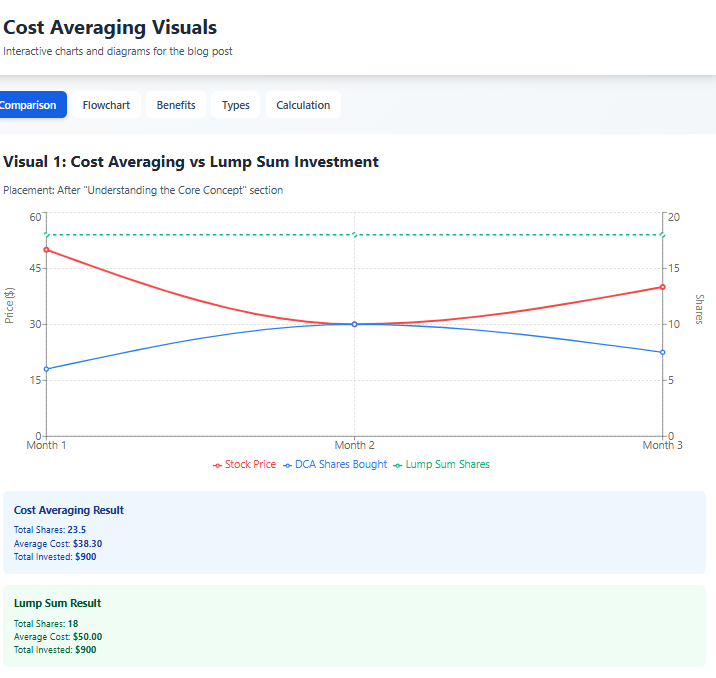
Total amount invested = $900 Total shares purchased = 23.5 Your average cost per share = $38.30
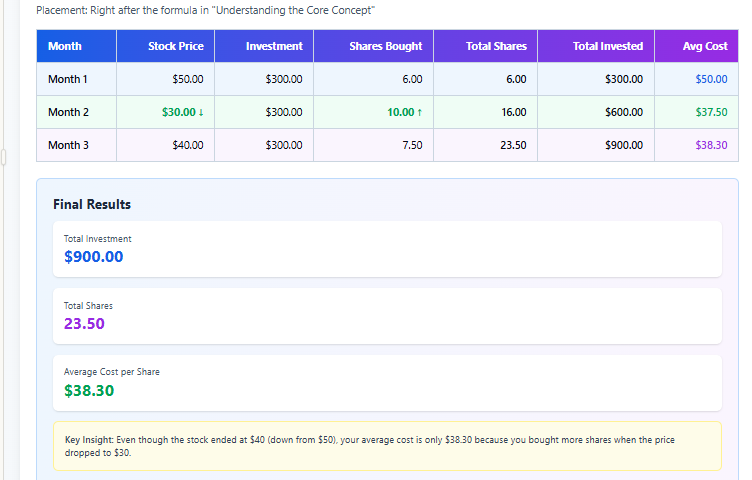
So what happened? After three months, the stock price ended at $40 (lower than it was at your initial purchase). However, your average cost ended up even lower than that. The stock price decrease in the second month helped your average cost, because your fixed amount of $300 allowed you to buy more shares.
Let’s compare this to a lump sum investment scenario where you invested $900 all at once. If you purchased shares on the first day at a price of $50/share, you would own 18 shares at a cost of $50/share. The average cost for your cost averaging scenario was lower and you were able to purchase 5.5 more shares.
This does not mean that dollar-cost averaging always wins. If the stock was steadily increasing from $30 to $50, an investor who puts all $10,000 into stock will always have a higher average purchase price and be better off than an investor who dollar-cost averaged $10,000. Again, dollar-cost averaging doesn't maximize returns, it manages risk and takes the emotion out of the decision.
The advantage of dollar-cost averaging derives its mathematical edge from volatility itself. As prices fluctuate, your fixed investment amount automatically takes advantage of those volatile swings. You effectively have the advantage of being forced to “buy low” more than when you decide “buying low" is for an entry point.
Imagine portfolio manager, dollar-cost averaging $10,000 monthly into a NASDAQ index CFD throughout the year in 2024. Some months she buys into optimistic rallies, other months she buys when fear is at a high and everyone is selling. At year-end she will have a diversified position with an average entry price that considered the full price variable from throughout the year, not just on one price point on an arbitrary day.
Or, consider an individual dollar-cost averaging Starbucks shares monthly through an eventful quarter. Starbucks dips to $85, rebounds to $95, then settles at $90. Given their dollar-cost averaging protocol, it is possible their average cost on Starbucks shares is at $88 because they bought more shares at $85 than at $95.
What’s the takeaway? Cost averaging converts market volatility to a low-key friend instead of an adversary. You're still exposed to market risk (the stock could drop and stay low), but you're no longer taking a chance on timing the perfect entry.
Advantages of Cost Averaging: Building Stability in a Volatile Market
The true benefits of cost averaging manifests in the emotional and practical benefits it provides.
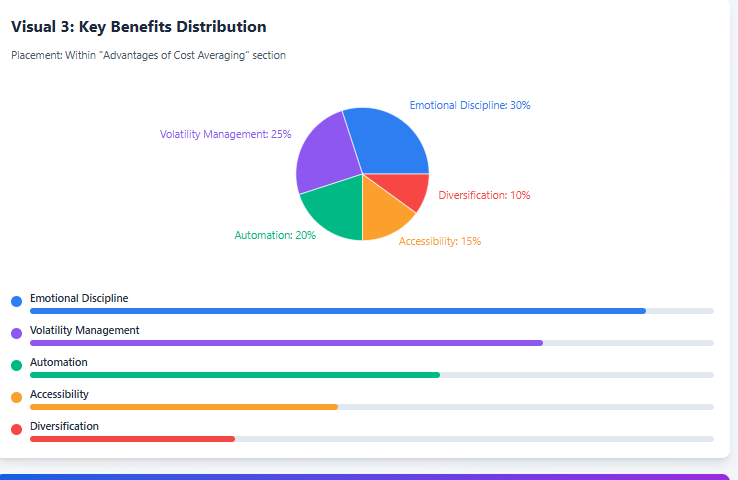
It removes emotional decision making from the equation. Email and greed can destroy a portfolio. When the market is crashing, fear yells "sell everything!" When the market is soaring, greed will whisper "buy even more now!" Cost averaging ignores both. You invest consistently, whether the market is up/down 10%. I think most investors do not realize how valuable the emotional discipline of using cost averaging really is in the grand scheme of things.
Volatility is less frightening. In fact, it can even be somewhat advantageous. When the market dips, you do not panic; instead, you know that your next purchase will allow you to purchase even more shares, as you are now buying at a lower price. Just like that, you begin to think of corrections as sales rather than disaster. This change in your mindset will keep you invested in a stock during a period when everyone is selling at the worst possible time.
It creates an automatic way to invest. Will power is not reliable, automation is. Contribute consistently to your investment. You never have to wonder if "now" is the right time to invest. You made a decision the moment you created the plan to invest consistantly. This removes procrastination and analysis paralysis from the equation.
Cost averaging works with $50 each week, or $10,000 each month. It is available to nearly all people and not just for those with $100,000 cash in a bank account waiting for the "right opportunity" to invest. In those cases, small investors can gradually build positions in expensive stocks that would otherwise be unaffordable in a one-time purchase. For example, a share of Amazon may cost $175 each, but you can over time accumulate a position by purchasing partial shares on 99% of modern trading platforms.
Cost averaging also works beautifully with automated resources. Robo-advisors obviously can cost average automatically. Furthermore, many modern trading platforms (CFD platforms like Tradewill included) can also cost average your strategy. Simply set your parameters, and let the system execute on its own. Cost averaging is especially powerful in index funds and ETFs when you are building a long-term position versus trading to create a short term profit.
Cost averaging allows for diversification. You aren't limited to dumping all of your available cash in a single investment at the time; you can build regular investments across multiple assets. For example you can dedicate $200 out of your budget monthly to an S&P 500 ETF, a technology stock, and an international index all at the same time. You are getting diversified exposure without having to spend more than you would have otherwise.
Imagine an individual who is using a mobile app each payday to buy $100 of an S&P 500 ETF. They aren't checking price predictions or what analysts say—it is simply a systematic plan put into action. Over time they build a large position without ever attempting to time the market.
Or think about robo-advisors managing retirement accounts. In most cases, they are using the principles of cost averaging to invest the contributions to your account. When you deposit money, that investment goes directly to your chosen allocation regardless if the market is at an all-time high or just corrected.
The beauty is in the discipline of not taking a prediction. You aren't trying to be smarter than the market. Rather, you are executing a plan that acknowledges that regularly participating, despite the noise of the market, is the better decision for most long-term investors.
Limitations and Misconceptions: When Cost Averaging May Not Work
Let's be clear on what cost averaging can't do: it is not a profit guarantee; it is a risk management strategy. In consistently rising markets, lump-sum investing usually wins. If you ever knew (somehow) that a stock or index was going to steadily rise in price, you would want all of your money invested immediately so that you could capture the entire rally. Cost averaging means you are holding cash to invest, and you would miss out on that early profit. Based on historical data on major indexes, lump-sum investing has typically outperformed cost averaging in about two-thirds of the rolling periods based solely on the fact that the markets tend to rise more than they fall.
Consider the S&P 500 at the beginning of 2023. An investor with $12,000 who invested all of it in January captured the entire 2023 rally from the very beginning. A different investor who cost averaged the $12,000 by buying a portion every month started acquiring shares at higher prices, and consequently their return was negatively impacted.
Cost averaging does not eliminate investment risk. If the asset you are accumulating declines and stays down, you incur a losss regardless of your entry approach. Averaging into a company that is failing simply means you are now a larger owner of something that has no value. Cost averaging does not eliminate the risk of your investments being poor. Cost averaging simply works to mitigate timing risk in good investments, and it works in mitigating volatility.
It requires liquidity and strategy. You must have cash flow available to continually invest according to the strategy. Additionally, you have to be able to maintain more than a short-term commitment to this investing approach. If you have to stop investing during a time when the market is down (which is when cost averaging typically has its max effect), you will not realize much benefit. For those people investing short-term and betting on quick returns, there would seem to be little value in cost averaging.
There are myths that have to be changed; No, cost averaging does not guarantee a profit. No, it is not always better than receiving gains from a lump-sum investment. No, it does not mean to buy something and not care what you are buying. It manages timing risk, not fundamental risk. You still need to consider each investment decision and ensure that you are investing in quality assets with reasonable long-term potential return.
There is also the argument about "opportunity cost." Money that is waiting to be invested is not earning a return for you. Generally, in most market conditions, having your money invested sooner rather than later will lead to better outcomes than delaying your investment to spread out purchases. Cost-averaging is essentially a hedge against poor timing, and hedges have a cost.
Let's look at a simplified example. Investor A has $10,000 and he invests all of it at the time the market is down. Investor B also has $10,000 but chooses to invest in increments of $1,000 over each of the next ten months, during which the market goes up approximately each month. One year later the initial portfolio of Investor A is likely ahead because he made a purchase when the market got down, then rode that recovery. Investor B paid an average higher price and consequently has less shares.
Cost-averaging is most justified when you are investing on a regular basis (from income, etc.)—don't know when time will provide an investment opportunity—or just want to manage stress psychologically. Less justified when you hold a sum of cash and markets have reasonable valuations.
In short, apply cost-averaging as an efficient process for building positions over time, especially with consistent new savings. Don't view cost- averaging as a magic bullet than amortizes all the negatives in perpetuity.
Cost Averaging in Stock, Index, and CFD Trading
Cost averaging is a principle that applies to various investment vehicles, but the specifics of implementing it are important.
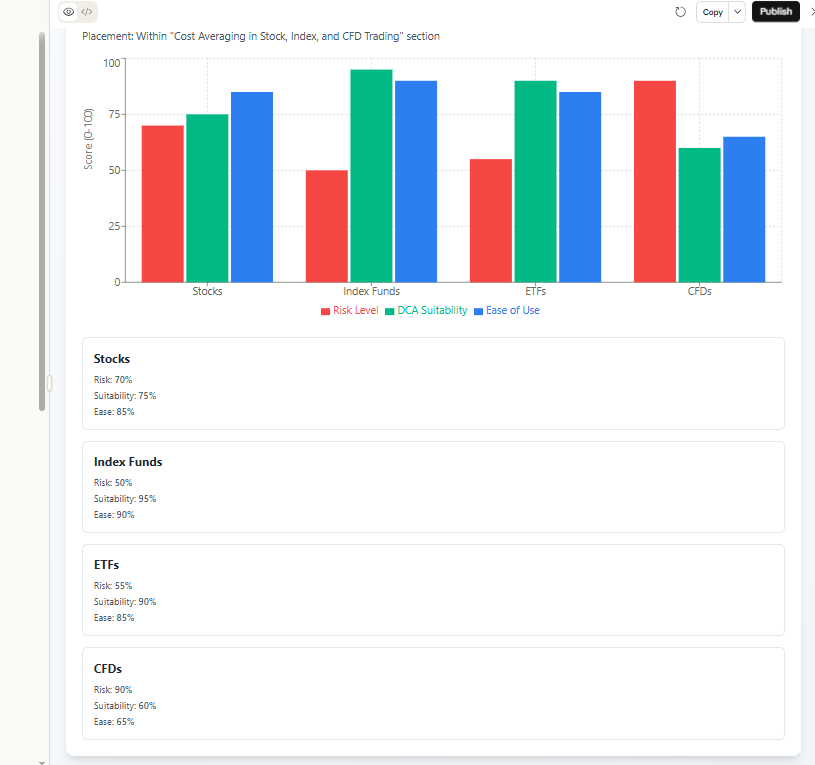
With individual stocks, you are purchasing shares of specific companies. Cost averaging is effective when you invest in stable companies that you are looking to hold for a long period. A risk comes with cost averaging in a declining stock, as it simply puts you in a better position to lose with each purchase. How and which stocks you purchase is paramount.
For an example, consider that someone invests $200 each month into Apple stock. If Apple drops due to outside noise, they can accumulate more shares. If Apple has strong earnings and the stock price moves upward, the investor will own fewer new shares but their existing position will move with the stock price. Over time, this investor will accumulate a large position in Apple, using cost-averaging to smoothen out their cost through the short-term volatility.
With index funds or ETFs, the argument for cost averaging may be the strongest to write about. A broad index diversifies away company-specific risk in favor of being exposed to the broader market risk. In historical context, equity markets generally have trended upward over long time periods, and, other then broad market downturns, diligent and patient investors that invest on an annual or more frequent basis with index cost averaging have been rewarded. This is why it is a very common rule of thumb in retirement investing.
Illustration: Making a regular monthly investment of $500 into an S&P 500 ETF. Some months the index is at record highs, and some months it is correcting. Over 10 years or so, you will accumulate a low-cost, diversified and purchased portfolio of stock without ever having to worry about predicting market timing. Your returns will simply follow the market less a small fee.
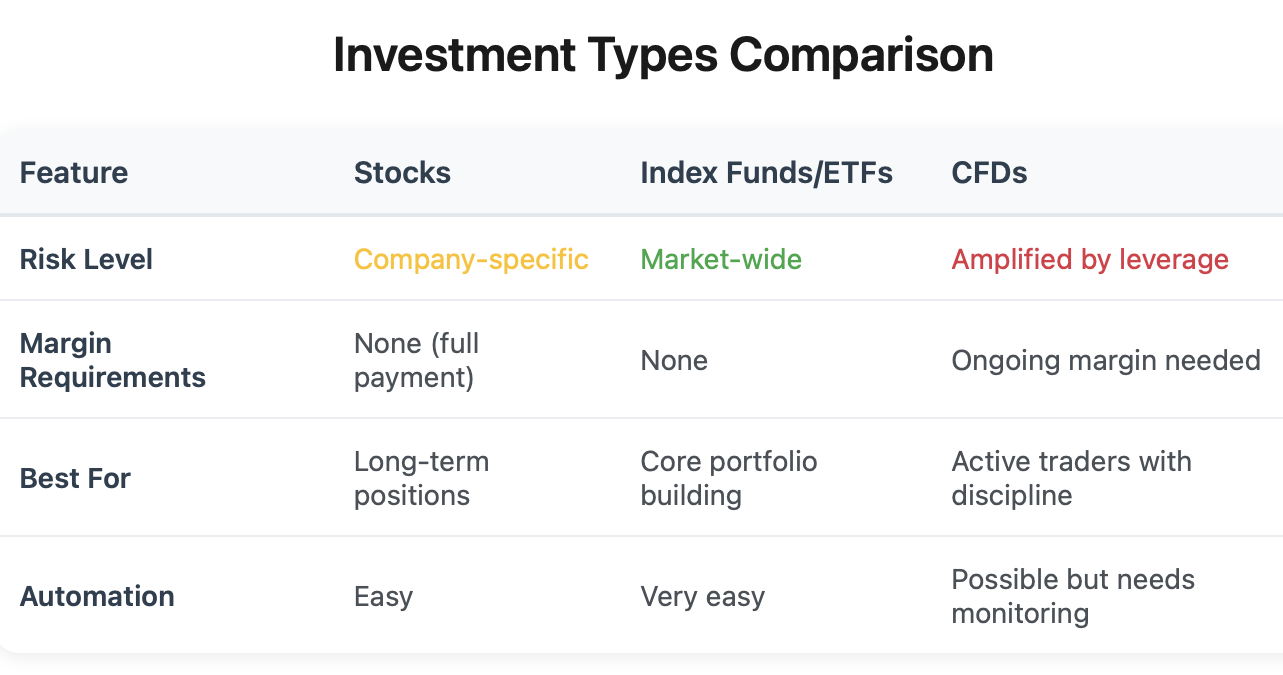
When it comes to CFD trading, however, cost averaging is a bit more complicated due to leverage and margin. CFDs allow you to control larger positions with less capital, but they leverage amplifies both gains and losses. Cost averaging with CFDs requires much more risk management due to the margin and leverage.
A CFD trader may use this method of scheduled entries to build positions in index CFDs like the FTSE 100 or S&P 500. Instead of one large leveraged position, they enter smaller sizes over time. The reason for this is that entry points can vary significantly and increase the possibility of entering the position at a poor price point. The act of entering a position less than favorable is less impactful when using a cost-averaging method. Automated planned trades and entries with providers like Tradewill can help make this easier.
The critical distinction with CFDs is margin calls. If your cumulative positions move against you substantially, you may have margin calls or forced liquidation. Therefore, cost averaging with CFDs is substantially less safe than a stock or ETF cost averaging. When trading a CFD using cost averaging, you must:
-
Utilize conservative leverage
-
Maintain balance margins
-
Establish stop losses on your open positions
-
Do not succumb to the impulse to aggressively "down-purchase" a losing trade
That last point is essential. There is a dangerous gradient between disciplined cost averaging and acting in a "martingale" subsequence when you just keep adding to the losing side in anticipation of a trend reversal. An absolute definition of cost averaging is to add to your positions on a schedule beforehand, regardless of positions being winners or losers. Emotional cost averaging, where you only add to the losing side of the position, spells disaster, time after time.
CFD platforms can offer up cost averaging on features like scheduled orders or position scaling options to assist with. Add leverage in and you're playing with fire if you do not have discipline with position size and risk limits.
Key differences across asset types:The fundamental principle stays the same: regular, fixed investments over time. But you need to adapt your approach based on the product's characteristics, especially around leverage and margin.
Practical Guide: How to Implement Cost Averaging Effectively
Eager to use cost averaging? Here is the right way to go about it.
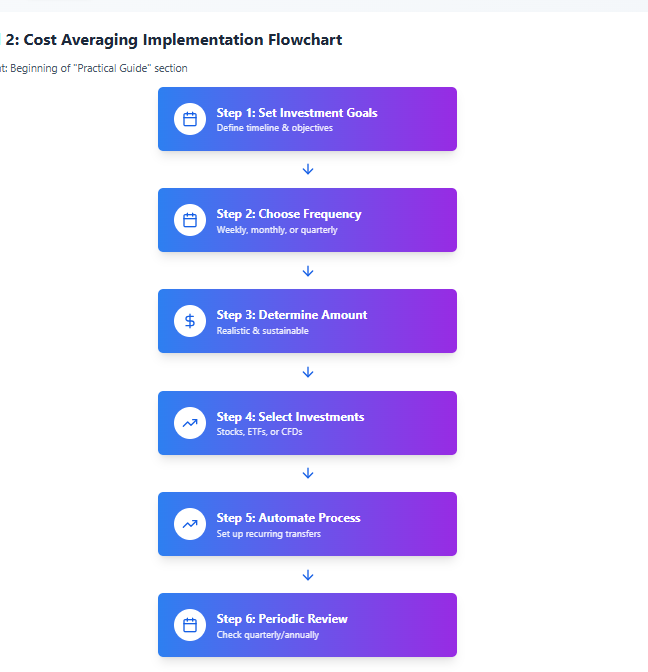
Step 1: Set investment goals
Are you saving over 20 years for retirement? Saving for a down payment for a house in 5 years? Your timeline is key to everything else. A longer timeline can withstand volatility and allow cost averaging to work better. Shorter timelines may need to be conservative.
Step 2: Decide how frequently to invest
Weekly, biweekly, month, quarterly - what works with your cash flow? Most people will match the frequency with their pay periods. If you are paid biweekly, then invest biweekly. If you are paid monthly, then have one monthly investment. It is less about the frequency and more about the consistency with the schedule. A person can even invest quarterly, if they really stick to it, and do better than just throwing money in at random times.
Step 3: Identify the investment amount
Be realistic. The amount has to fit within your budget for possibly longer, even when you are at a financial crunch, you should still be investing it. It is better to invest $100 a month for years than take $500 for a month or two then not be able to spend again. Many will say to go 10-15% income for a monthly invest, but it is about what fits your budget and your investment goals. There is no magic number.
Step 4: Choose the right investments
For most investors, the most suitable investment choice would be a broad market index fund or ETF. Such investment types automatically achieve diversification and commonly have low fees associated with them. In the case of investing in individual equities, select quality companies you’d be comfortable to own for many years. In the case of someone who is trading CFDs, use liquid instruments with reasonable spreads while staying conservative when using leverage.
Step 5: Automate everything
This is something you cannot compromise on. Set up an automated transfer to deposit from your bank account into your brokerage and set up automated purchases of your preferred investments. You want to remove as much of the decision process from the equation as you can. Every time you have to purchase an investment manually, you leave a chance to pass on the opportunity to invest or second-guess your decision to buy.
Most brokerages and apps (however, Fidelity, Vanguard, Robinhood or other web based platforms that trade CFDs, Tradewill) allow for an automated recurring investment. Spend settings this up, for thirty minutes or wonderful investments, or systems, or whatever you choose, and let it be.
Step 6: Periodically check in and do not obsess over it
For assets that your monitoring, check in quarterly or yearly. If your target allocation has significantly drifted from your chosen coming, rebalance towards your output, but avoid looking on a daily basis at prices. Daily checking breeds emotional responses that are counter-productive or less desirable to your investing strategy. If your portfolio is volatile, every price change should be a green light for you to invest, not the opposite.
Every investor should remember, volatility, the good kind of volatility helps you buy your investments at lower prices, not higher.
Step 7: Don’t allow yourself to “improve” the system
During market declines, you will want to pause and wait for “the bottom.” Don’t. When the market rallies, you will want to invest more money to capture the momentum. Don’t. Stay true to your commitment schedule. It is all about eliminating feelings and timing from the market.
Step 8: Review and make changes year-over-year
Annually review and determine if your contribution makes sense – did you get a raise? Increase your contribution. Do you now have a new financial obligation? Reduce your contributions temporarily. Adapt your commitments to changes in life. But be consistent throughout the year. For CFD traders using cost averaging: Use the tools available in the platform to schedule position entries. On platforms such as Tradewill, you can even set reoccurring orders to automatically fill. Start with small position sizes to initiate the practice. Maintain strict stop losses on your cumulative positions. And don’t use cost averaging to excuse holding losing trades without risk management.
Illustrative example for a beginner:
-
Goal: Accumulate wealth for retirement over the long-term (time horizon of 30 years)
-
Frequency: Every two weeks (paycheck aligned)
-
Amount: $150 per paycheck ($300 a month or 5% of gross monthly income)
-
Asset Mix: 70% in S&P 500 index ETF, 30% in an international index ETF
-
System: Automation through auto-investment with brokerage
-
Review: Annually each January
Illustrative example for an active trader:
-
Goal: Build core long positions over the long-term while trading actively
-
Frequency: Monthly
-
Amount: Amount of any new capital invested equals 20% of trading account balance
-
Asset Mix: Index CFDs on S&P 500, maximum leverage of 2:1
-
System: Automated scheduled orders through trading platform
-
Review: Monthly risk assessment of portfolio holdings and holding positions to strict limits
The essence of success is simplifying everything. Choose a reasonable option, set it on autopilot, and let time and consistency do the work. The best plan is the plan you are able to stick with, and better yet, cost averaging is so simple it is easier to stick with.
Consistency Is the Real Edge
This is our understanding of cost averaging: it's not a magic wand, however, it is a remarkably powerful risk management strategy.
The strategy works best when it removes emotion from your investing. It forces you to buy when others are panicking and automatically maintains your program when they are euphoric - and you are not being courageous or waiting for the perfect time.
Cost averaging is best for long-term investors who build positions over time in stocks or stock indexes (or even leveraged products like CFDs if you know what you are doing). It effectively eliminates the market's volatility, and you are developing the discipline that separates successful investors from those who continuously performance-chase and poorly time their investments.
The strategy is not without flaws. In consistently rising markets, having long-term cash invested sooner will outperform buying over time. The strategy manages timing risk rather than fundamental market risk - you can still lose money if you are wrong about where to invest long term. Cost averaging also requires the patience (as opposed to sudden commitment) and time to keep investing on a regular basis even in uncomfortable periods.
Combine cost averaging with appropriate diversification and position sizing. Don't fall prey to cost averaging as an excuse to disregard valuations entirely or to average into mortal investments. Use it for what it is: a reasonable way to build positions over time without all the strain and frequent losing bets of attempts at timing.
Markets reward discipline much more reliably than they reward prediction. In the vast majority of cases, trying to outsmart the market by attempting to accurately time your entries is a losing game. Cost averaging enables us to admit that we are not going to accurately give ourselves the perfect entry and that is fine. Consistent participation over time trumps sporadic excellence for nearly everyone.
It doesn't matter if you are starting today by investing $50 weekly into an index fund, or if you're experienced and you're using scheduled CFD entries. The underlying principle will still remain: simply arrive, invest consistently, ignore the noise. Trust that the results will take care of themselves in the long run.
Ready to put cost averaging into action with your trading strategy? Tradewill's educational resources and automated investment tools can help you build disciplined, long-term positions while managing risk effectively - whether you're trading stocks, indexes, or CFDs.
Disclaimer: The content of the blog does not represent any position of Trade W, does not serve as any trading-related decision advice, and does not endorse any third-party.