

 Trade W
Why Understanding the Dow Jones is Essential for Forex and CFD Traders
Forex, CFDs or Crypto traders likely heard of the Dow Jones Industrial Average (DJIA) at some stage, but what is it and why does it matter to you?
The DJIA is not merely another stock market number, but one of the world's most powerful financial benchmarks, influencing every financial market when it fluctuates. The currency markets react when the Dow fluctuates and traders adjust their market positions based upon the Dow's price movement. For this reason, understanding how the DJIA works can give both large portfolio managers and novice demo traders a significant advantage.
The following will examine what you need to understand about the Dow, including the history of the index, the calculation of the index, the importance of the Dow to the global markets, and the application of the Dow's price movement to developing trading strategies. There will be examples provided for both professional and beginner traders of both the Dow's performance and actual charts with practical examples and success tips that you can use immediately following the read of this guide.
The Dow is your compass to the market; it does not indicate your direction but definitely helps you make informed decisions on where you want to go.
The History and Composition of the Dow Jones: Key Facts Every Trader Should Know
The Dow Jones Industrial Average (DJIA) was created by Charles Dow and Edward Jones in 1896 to provide an easier way for investors to monitor stock prices for various industries in one place. The DJIA started with 12 companies, mainly railroads and manufacturers, but has now grown to 30 of the largest and most influential American companies. Some of these are household names such as Apple, Microsoft, Goldman Sachs, Nike, and Coca-Cola. These blue-chip stocks represent diverse sectors of the economy, including technology, finance, health care, and consumer goods; thus, if Apple or Boeing stocks change value significantly, it will reflect on the DJIA.
Additionally, it is interesting to note how the DJIA has transformed over time. Companies are added or deleted depending on how relevant they are today. In 2015, for example, Apple was added to the DJIA and AT&T was removed, which reflects a change in telecommunications from traditional communications to technology-driven communications. Similarly, Microsoft's entry into the DJIA in 1999 marked the emergence of software as an essential component of the investment process.
These adjustments are important to traders. When one of the "big four" tech companies, such as Apple Inc., joins The Dow Average, that change affects how The Dow behaves. Covering earnings from Cupertino suddenly has a lot more weight and major product launches like the new iPhone can swing the complete index.
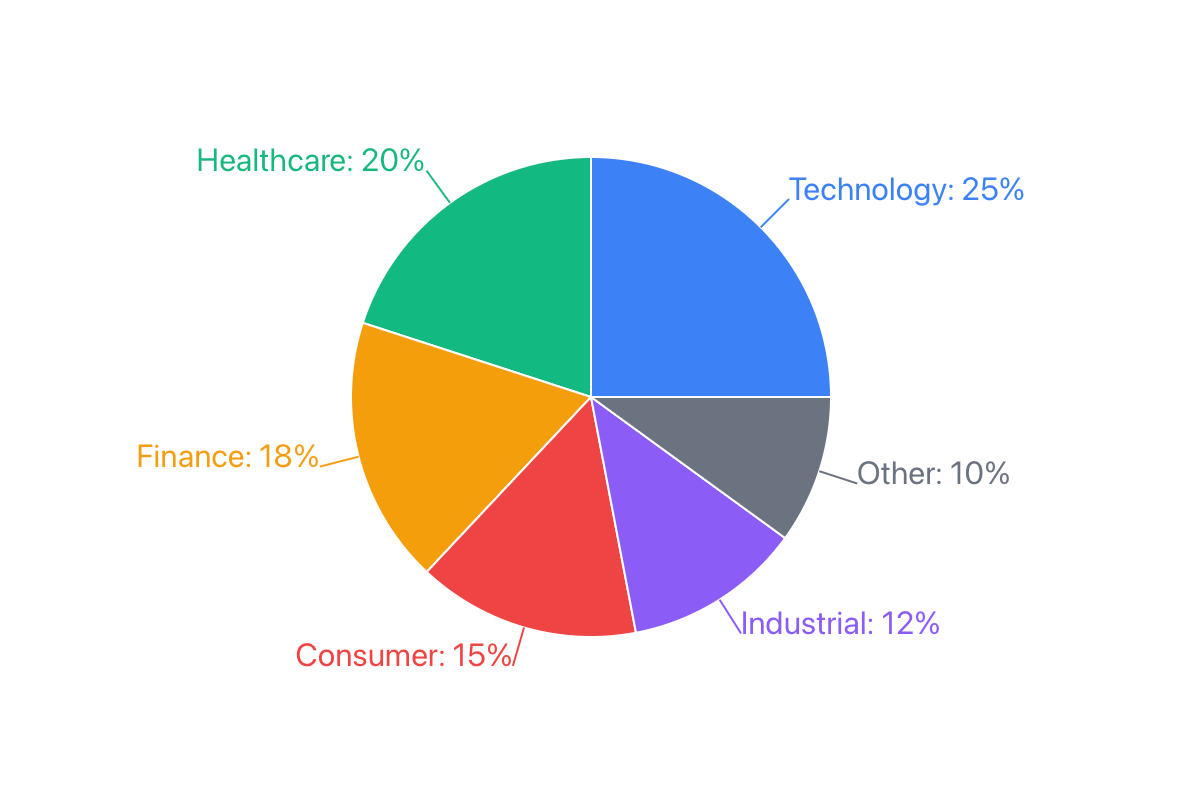
A simple analogy is to think of it like tracking the performance of 30 of your best and/or worst students. If you replace a consistent B student with a consistently B student with an ever-changing GPA, your class average becomes more difficult to predict (based on that B student's performance). This is exactly the same idea as the impact of changing from stable older companies to rapidly growing tech companies in The Dow.
How the Dow Jones is Calculated: A Complete Guide for Traders
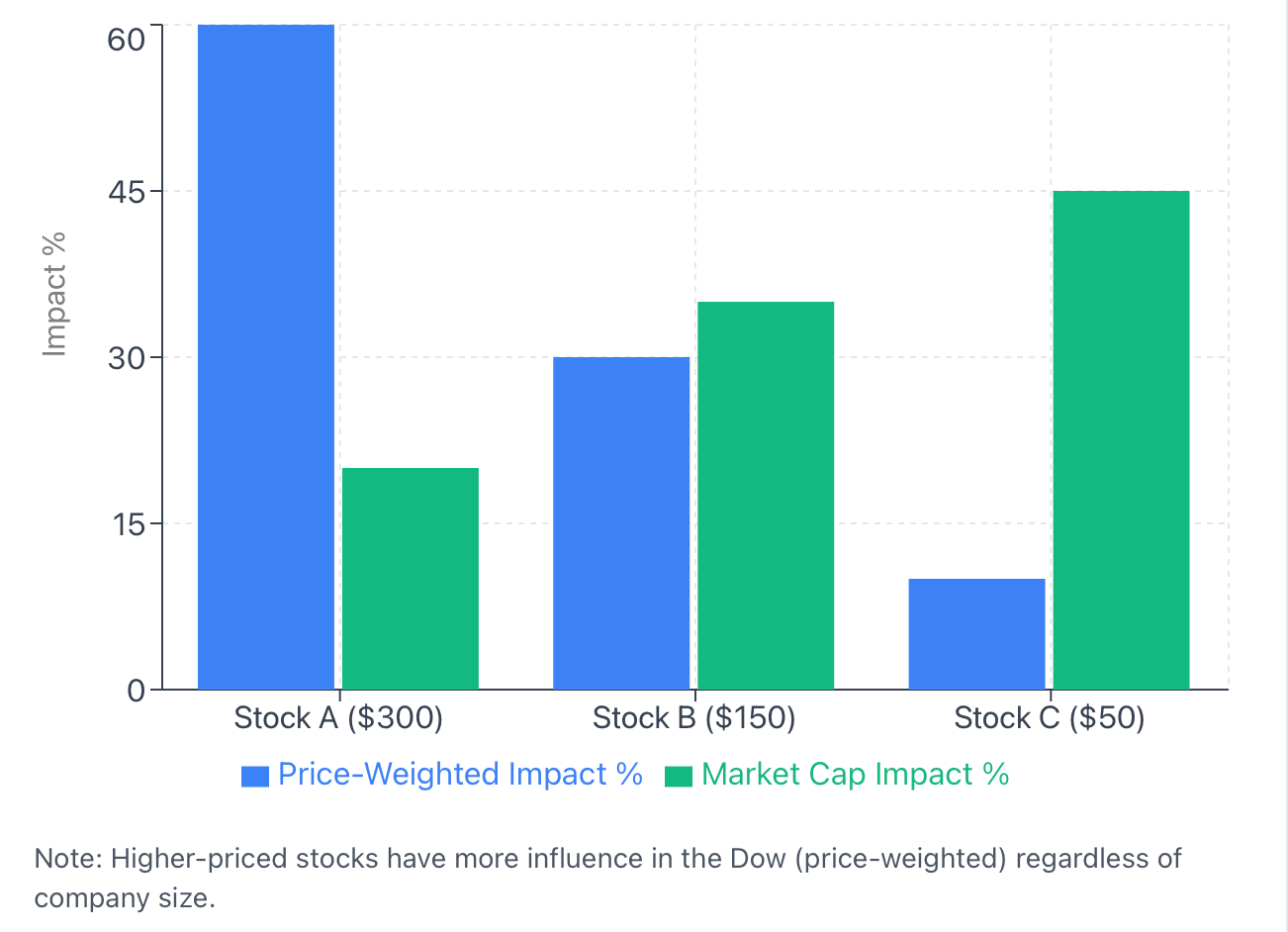
The Dow Jones Industrial Average is a Price-Weighted Index, which essentially means that the company's stock prices are weighted (influenced) based on the price of the stock, rather than market capitalization. Therefore, a higher priced stock will weigh more heavily in the index (Dow), then other lower-priced stocks.
For example, if a $300 stock moves 1%, it will have a greater impact on the Dow than if a $50 stock (that is weighted less) moved 1%. This differs from the S&P 500, where the companies are weighted according to market capitalisation.
The weighting of the Dow is calculated by adding all 30 stock prices together, and dividing that number by the Dow Divisor (which changes). Currently, the Dow Divisor is approximately 0.152 (and it can change). Therefore, if we add the prices of the 30 stocks and say they total $4,560, we will divide that number by 0.152; we will then have a current Dow value (approximately) of 30,000.
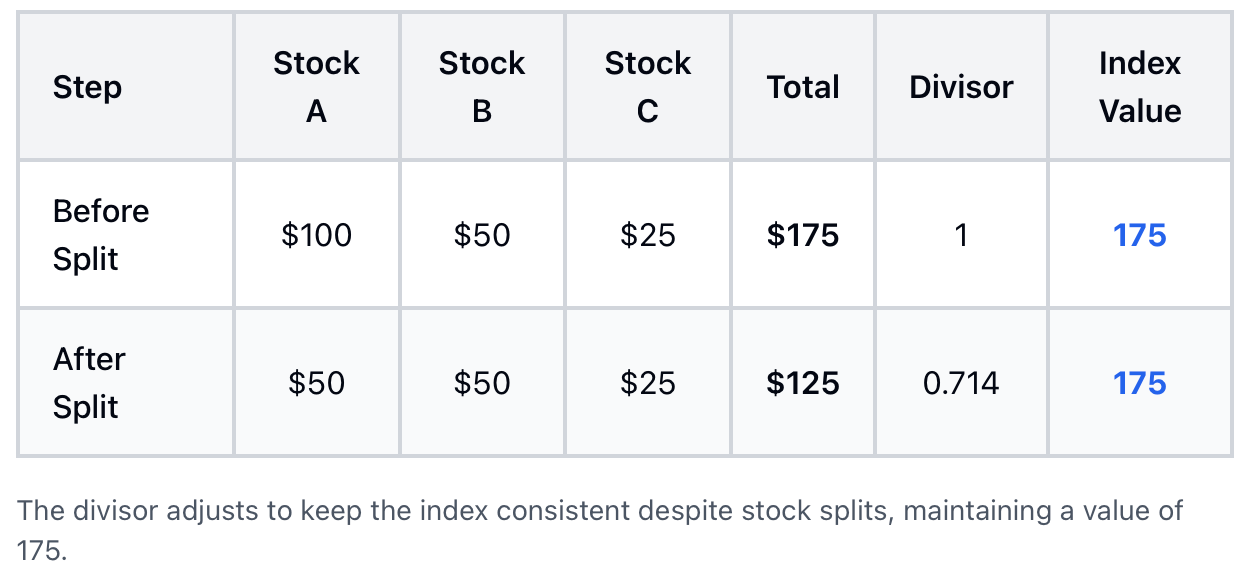
So, why do we have a divisor? In order to keep the index consistent, with respect to factors such as stock splits, dividends, and the addition or subtraction of companies from the index. Without the divisor, a company's 2-for-1 stock split would “theoretically” reduce the index's value to 50% overnight, despite the fact that nothing about the market had actually changed.
Let's make this practical with a simple example. Imagine a mini-index with just three stocks:
-
Stock A: $100
-
Stock B: $50
-
Stock C: $25
Total: $175
After Stock A has a 2-for-1 stock split, it now has a value of $50, causing a drop in total value to $125. However, the overall value of the stocks hasn't changed. The solution is to increase the divisor to 0.714, resulting in an index value that remains at $175.
This calculation is beneficial to traders because it provides insight into which stocks are causing the daily fluctuations within the market. In the example above, a 5% increase in the price of UnitedHealth (a high priced Dow stock) will increase the total index more than the same percentage increase on Intel, for example. Being aware of the trading activity on Dow futures and CFDs will provide you with an advantage when analysing earnings reports and determining where to place your trades.
How the Dow Jones Influences Global Financial Markets
This is something many new traders do not know: the value of the Dow Jones Industrial Average (DJIA) can have an impact on many different aspects of finance. The DJIA impacts currencies, commodities and markets all over the world.
When the DJIA has a great day, more usually than not, the U.S. Dollar will strengthen against most currencies because foreign investors see the strength of the U.S. economy as good, and will in turn, purchase more goods and services that are priced in the U.S.D. This, in reality, affects most U.S. Dollar currency pairs when the DJIA is having a great day. Many people that trade currencies may be surprised to find that if the DJIA went up by 500 points, the dollar is likely to appreciate relative to the Euro.
Of course, when the DJIA declines or has a bad day, fear becomes rampant and many investors will seek safe havens such as gold or JPY to avoid losses. During times of great economic uncertainty, an outflow of money from riskier assets can weaken the USD. In addition, many commodities (such as oil) may fall in value as traders anticipate weak demand during an economic recession.
Automated trading systems have amplified these connections. High-frequency trading (HFT) systems are continuously monitoring the DJIA, and making automatic adjustments to their respective portfolios and positions. A sudden decline in the DJIA can set off a chain reaction of automatic selling in global financial markets, typically before a human trader can even finish their cup of coffee.
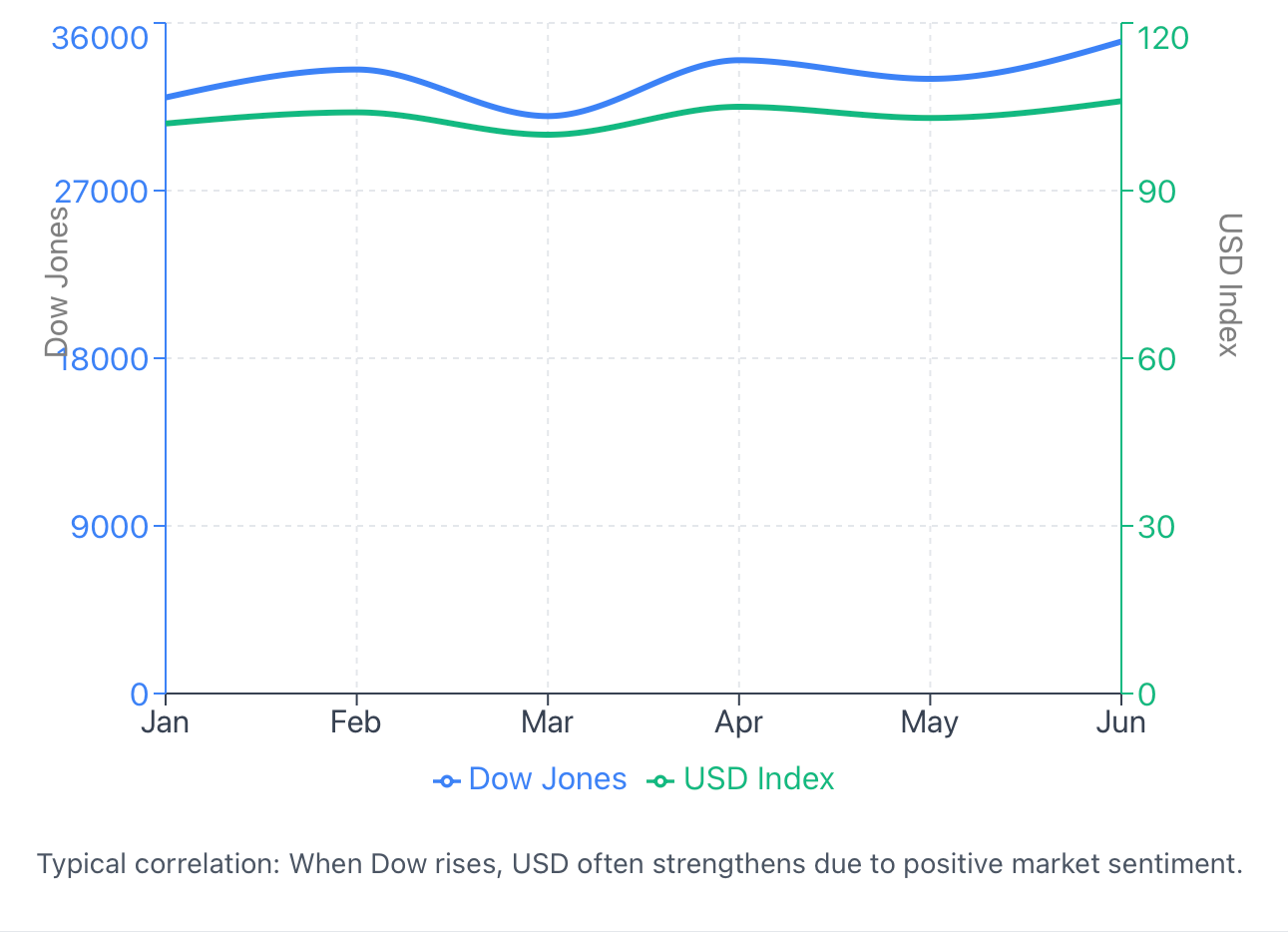
An actual occurrence that took place during March 2020 when the COVID crisis occurred was that the DOW fell almost 3,000 points in one day. This caused the EUR/USD to spike as lots of panic caused investors to dump their US dollars. Gold prices shot up. But oil prices plummeted. Forex traders with knowledge of this correlation could take a position ahead of all this volatility.
For new traders, a basic rule to use is that when there is a consistent upward trend of the DOW, this is a good time to look for bullish positions on US Dollar pairs, while if the DOW is continually falling, this means there is likely to be a weakness in the US dollar, causing significant volatility across all markets. The DOW serves as a leading indicator for market sentiment.
Professional Forex traders will take this a step farther, by studying the correlation between DOW movement and multiple currency pairs at multiple time frames. For example, a Hedge Fund may choose to short the EUR/USD when they see a divergence on the indicators based on bearish trends on the DOW, as usually, when there is a pullback in the stock market, there will be a strengthening of the US dollar initially before normal risk-off flows come into play.
Trading Strategies Using the Dow Jones: From Trend Following to Risk Management
I want to share with you some actionable plans that you can implement in the stock market.
Trend Following: If the Dow is trending upward by creating new highs and lows, a trader using this strategy would look to find risk-on investments. Specifically, a trader would enter long positions in the EUR/USD currency pair, buy commodity currencies such as the AUD or CAD, and enter long positions in contracts for difference based on stock indexes. If the Dow began to decline, a trader would then take defensive positions or enter short trades.
A trader using the trend following strategy needs to wait for confirmation before making any trades. A trader should look to enter trades after seeing that the Dow has broken out of important support or resistance levels with volume. As another example, a trader can use Moving Average indicators (50-day and 200-day moving averages are typically used) to identify when a trend is about to change direction.
For volatility trading, the daily range of the Dow provides insights into the overall market conditions. If the Dow has been moving in tight, narrow ranges (indicating low volatility), this indicates relatively calm markets, and therefore it is more likely that the Dow will experience breakout moves. On the contrary, if the Dow continues to make larger swings between its highest and lowest points (an indication of higher than average volatility), the trader should avoid these markets or decrease size to lower risk.
Pro traders modify their leverage levels according to the volatility of the Dow. If the VIX spikes, which is a measure of expected volatility in the S&P 500 but also has a high correlation to the direction of Dow movements, they will reduce their position sizes to half or less. In contrast, as the volatility shrinks down to a low level, traders will increase their positions ahead of potential breakouts.
Correlation arbitrage refers to the more advanced methodology; there are times when Dow futures will trade at a premium or discount to the physical/index prices. More sophisticated traders will take advantage of this 'spread' by taking a long (buying) position in one market and a short (selling) position in the other market, profiting from the resulting convergence of the two. To do so, these technical traders need to have very fast execution times and low transaction costs.
Risk management is critical, as the Dow should never be your only signal but rather a way to confirm other signals or to filter other methods you are using. For example, if you're trading EUR/USD based on a technical signal, you want to check the direction of the Dow first; if both are in agreement, you feel more confident. If both are going in opposite directions, then you should investigate further as to why this is occurring.
It is important to always use stop-loss orders when trading the Dow Jones Industrial Average (DJIA). When a trade is based on a DJIA breakout and it fails to perform as expected, quickly exit your position to cut your losses. You should also consider the size of the position being entered when determining how much risk is associated with that position. It is highly recommended that you risk only 1-2% of your trading account on any one trade regardless of how much confidence you have in the DJIA signal you received.
As a beginner example, if you were trading a demo account, noticed that the DJIA has broken through a resistance level (50-day moving average) with heavy volume, and decided to purchase a CFD for USD/JPY with a stop-loss placed just beneath the most recent swing low, then your trade would work out if the DJIA breaks through to the upside and continues to gain strength. If the DJIA fails to break above this level, you'll have lost only a small amount on the USD/JPY CFD.
Investment Instruments Linked to the Dow Jones: Futures, ETFs, and CFDs
Traders are unable to trade directly in the Dow Jones Industrial Average; however, they can trade products that follow that market index.
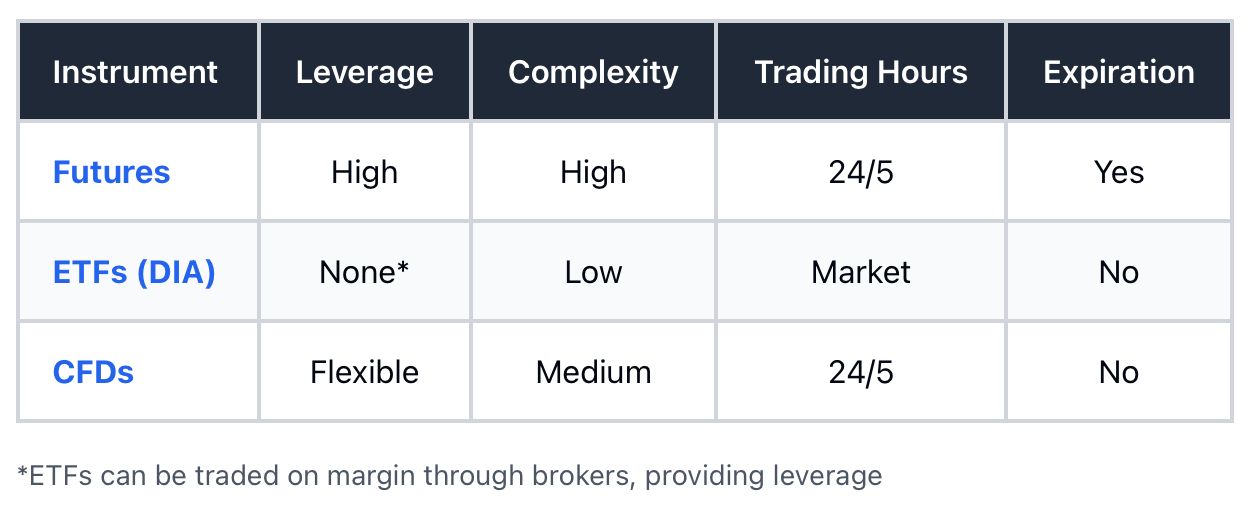
Dow futures are contracts that mandate a buyer or seller of the Dow Jones Industrial Average at some point in the future. As such, Dow Futures are leveraged instruments. Generally speaking, leverage provides traders with control over a larger number of shares without having to put down as much capital. E-mini Dow futures contracts are becoming increasingly popular among retail traders as they allow for lower capital outlay compared to full-size Dow futures contracts. Futures trading can occur virtually around the clock Monday to Friday, so therefore traders are able to trade Dow futures contracts even when the conventional trading hours have finished.
Trading on margin is risky. Even a slight adverse price movement can eliminate all of your margin. Futures also have an expiration date, and thus traders will be required to either "roll" their contract into a new one or simply close their existing position prior to the expiration date.
Traders can use Exchange Traded Funds such as the SPDR Dow Jones Industrial Average ETF Trust (DIA) to buy shares that mimic the price movements of the Dow Jones Industrial Average. Unlike futures contracts, an investor in DIA does not use a margin account nor will DIA have an expiration date. If an investor wants to acquire Dow exposure and does not want the complexity of a futures contract, an investor can purchase the ETF DAI as they would a stock. A trader wanting to make a long term investment in the future with an asset that mimics the price movements of the Dow can purchase DIA.
Investors can also use DIA to hedge against portfolio losses in a falling stock market. If a trader has constructed a portfolio of technology companies and is concerned about the potential for a market decline, they may want to take short positions in DIA or purchase put options on DIA.
Although CFDs (Contracts For Difference) are mostly associated with traders in Europe or Asia, they are becoming more prevalent in the United States. They allow you to place a “bet” on the movement of a major index (in this case, the Dow Jones Industrial Average) regardless of whether you own anything or not. They provide ample flexibility when it comes to leverage and make it easy to open long and short positions alike. Many Forex brokers provide Dow CFDs on a very reliable basis and often at tight spreads.
CFDs also incur overnight financing costs when held overnight or longer, which may make them advantageous for short-term trading strategies (day trading). The financing costs are generally considered a drawback to CFD trading.
-
Comparison: Futures: High leverage, 24-hour availability, very complex instrument.
-
ETFs: Very simple instrument, no leverage available for normal purchases (only available if purchased on margin), provide long-term buy-and-hold opportunities only.
-
CFDs: Flexible leverage, easy to perform short-sell, incur no overnight financing costs if not held overnight.
I recommend opening a demo account to practice trading Dow CFDs prior to risking your own capital. By practicing with a demo account, you will become familiar with how CFDs function prior to placing live trades. After learning how CFDs operate, you may also wish to explore Futures or begin using DIA (the Dow Jones Exchange-Traded Fund) for long-term investments.
Global Case Studies: How Traders Use the Dow in Real Markets
We can analyze how the Dow Jones Index behaved during Key Events in the Market.
The Financial Crisis of 2008: The Dow Jones Index lost approximately 4,000 points in numerous weeks in September 2008. Fund managers following the Dow Jones Index with a momentum approach saw warning signs of the upcoming crisis and thus utilized a hedging strategy and shorted Dow Jones futures to cover their long equity exposure. Once Lehman Brothers collapsed, the Dow Jones Index fell off the cliff, and there were significant profits to be made and losses to be avoided as a result of this hedging strategy.
Forex Traders used this to their benefit. The decline of the Dow Jones Index after Lehman Brothers collapsed resulted in a weakening U.S. dollar (risk aversion), as well as an eventual increase in the U.S. dollar because of deleveraging, when global investors bought U.S. dollars to cover their open positions. Traders were able to make a profit on both parts of this pattern, provided that they understood it.
The March 2020 COVID-19 Crash: The Dow Jones Index fell from around 29,000 to around 18,000 in three weeks. The volatility was insane! Smart traders did not try to catch the falling knife; they waited for stabilization signals (such as the Fed's massive intervention announcement) to enter the marketplace. After the Dow Jones Index found support and the VIX started to come down, they entered long positions on both the Dow Jones Index and correlated currency pairs (AUD/USD).
New traders who panicked and sold near the bottom of the market learned a painful lesson. Traders who remained disciplined and kept their stop losses in place while waiting for a clearer signal before entering the market were tremendously better off.
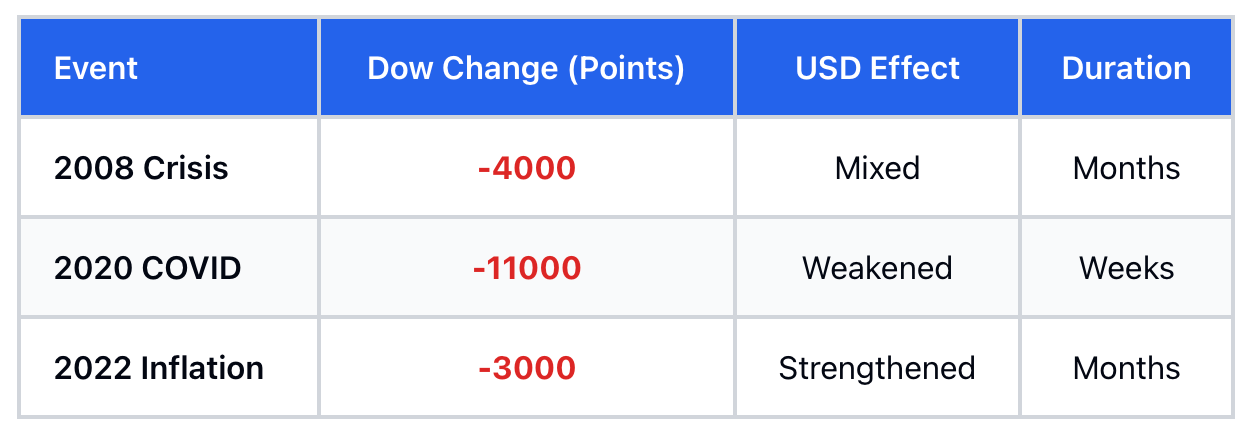
Multi-Market Linkages: In the wake of rising inflation in 2022, the Dow and Forex markets became increasingly disconnected. In almost all cases, when the Dow declines, the Dollar will become weaker. This time however, due to the Fed’s aggressive interest rate hikes, the Dollar strengthened well above the Dow, even as stocks continued to decline. Traders who relied on the traditional correlation became caught. The lesson learned: Relationships between the markets change; you must know the fundamentals of the market to better understand the causes driving the markets.
Professional Example: In 2020, a hedge fund noticed a loss of correlation between the Dow and Euro/USD. Instead of experiencing the normal inverse relationship, both were declining. Upon further analysis, they learned that the European economic situation was worse than the US economic situation, therefore the Euro was weak regardless of the state of US stocks. They proceeded to short the Euro/USD and profited from it even while the Dow remained volatile.
Conclusion & Actionable Takeaways: Start Leveraging the Dow in Your Trading
The DOW is not only a number on a global display board; it is also a tool that you can use to help determine directions in many different markets. The DOW has evolved from a basket of 12 industrial stocks to now include 30 large Blue Chip companies. How the DOW is calculated is by price-weighted average of the 30 companies; these 30 stocks provide the ability to influence the Forex and CFD markets around the globe. The DOW can serve multiple purposes by providing an easy method to implement some trading strategies.
As you observed throughout this series, examples of others using the DOW to help determine their trades have been provided, including from both professional fund managers and new traders using a demo account.
The most important thing to take from this course is to take what you've learned and begin incorporating the DOW into your trading strategy by using the DOW on a daily basis, alongside your normal currency pairs and CFDs. As you track the daily DOW alongside your currency pairs and CFDs, pay attention to any correlation trends that exist. By tracking these trends, you can start to develop a possible correlation between the DOW and your stocks and currencies, and you can end up with a stronger trading strategy. Before applying risk capital, always practice your trading theories on a demo account.
Another important item is that the DOW should not be treated as a crystal ball or a specific prediction. The DOW can serve as an effective reference point for decision making but should not be the only reference used to guide trading decisions. The best traders will utilize a combination of many tools and should always include the DOW as one of their primary decision models.
Ready to put this knowledge to work? Open a demo account at TradeWill.com and start practicing Dow-based strategies risk-free. Master the theory, test your ideas, and build the confidence you need to trade smarter.
Disclaimer: The content of the blog does not represent any position of Trade W, does not serve as any trading-related decision advice, and does not endorse any third-party.