

 Trade W
Investors who want to be serious about their investment activities should consider the FTSE 100 Index as an essential benchmark. The FTSE 100 is not just a measure of the performance of the UK market; it provides insight into the performance of commodities traded globally, the financial results of multinational corporations, and some of the strongest dividend-paying companies in the world.
With inflation cycles approaching maturity this year, ongoing interest rate discussion to remain a key part of economic policy, and commodity prices being readjusted, the need to know about the FTSE has never been greater than right now.
This guide provides a comprehensive overview of the FTSE index, including its definition, how it's constructed, how it compares to the US S&P 500 index, what the future holds for the FTSE index through 2026, and how active traders utilise financial instruments such as CFDs to capitalise on changes in the FTSE Index.
What Is the FTSE Index?
The FTSE Index, which is most frequently referred to as the FTSE 100, is a market-capitalisation-weighted index containing the 100 largest companies that trade on the London Stock Exchange. The index is run by the FTSE Russell, which is part of the London Stock Exchange Group, and the index is updated and rebalanced every quarter to capture fluctuations in the values of its constituent companies.
While the FTSE Index is often compared to the S&P 500 in the UK due to its prominence, the two indexes differ greatly in the sectors they represent and in their attractiveness as an investment.
At a glance:
-
Tracks the top 100 companies on the London Stock Exchange
-
Weighted by free-float market capitalisation
-
Dominated by financials, energy, mining, and healthcare
-
Major constituents include HSBC, Shell, AstraZeneca, BP, and Rio Tinto
-
Widely used as a proxy for UK economic health, though over 70% of constituent revenues are generated internationally
The Structure and Composition of the FTSE 100
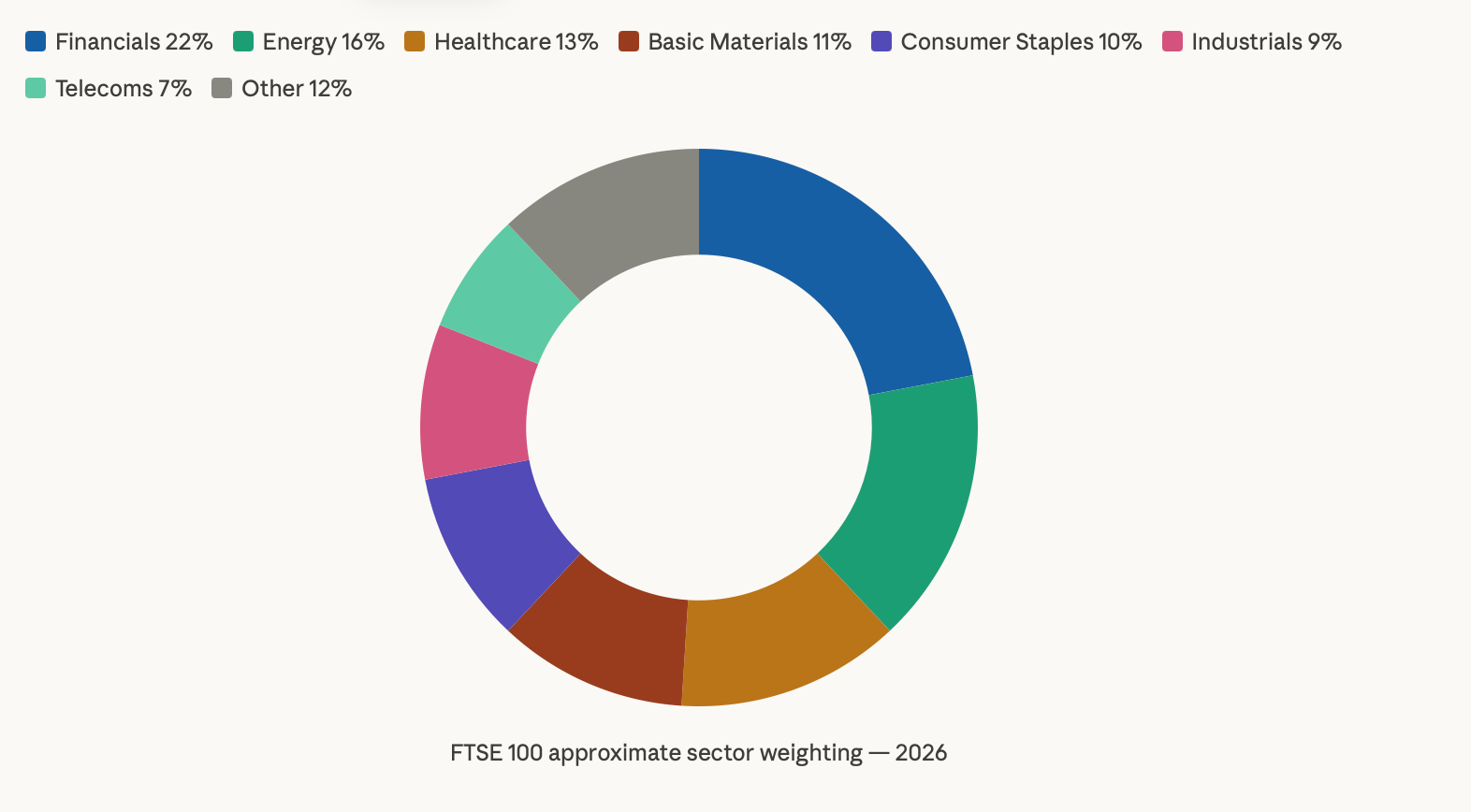
Most people are surprised when they begin analysing stocks on the FTSE 100 because many of the stocks in the Index belong to companies with operations outside the UK. All of the stocks listed above operate globally, as they have operations in several parts of the world. Therefore, it contains stocks that are exposed to global movements in commodities and financial markets, rather than being just a direct indicator of the overall UK economy. This point should be noted as you read economic news related to the UK and the global economy.
Another consideration regarding the FTSE 100 Index is that it is primarily represented by companies involved in old economy sectors. While the S&P 500 contains a large number of technology stocks, the FTSE 100 contains limited representation in this sector. As such, the lack of tech stocks significantly influences how the Index behaves throughout economic cycles.
How Is the FTSE Index Calculated?
A free-float market capitalisation weighting system is used for the FTSE 100. In simple language, it means that each corporation affects the index based on the total amount of money that they have available in their shares for public trading, rather than the total value of all of their equity.
The following example illustrates how this system works: If Company A has a free-float market capitalisation of £80 billion and the combined amount of free-float market capitalisations for all 100 companies is £2 trillion, then Company A accounts for 4% of the FTSE 100 Index. Therefore, if the share price of Company A rises by 5%, the value of the FTSE 100 Index will also increase by 4% multiplied by 5%, which is equal to 0.20 percentage points due solely to Company A's share price increase.
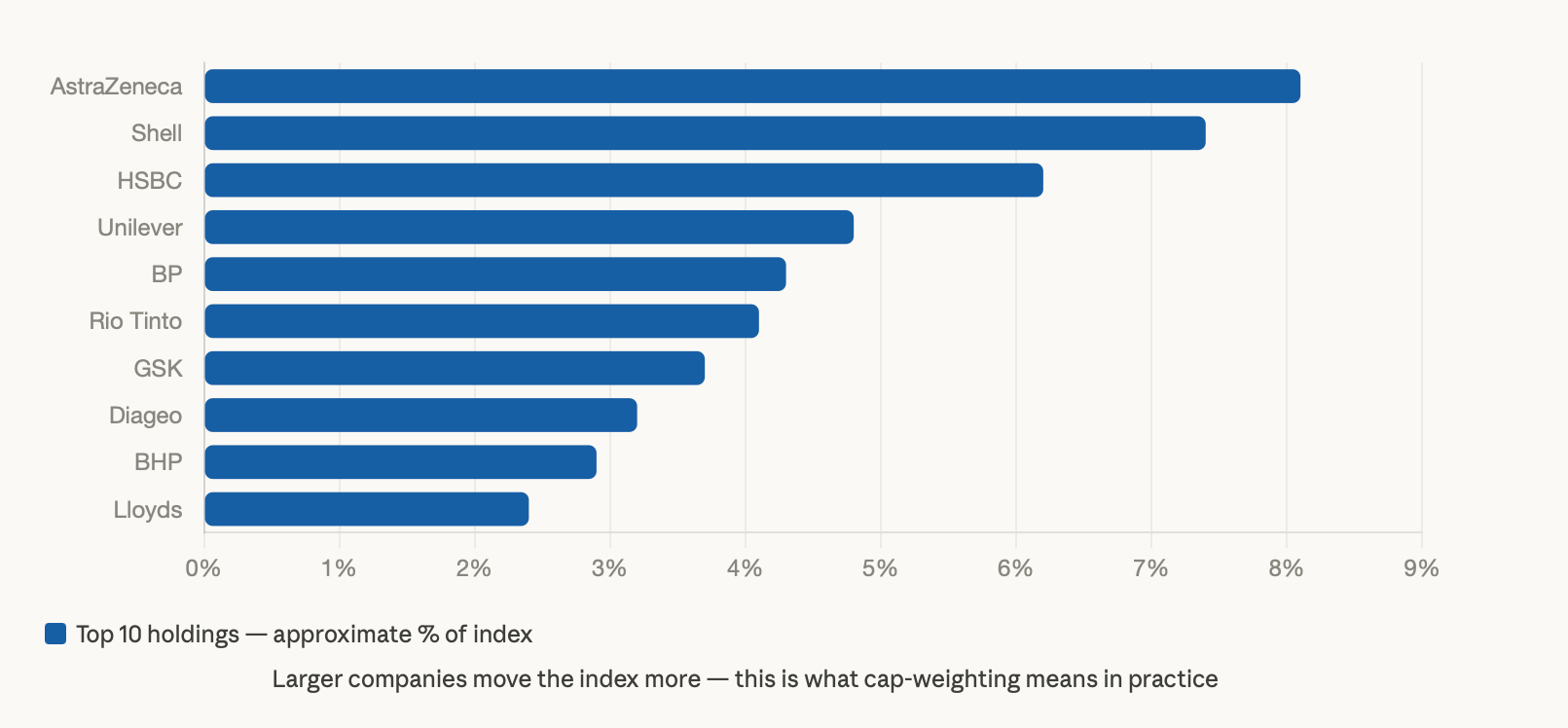
The Index is rebalanced on a quarterly basis in March, June, September, and December. The rebalancing process for the Index includes adding or removing companies from the Index based upon the company's market capitalisation and including or excluding the company from the FTSE index based on a company's position in the market.
For example, if a company has a market capitalisation less than that of the top 100 by market cap, it is reallocated to the FTSE 250; conversely, if a company has a market cap greater than that of the FTSE, it is promoted to the FTSE. As a result of this, the Index is automatically updated, which is one of the main reasons that the Index is considered to be one of the most reliable and accurate indices due to its rules-based structure as opposed to its curated nature.
The FTSE differs significantly from other price-weighted indices such as the Dow Jones Industrial Average, because in the FTSE, a company whose shares are priced at £10 and has a large market capitalisation will have a significantly higher weight than a company whose share price is £500 with a small market capitalisation. Therefore, the share price of the company alone does not indicate the company's ability or influence.
FTSE 100 vs S&P 500: Two Very Different Animals
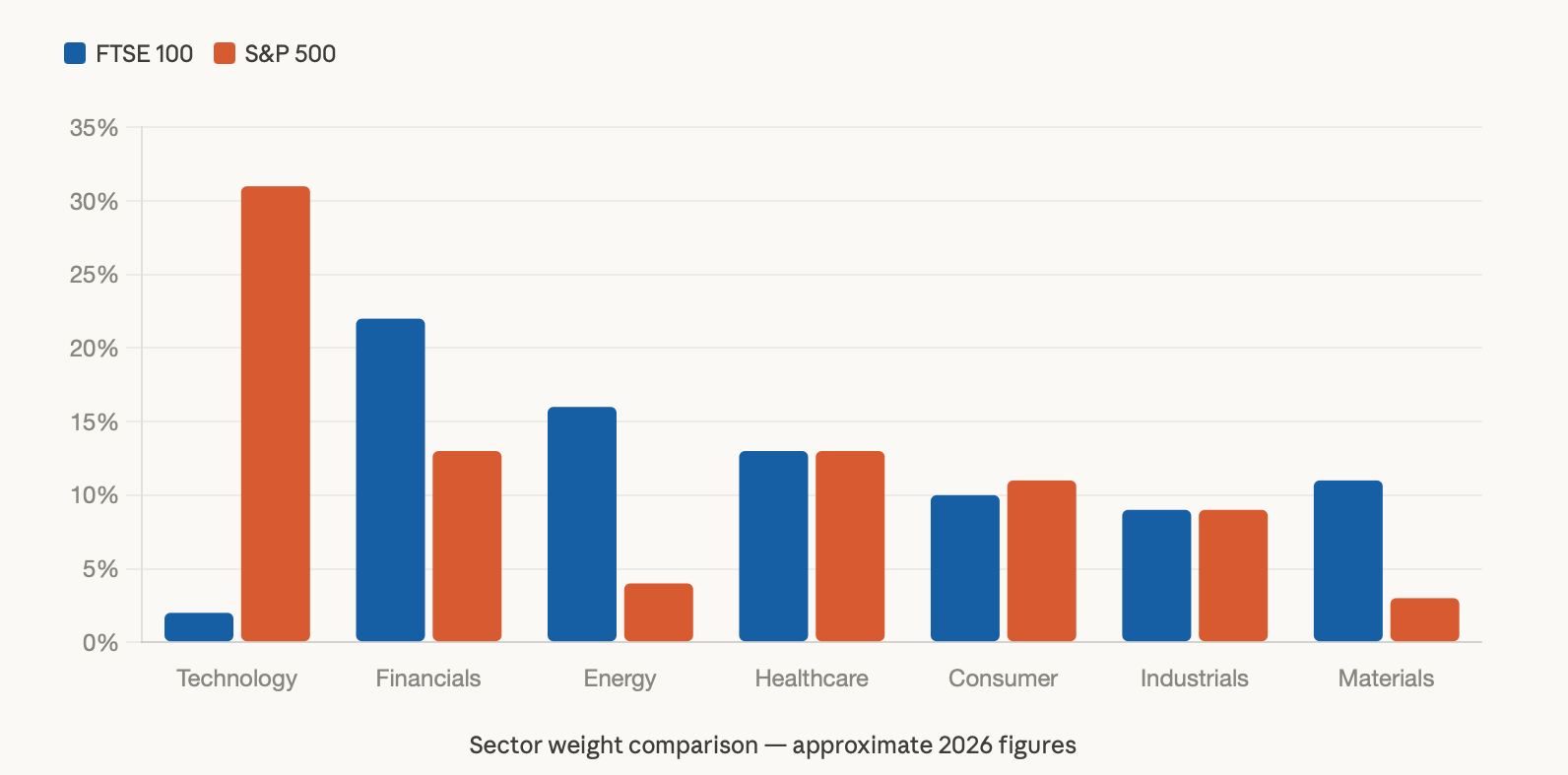
Analysing these two indices, the difference in characteristics is very stark and cannot be ignored. The S&P 500 Index is an index that is predominantly made up of technology-based companies. The FTSE 100 Index, on the other hand, is an index that is predominantly focused on income-producing companies with large exposures to energy, financial services, and materials. The respective exposures to each sector create substantially different types of investment characteristics.
The FTSE 100 Index has generally performed better than the S&P 500 Index during periods of increasing inflation and increasing interest rates because of the benefits of a wider net interest margin for banks and the increasing price of energy commodities during inflationary environments. On the other hand, during periods of rising prices of technology stocks, the S&P 500 Index has outperformed the FTSE 100 Index due to the fact that technology stocks are such a small part of the FTSE 100 Index.
If an investor is looking for a defensive allocation to hedge some of the systemic risk associated with the volatility that usually affects growth-equity-type stocks, the structure of the FTSE 100 Index will provide investors with a natural hedge against these risks. In no way is the FTSE 100 Index better than the S&P 500 Index on an absolute basis, but it serves a different purpose in a well-rounded diversified portfolio.
2026 Market Outlook: Is the FTSE Poised for a Breakout?
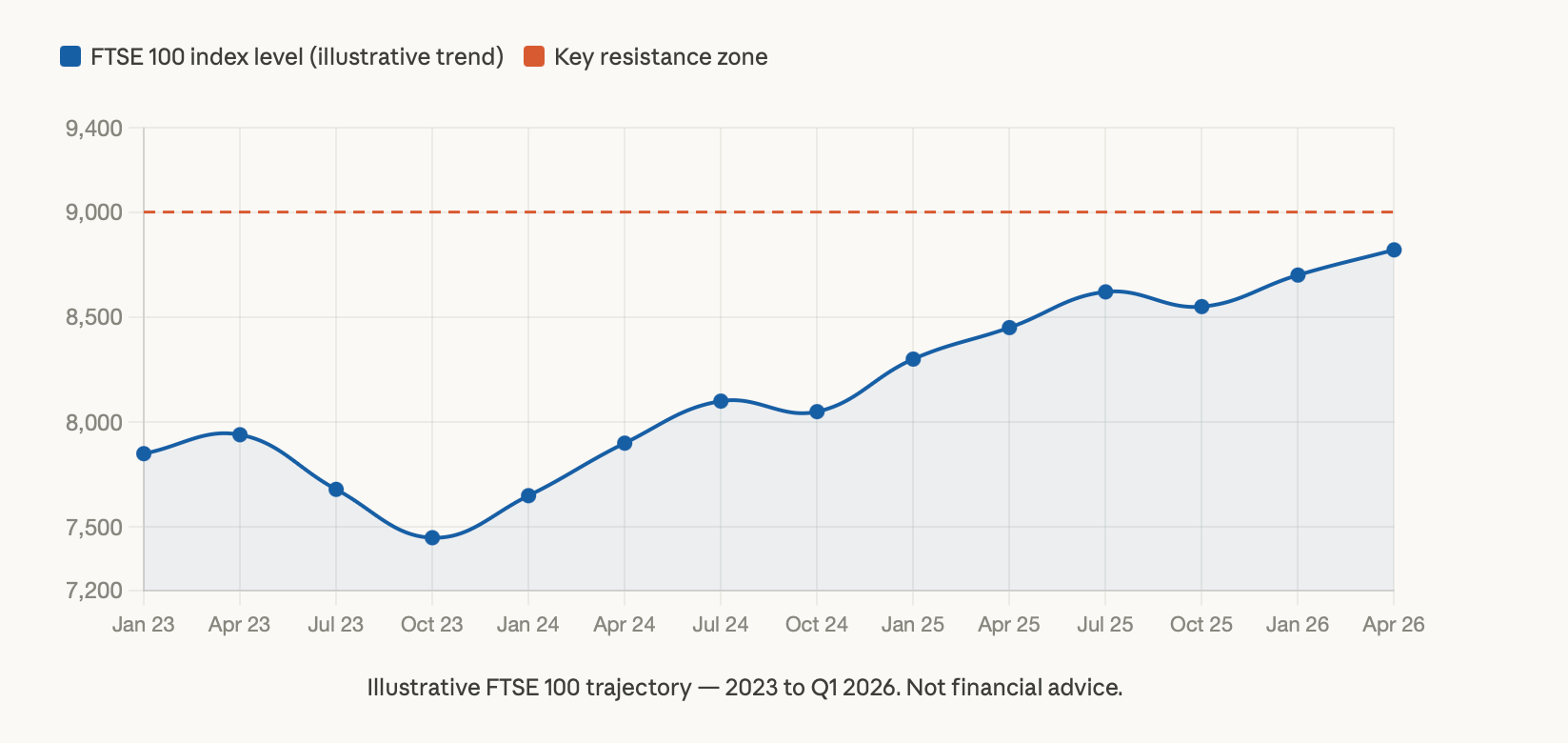
There are many macroeconomic factors affecting the FTSE in 2026, making it a particularly attractive investment. UK pension reform will redirect some institutional capital toward domestic equities, creating a structural demand for domestically traded securities, something the UK hasn't had for years. On the other hand, commodity prices, particularly copper, silver, and energy, are well above their historical averages, which directly translates into gains for the two largest sectors in the FTSE.
The FTSE has been testing the 9000 level, a major psychological resistance level that has not been convincingly breached yet. A sustained breakout above the 9000 level, driven by improvements in earnings from FTSE companies in the financial and energy sectors, could be one of the biggest breakouts the FTSE has experienced in over a decade.
Although the UK is facing some considerable domestic economic obstacles, such as a lack of consumer confidence and a slow housing market, these problems, although they hurt the long-term outlook for UK equities, are somewhat mitigated by the global nature of the revenue streams from many FTSE companies. With that said, it is still very important to be mindful of the Bank of England’s interest rate decisions, as any changes to interest rates will directly impact the profitability of many of the large financial institutions making up the FTSE.
Dividend Investing with FTSE Stocks: Building Passive Income
The FTSE 100 is ranked among the world’s top dividend stock indexes; it comprises large-cap mature, capital-intensive companies, including those mainly involved with the energy, banking and consumer staple industries. Companies fitting this profile usually provide shareholders with regular dividend payments as opposed to reinvesting all of their capital into business growth.
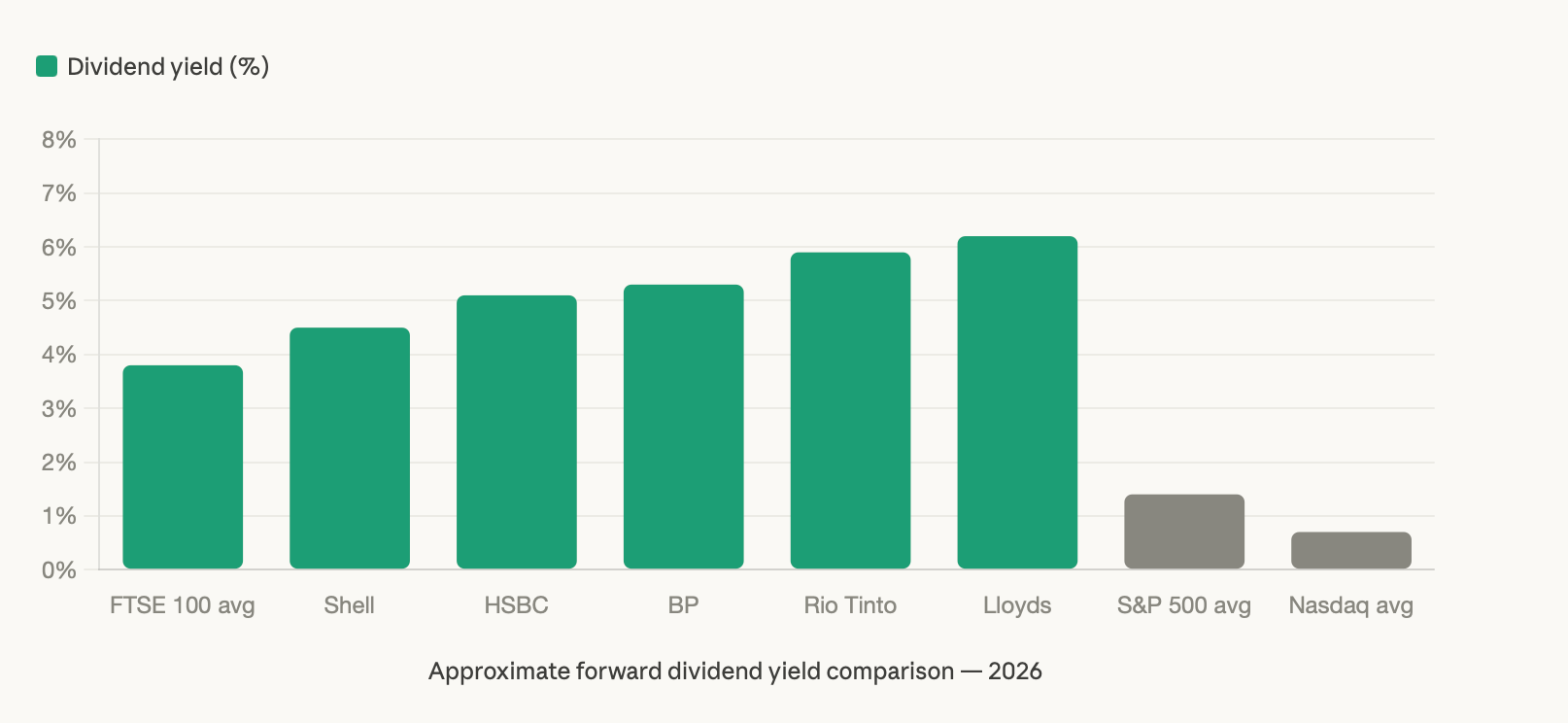
The difference in dividend yield between the FTSE 100 Index and U.S. indices is substantial. Long-term FTSE dividend yields have been approximately two to three times that of the S&P 500 average. The individual companies that are members of the FTSE have also historically provided dividends that have been significantly higher than those of U.S. companies, either in the form of cash or additional shares in those same companies.
Companies such as Lloyds Banking Group (Lloyds) and Rio Tinto have historically provided dividend yields in the range of 5% to 6% or more for certain periods of time. These characteristics make the FTSE particularly attractive to income investors who are constructing a portfolio of investments that will produce long-term passive income.
Another aspect of this characteristic of the FTSE is that through reinvesting dividend distributions into the same companies, investors are able to take advantage of compounded returns over the long term on a larger base of capital invested in those same companies.
When viewed over ten years, the result of this compounding on dividend yields that are greater than the average yield of the S&P 500 will have a measurable impact on total returns from that investment, as well as the income generated by that investment.
How to Trade the FTSE Index Using CFDs
Contract for Difference (CFD) are mainly used by Investors and especially by traders who buy and sell shares on FTSE and would like more leverage or exposure, but do not want to own the shares themselves; the CFD is an agreement between the trader and the broker to share in the difference between the price at which the trade opened and the price at which the trade closed.
The main benefits of CFDs for traders are two-fold: The ability to short and the leverage factor, meaning that the trader is only required to post a certain percentage of the value of their trade as margin. For a 10:1 leverage ratio, for example, a trader would only have to post £1,000 as margin and would be able to control a £10,000 position.
The downside of leverage is that it increases the potential for both profit and loss. Therefore, it is essential to practise risk management as part of your CFD strategy because if your position moves against you by 5% on a 10:1 leveraged position, you will lose 50% of your initial margin. You must set stop loss orders, size your positions correctly according to your account equity and not over-leverage a single trade; these factors separate sustainable traders from those who blow up their accounts.
The FTSE can be a particularly volatile market at times of high macroeconomic news flow, such as Bank of England (BoE) rate changes, UK government budget announcements, US Federal Reserve open market committees and large changes in commodity prices. These are times when intraday traders have a good chance of finding well-defined trading setups with strong directional bias and high price volatility.
FTSE Trading Strategies for Different Investor Types
Different strategies exist for trading the FTSE; none of these strategies looks alike, and which one you choose depends on how long you're going to hold your positions, your risk tolerance, and how much time you can devote to trading the market.
The most popular trading method among traders who want to go with the trend is known as trend following. This means that on a daily chart, as long as the FTSE is establishing a series of higher highs and higher lows, a trend follower will generally set limit orders or buy pullbacks to critical moving averages or previous swing lows. Once established, a trend follower typically remains in a trade until a changing event causes a reversal in the trend that they have been following.
Breakout trading concentrates solely on the times when the FTSE breaks through an important level of resistance or support. With a breakout trading strategy, traders typically see a large increase in volume as new buyers enter the market and short sellers cover their positions. The goal of a breakout trading strategy is to create momentum for the FTSE in the direction of the breakout.
Swing trading has a longer time frame than intraday trading, ranging anywhere from a few days to a few weeks. Swing traders wait for the FTSE to move between levels of support and resistance by buying near support with a stop loss below the support level and aiming for the next resistance level. This method of trading is best for those traders who are unable to follow price action on a minute-to-minute basis, but who still want to be more active than a buy-and-hold trader.
Trading intraday is relatively self-explanatory in that an intraday trader opens and closes their position on the same trading day; an intraday trader never holds a position overnight. The first hour of trading, when the London market opens, and the period that overlaps with the New York market opening are the two best times to trade due to the enormous volume these two periods generate. These two trading windows generally contain the majority of the best setup trading opportunities for intraday traders.
Regardless of which method you use for trading the FTSE, what is most important is having a risk-to-reward discipline. The win rate a trader has is much less important than the risk-to-reward ratio a trader has on each trade.
For instance, if a trader wins on 40% of their trades but maintains a 2:1 risk-to-reward ratio on every trade they take, the trader will ultimately be profitable on all trades that they take over a statistically significant number of trades. If a trader pursues wins at the expense of the risk-to-reward ratio or moves their stop loss when a trade starts to go against them, the mathematical advantage will disappear quickly.
Global Portfolio Perspective: Why Diversification Across Indices Matters
The FTSE 100 does not exist in a bubble; because of specific characteristics, such as defensive, income-generating and commodity exposure, it is a natural way to diversify your portfolio of US equities held in an S&P 500 tracker.
The FTSE 100 and the S&P 500 tend to respond differently, in direction and magnitude, to the various phases of the economic cycle. While US technology companies may underperform or struggle against rising interest rates, UK energy companies may benefit from rising oil prices. Holding investments in both regions and sectors helps reduce the volatility of the entire portfolio and prevents reliance on any single regional economy.
What does this mean? If your current portfolio is primarily invested in US growth investments, adding FTSE exposure through a suitable ETF or index CFD provides a genuine diversification benefit, as you will have access not only to an entirely different geographic market but also to a different kind of (and higher) dividend yield and significantly weaker correlation to interest rate sensitivity.
Building Your FTSE Investment Plan in 2026
So you understand the FTSE Index; you know what it is. The next part of the process is to determine where the FTSE fits within your investment/trading plans.
When investing for the long term, the FTSE's dividend yield, as well as its make-up of defensive sectors and commodities, makes it a viable asset to include in a diversified portfolio of Global Assets, especially with respect to the relative valuation of UK equities compared to US equities on many valuation metrics.
Also, if you are an active trader, there are numerous trading setups available on the FTSE, which can be traded on various time frames, with well-defined macroeconomic catalysts (e.g., the BOE meeting, etc.) and defined technical levels. The FTSE also provides traders with multiple methods to hedge their positions long and short through the use of the various contract-for-difference products (CFDs).
Regardless of your trading or investing approach, do not underestimate the importance of position sizing and risk management. Establish your risk per trade and position when entering a trade, and adhere to that. Maintaining this level of discipline will reward disciplined trading practices over the long haul as opposed to utilising instinct or gut feeling.
Frequently Asked Questions
What is the FTSE Index? The FTSE Index, most commonly the FTSE 100, is a stock market index tracking the 100 largest companies by market capitalisation listed on the London Stock Exchange. It's calculated and maintained by FTSE Russell and is widely used as a benchmark for the UK stock market and, by extension, a proxy for global financial and commodity sector health.
How is the FTSE 100 calculated? It uses free-float market capitalisation weighting, meaning each company's weight in the index is proportional to the total market value of its publicly tradeable shares. Larger companies have more influence on the index's daily movements. It's rebalanced quarterly.
Is the FTSE a good long-term investment? For income-focused investors, the FTSE's historically high dividend yield makes it attractive over long time horizons, particularly when dividends are reinvested. As a capital appreciation vehicle, it has historically underperformed the S&P 500, largely due to its lower technology exposure. It works best as part of a diversified portfolio rather than a standalone holding.
Can I trade the FTSE with leverage? Yes, through instruments like index CFDs, which allow leveraged long and short positions on FTSE price movements. Leverage amplifies both gains and losses, so proper risk management, including stop-loss orders and appropriate position sizing, is essential.
What affects FTSE price movements? The main drivers include Bank of England interest rate decisions, UK economic data releases, global commodity prices (particularly oil, gas, and metals), currency movements (sterling strength affects international earnings when converted back), and broader global risk appetite.
Is the FTSE defensive during inflation? Generally, yes. The FTSE's heavy weighting toward energy, banks, and commodities means it has natural inflation hedging characteristics. Energy and mining companies often see revenue rises during inflationary periods, and banks benefit from higher interest rate margins.
How can beginners start trading the FTSE? The most practical starting point is a demo account with a regulated broker, which gives you access to real market prices without risking capital. From there, focus on understanding one strategy, learn to read basic chart patterns, and practice consistent risk management before moving to live trading.
Ready to put your FTSE knowledge to work? At TradeWill, you get access to live FTSE pricing, professional-grade charting tools, and a risk-free demo environment to test your strategies before committing real capital. Start trading on TradeWill.com — because understanding the market and acting on it are two very different skills, and we're built to help you develop both.
Disclaimer: The content of the blog does not represent any position of Trade W, does not serve as any trading-related decision advice, and does not endorse any third-party.