

 Trade W

Why Extreme Weather Is Becoming a Serious Market Driver
For most of trading history, the concept of profiting from a heatwave was generally an abstract idea, and traders in equity markets or commodity desks did not really care about the weather, as this typically only mattered to farmers. This is no longer the case, as global temperatures continue to break records and climate volatility leads to changes being made to energy infrastructure, extreme heat events are arguably the most significant variable in today's financial markets.
The term heatwave trading refers to a collection of strategies that can be used by both traders and institutions to create positions based on temperature events, through either dedicated weather derivatives or via trading the energy and commodity assets that will be most greatly affected by temperature increases.
The core premise driving the heatwave trading phenomenon is simple; rather than being only a consideration for markets, weather has become one of the most significant variables moving prices and can be measured, modelled, and traded with the same diligence as with any other market variable.
Some of the most directly impacted markets due to prolonged extreme heat events are those related to electricity and natural gas, which can experience extreme periods of increased demand for both fuel and electrical generation, as well as agricultural commodity, industrial metals, and even insurance-linked securities markets.
For example, when a heatwave affects a metropolitan area, demand for air conditioning, the electrical grid load and fuel supply, as well as utility company energy procurement, will all experience increased demand, leading to a chain reaction of volatility where well-prepared traders can potentially generate positive returns and poorly-equipped traders can incur significant losses within a short period of time.
In this guide, we will provide an overview of what weather derivatives are, how they are structured, how to calculate and interpret Cooling Degree Days, different strategies and how they can be applied to varying degrees of trading experience, and what risks to take into consideration before placing an order in this market segment.
What Is Heatwave Trading?
Heatwave trading is the practice of utilising weather derivatives to capitalise on extreme heat events. Both traders and institutions can utilise these financial instruments to either hedge against increased demand for energy during heatwaves or to speculate on this increased demand through either direct investment or trading of energy-related securities such as natural gas futures or CFDs linked to electricity, all of which react to changes in demand caused by temperature.
Weather Derivatives Explained: What Are CDD and HDD?
Weather derivatives are financial contracts with payoffs based on measurable weather metrics as opposed to conventional market prices. As they relate to energy companies' desire in the late 1990s to structure their revenues against the unpredictability of temperature-driven demand, the Chicago Mercantile Exchange began listing standardised weather derivative contracts in 1999, and since then, the weather derivative market has continued to grow, even after experiencing a relative decline during the 2008 financial crisis.
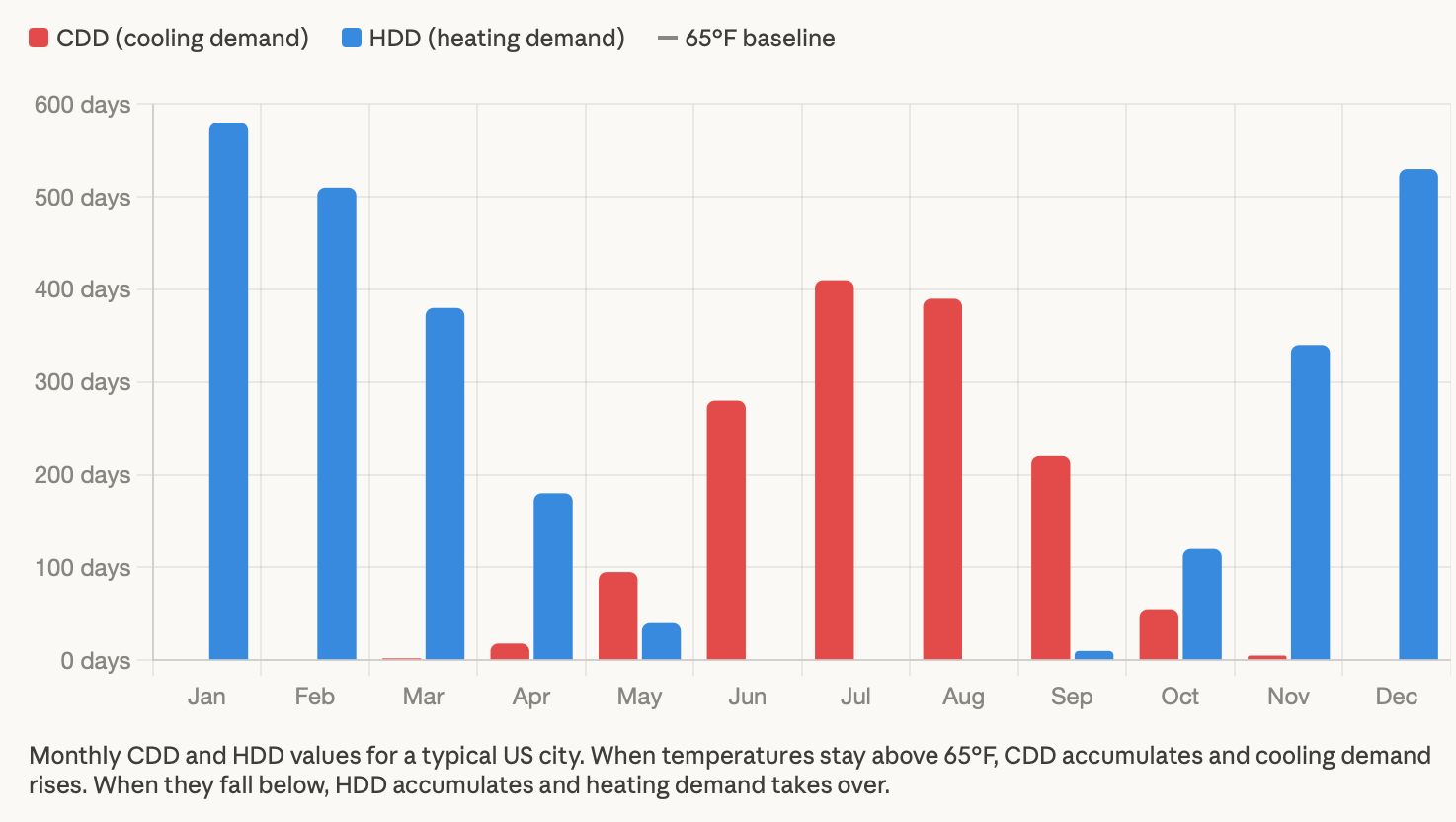
The two most commonly used unit metrics in the weather derivatives marketplace are Cooling Degree Days (CDD) and Heating Degree Days (HDD). Both of these units measure how much variance there is between actual average daily temperature and an accepted baseline (typically 65°F or 18°C), which is considered the temperature at which cooling systems would begin to operate, or heating systems will cease to operate.
Cooling Degree Days (CDD) are determined by averaging the high and low temperatures of a single day, subtracting the 65° Fahrenheit baseline temperature. Therefore, if the average temperature of that day was equal to 80° Fahrenheit, CDD for this day would equal fifteen. As the daily CDD values cumulate over the course of a summer, those total numbers will be what actually drives contract valuation at the close of business each day. When the CDD total number is higher for a period of time in summer than for a period of time in winter previously completed, it indicates more average cooling energy was used, which makes the long CDD position more desirable.
Heating Degree Days (HDD) measure the temperature variation from the baseline mean of 65°F. Therefore, HDD will actually measure the amount of BTUs (British Thermal Units) required for heating as a result of extreme cold conditions during the winter months, and are less prevalent in trading contracts for the winter time period because they represent the quantity of BTUs used for heating. However, since traders will often transact as the heating and cooling climate starts to transition seasonally, traders need to understand both CDD and HDD in order to determine how to proceed with their trading strategy based on HDD and CDD.
How Heatwave Trading Works: The Core Logic Behind CDD-Based Strategies
If you know what a CDD measures, you will find that the principles of CDD trading are simple to understand. The CME Group is designing a contract for each of the major cities in North America (you can trade a CDD based on the cumulative total for New York, Chicago, Dallas, and Atlanta) for the month of the contract. The CDD index for an individual city can also be computed on a cumulative CDD basis. The cash settlement for an individual CDD index point is currently $20 for US CDD contracts.
A trader who buys futures contracts on a city’s CDD is speculating that the temperature will be hotter than the average temperature that the market expects to be observed during that summer season. By accumulating greater CDD values than were anticipated based on the seasonal consensus forecast because of unexpected CDD accumulation, the futures price of the contract will go up, and the trader will generate a profit on that purchase.
Many of the largest consumers of electric power, such as commercial utilities, airlines, farmers, and other energy retailers, take the opposite side of the trade to reduce operational risk associated with their actual demands for power. As a result of market participants taking opposite positions in the CDD market, there is more liquidity in the CDD market than most participants expect to find.
The correlation between temperature and market activity is strongest during heat waves, because CDD values will not gradually increase in a linear progression as temperature increases. When the day temperatures remain higher than average for 10 days in a row without cooler temperatures at night to reduce the demand for energy, the total CDD required will increase at an accelerating rate, resulting in increased demand for energy and, consequently, increased price volatility for the corresponding contract.
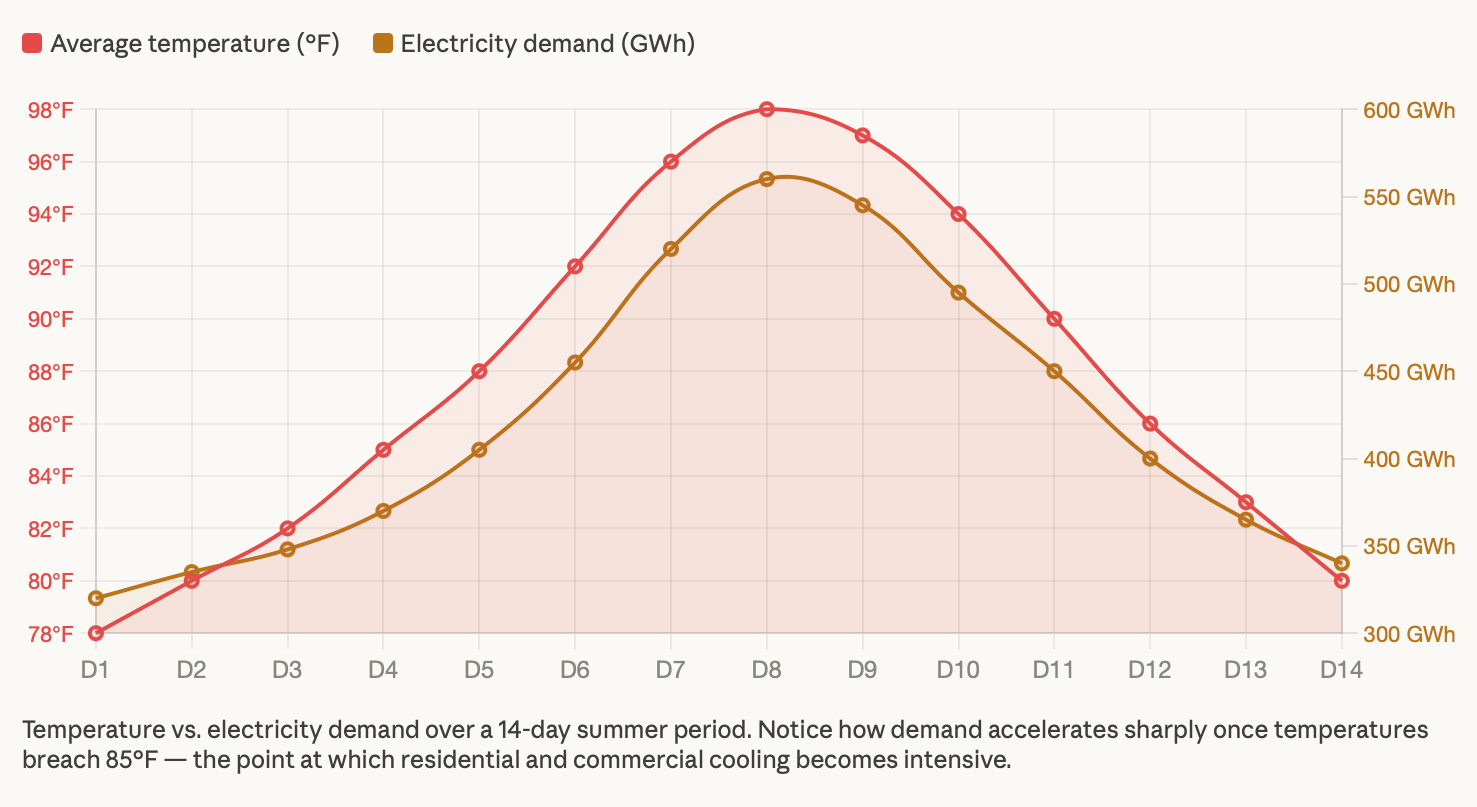
The CDD index is an indirect measure of the heatwave trading via traditional futures and CFDs; when the CDD forecast for a given regional market is significantly above the seasonal average, experienced energy traders will adjust positions in natural gas and electricity futures based on their expectation that the increase in demand will occur before it’s reflected in the spot market.
How Heatwaves Impact Energy Markets: From Temperature to Price Spikes
The relationship of heatwaves to the volatility of energy prices is both direct and indirect. At its core, heat forces all parties that use electricity, e.g., residences, offices, data centres, hospitals and transportation systems, to increase their usage all at once, resulting in a significant amount of pressure on the regional electricity grid because they are not designed to handle average load profiles but rather for average annual loads.
At the same time, electricity prices are impacted first by how these markets are structured, then second by the way these markets function. In the deregulated electricity markets of ERCOT in Texas, PJM in the northeastern US, and the various power exchanges throughout Europe, market prices for wholesale electricity are set at the margin. This means the most expensive source of electricity generation supplied at any given time to satisfy demand will set the market-clearing price for all of the electricity provided by the market.
Therefore, when heatwaves cause electricity demand to exceed the normal peaks that occur in winter months, generators will continue to dispatch to support these additional loads; as such, they are forced to generate from more expensive peaker plants, which results in an increase in electricity wholesale price. This was evident during the Texas Freeze in 2021 and the European heatwave in 2022 when wholesale electricity prices spiked to levels 10 to 20 times the seasonal average.
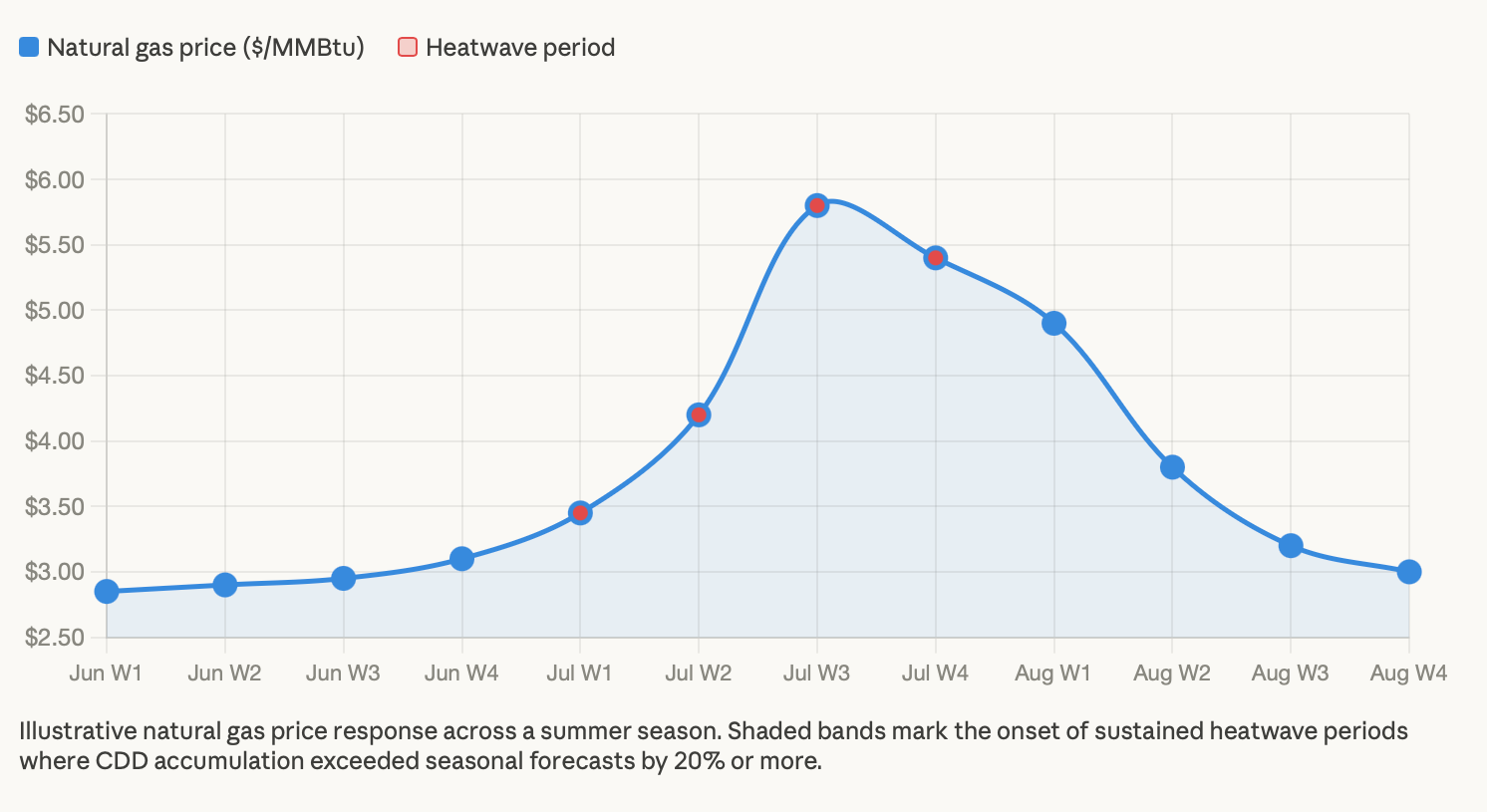
Natural gas demand will also increase during heatwave periods due to the relationship between gas and electricity. Gas fired generation typically represents the marginal generation source in almost all Western markets, therefore the demand increase for gas fired power generation during heat waves increases the demand for natural gas in the spot market resulting in a tighter supply and increased futures prices across the curve.
Heatwave Trading Strategies: How Traders Profit From Extreme Weather
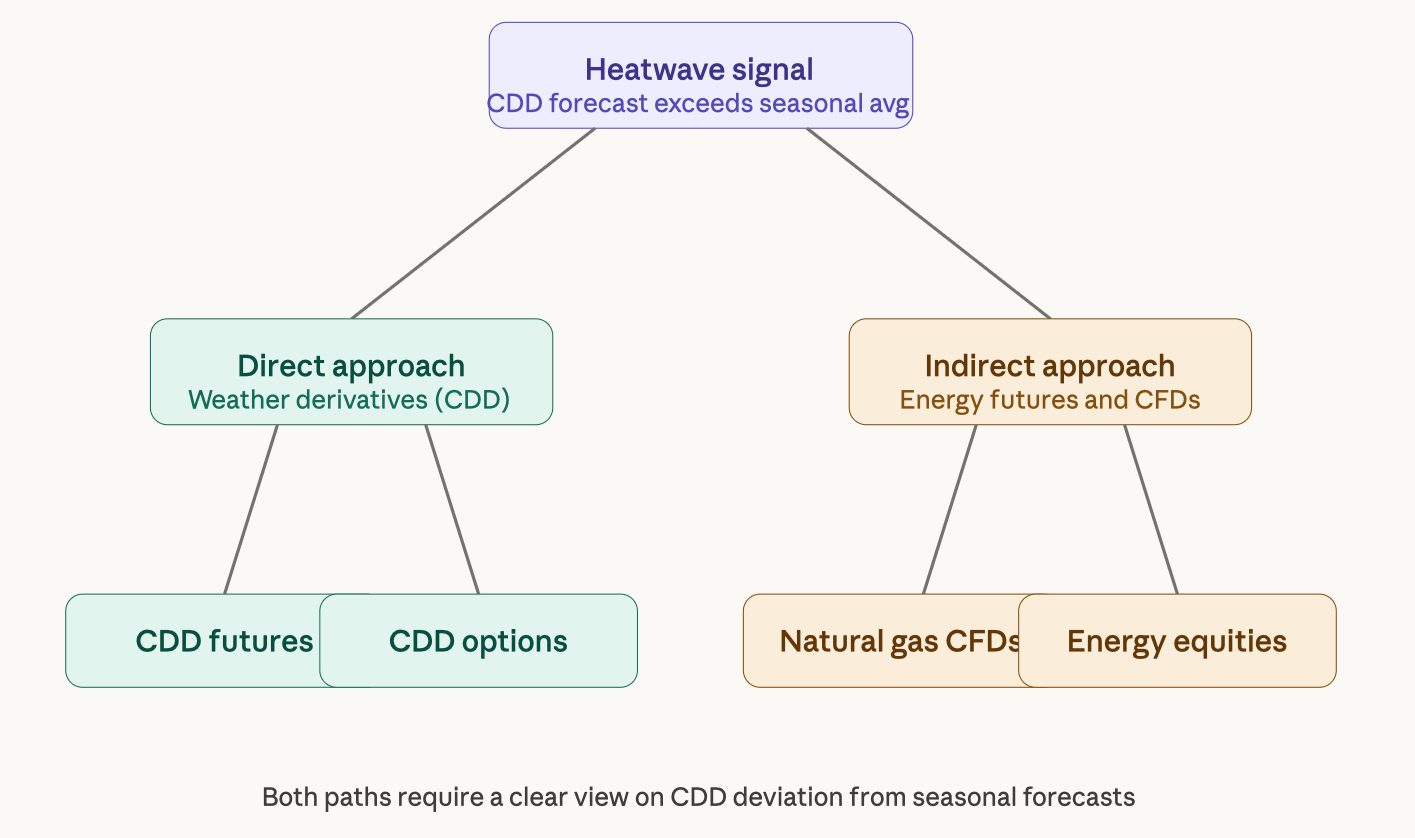
There are many different ways to trade heatwaves; these range from using highly sophisticated weather derivative contracts available to mostly institutions to using contracts for difference (CFDs) that are available to retail traders on standard trading platforms. The trader's experience, available capital and risk tolerance will determine which method is the best fit for them.
Direct trading in weather derivatives is the most authentic representation of the heatwave thesis, where traders buy cooling degree-day (CDD) futures contracts on the CME when they feel that forecasted temperatures exceed the marketplace's consensus on the summer forecast for a given location. The CDD contracts will settle each month based on the actual CDD amount, and traders will make or lose money based on the delta between the settlement amount and the purchase amount multiplied by the tick value. Institutional energy companies create a market for this class of trading as they provide liquidity through their hedging actions.
Indirect trading also allows traders to implement a heatwave forecast through the use of standard futures or CFDs available on the most commonly traded energy products (natural gas, electricity, and energy equities).
For example, a trader may take a long position on natural gas futures if they anticipate higher electrical usage in the summer as a result of forecasting mild summers. Similarly, a trader may buy utility equities priced at the wholesale market due to an anticipatory heatwave.
CFD strategies allow retail traders to capture the volatility associated with CDDs without needing direct access to water derivatives contracts on the CME. For example, retail traders anticipating higher prices for natural gas during a summer heatwave can take a long position on a CFD related to natural gas, also accounting for the volatility associated with USDA CDDs, with a reasonable position size.
In addition to making direct or indirect trades related to climate forecasts, many institutional investors use CDD hedging strategies as a primary driver of liquidity in the weather derivative marketplace. For instance, a utility with significant electricity cooling load exposure might purchase CDD call options on futures in order to protect profitability if actual cooling loads are low and revenues fall while fixed costs remain constant. Also, a commercial building owner with high electrical costs could hedge their summer energy budget using CDD futures.
Real-World Case Studies: Heatwaves and Market Reactions
When we analyse how heatwaves affect trading decisions for the energy markets in real-time, this theoretical framework becomes even more compelling. The heatwave that occurred throughout Europe during the summer of 2022 provides us with one of our most recent and significant examples. For several consecutive weeks, record-high temperatures were recorded across France, Germany, the United Kingdom, and Spain.
Due to the soaring river temperatures used for cooling, France's nuclear power stations were required to trim their production levels, thus decreasing supply precisely at the same time as demand was experiencing the most dramatic increase imaginable from increased cooling needs. For comparison, during this time frame, at one time, Germany's wholesale power price reached above €700 per megawatt-hour compared to €50 to €80 per megawatt-hour in the summer. Traders who had taken positions in the European power futures and/or the long CDD-linked contracts before this event experienced exceptional returns.
In the summer of 2023, we saw record-setting heat experienced in the Southwestern United States and, specifically, Texas. ERCOT continuously issued emergency notifications when power demand was nearing all-time highs. As the power sector continued to consume the natural gas available to them, futures prices for natural gas increased sharply during July, while electricity prices for real-time ERCOT traded at extraordinarily elevated prices on several occasions. Traders who had established an exposure to either Henry Hub natural gas futures or ERCOT power contracts and who understood the CDD dynamics leading up to these two extreme heat events had significant profit potential.
The consistent pattern presented across both events is that the financial markets underestimate the possibility that a heatwave will occur when they trade in weeks before the weather-related events. While forecasts have improved significantly over the past few decades, there continues to be a fair amount of uncertainty associated with seasonal weather forecasts, especially when considering that the time period of uncertainty associated with these forecast models continues to grow. As a result of this uncertainty, traders who pay close attention to weather data that is generated close to real-time will have an opportunity to identify pricing discrepancies prior to these discrepancies closing.
Risks and Limitations of Heatwave Trading
Heatwave trading entails a specific set of higher concentration risk factors compared to traditional equities or fixed income strategies, and not understanding these risks is one reason to apply structured discipline rather than impulse enthusiasm when engaging in this type of trading.
Forecast uncertainty is the primary source of risk. Temperature forecasts lose credibility quickly beyond a ten-day forecast horizon, and in less than three to seven days, the most workable heatwave trading setups will have been established once the presence of a heatwave is confirmed. Traders who establish large directional positions based on 2-4 week seasonal outlooks do so with much lower probability than traders establishing their positions with a three-to-seven day forecast.
Liquidity limitations for weather derivatives markets do exist. The CME Weather Derivatives market is reasonably active with metropolitan areas in the United States; however, as compared to other major asset class futures (equities or commodities), the bid-ask spread of a CDD Rights Contract relative to the temperature's expected impact on demand is significantly greater than those of other asset classes and large block trades can affect price materially.
Retail participants that are unable to access CME weather derivatives must rely on using either energy derivatives or equities to express their view of a heatwave, and therefore have the additional risk of basis as a result of one of these products being tied to multiple factors in addition to the temperature.
The instruments used in heatwave trading are complex and require a great deal of learning to understand them fully. The terminology associated with CDD Rights Contracts is not inherently descriptive, and the relationship of temperature forecast to pricing to seasonal averages, and to settlement mechanisms requires study before committing any capital to trade a CDD Rights Contract.
Beginner vs Professional Approaches to Heatwave Trading
The appropriate entry point into heatwave trading differs substantially depending on the trader's background, capital, and platform access. The table below summarises how the two groups typically approach the strategy.

No matter what category of trader you are in, the base discipline is the same: understanding the CDD metric completely, establishing and constantly following a temperature forecast process or system, sizing your positions conservatively relative to the uncertainty you are dealing with, and having a definite exit plan before entering the trade rather than after the trade has already been entered.
Heatwave Trading Checklist: Practical Execution Guide
When considering trading based on heatwave trades, it is important to go through the steps of the checklist to ensure understanding of the setup and have a clear understanding of the risk involved, rather than just accepting it.
1. Do you understand how Hot Weather Cooling Degree Days are calculated and what the current seasonal forecast is for the next month?
2. Have you compared the current temperature outlook with the historical average temperature of that area for the same time frame to assess how abnormal the temperature expectation is?
3. Have you determined whether you will be trading the hedge on a direct basis, utilising weather derivatives or indirectly through energy futures or CFDs, and do you understand the basis risk of the indirect way of creating your hedge?
4. Have you established a maximum allowable loss for your position, and accordingly sized your position to fit your maximum loss tolerance?
5. As the week progresses and you receive updated temperature forecasts, do you have a plan to monitor your position to account for daily changes in weather forecasts?
6. What is the liquidity profile of the instrument you are trading, and how will you exit your position if the trade does not go your way?
Having met the criteria for "yes" on all six questions is not going to ensure a successful trade, but it will distinguish between speculation and gambling.
Why Demo Trading Is Essential Before Entering Weather Markets
Traders who are first-time entrants to weather markets will find that they differ from equity markets in ways that may not be readily apparent. Price movements can be extremely volatile over a very short period of time; a single updated weather forecast bulletin can make a huge difference in the price of your position, and there is a need to fully understand how cumulative temperature data will impact the value of your CDD contract when it comes to settlement.
Before utilising one’s own capital for these types of trades, it is prudent to practice and develop pattern recognition skills within a simulated environment. A demo account allows you to practice your skills at reading CDDs and the relationship of energy CFDs to the weather, build position sizing strategies, and become familiar with these variables to manage operations efficiently once your capital is real.
Conclusion: The Future of Heatwave Trading in a Changing Climate
Every year, the structural case for heatwave trading as a long-term strategy continues to strengthen. Average temperatures have continued to rise globally for years, and over the last several decades, extreme heat has increased in both frequency and intensity across all populated areas of the world. In addition to that, market participants have developed more and more sophisticated tools for managing and evaluating how they will price and transfer weather-related risks to give governments in most developed countries a new financial instrument for the trading of weather-related risks.
For individuals looking to trade based on the mechanics of cooling degree days (CDD) it can be very beneficial to develop an understanding of how to track meteorological data much like one would track an economic data calendar; manage their own unique risks for trading weather driven trade; and have developed proprietary research methodologies in CDD methodology to find true alpha sources that are structurally uncorrelated from the underlying interest rates, corporate earnings and geopolitical events that drive traditional asset prices.
Weather is now the primary focus of a trader and no longer just the background of a trade - provided the trader has an understanding of how to read and interpret the methodology behind CDDs.
Frequently Asked Questions
What is heatwave trading? Heatwave trading involves using financial instruments, primarily weather derivatives tied to Cooling Degree Days, to speculate on or hedge against extreme temperature events that drive energy demand and market prices higher.
How do weather derivatives work? Weather derivatives pay out based on measurable weather outcomes rather than asset prices. A CDD futures contract, for example, settles against the actual cumulative Cooling Degree Days recorded in a specific city over a calendar month.
What is CDD in trading? CDD stands for Cooling Degree Days, calculated as the average daily temperature minus a 65°F baseline. It measures the cumulative cooling energy demand over a period and serves as the underlying index for weather derivative contracts.
Can retail traders access weather derivatives? Direct CME weather derivatives are primarily available to institutional participants, but retail traders can access the heatwave theme through CFDs on natural gas, electricity, and energy equities via standard trading platforms.
Is heatwave trading profitable? Like any specialised trading strategy, heatwave trading carries meaningful risks alongside its return potential. Profitability depends on the accuracy of your temperature forecasts relative to market consensus, disciplined position sizing, and a thorough understanding of the instruments involved.
TradeWill's demo platform replicates live market conditions with zero capital at risk, giving you full access to energy CFDs and the tools you need to build your heatwave strategy before you trade it for real. Open your TradeWill demo account at tradewill.com and start trading weather volatility today.
Disclaimer: The content of the blog does not represent any position of Trade W, does not serve as any trading-related decision advice, and does not endorse any third-party.