

 Trade W

What Is PALL Stock? Complete Guide to Understanding This Unique Investment
Many people have confusion when typing in to find "pall stock" to see what pall stock means.
The term pall stock has different meanings across two very distinct contexts. Some day traders think that Pall stock means stocks from the Pall Corporation, which was acquired by Danaher many years ago. Others are looking for the PALL ETF, which is used to track the price of Palladium. The focus of this article is to describe PALL as the Aberdeen Standard Physical Palladium Shares ETF.
When you purchase PALL Shares, you are not purchasing into a company with Employees or a Chief Executive Officer who is making strategic decisions for them. You are purchasing Exposure to the Spot Price of Palladium Metal through Physical Bars that are sitting in a safe place, an off-site vault. No Dividends or Growth Story, just pure Tracking of Price.
This is one of the main reasons why beginners have trouble. They feel that PALL Stock is similar to how stock works at Apple or Tesla, in which the price is usually positively influenced by Earnings Reports and other Company News. PALL does not follow this same pattern. PALL prices move with the movement of Palladium Prices, and Palladium Prices move according to Supply and Demand, as well as Industrial Demand.
Let's break down the differences:
Company stock represents a share/ownership in the company. Your bets are essentially on the company's management, innovation, and profit growth. For example, as Tesla sells more vehicles and increases its earnings, the value of its stock increases.
Mining companies provide a leveraged bet on the price of the underlying commodity. However, they are still a company. Thus, there are also other company fundamentals, including quality of management and operational efficiency. An example would be a palladium mining company that is losing money even though the price of palladium is on the rise; this would likely be because of poor management.
With the PALL ETF, you are essentially buying and selling a price-tracking instrument for palladium only. If the price of palladium rises by X %, then PALL rises by approximately X % minus small fees. If the price of palladium were to crash, PALL would also crash. There is no CEO to save you, no pivot strategy, and no diversification into different product offerings.
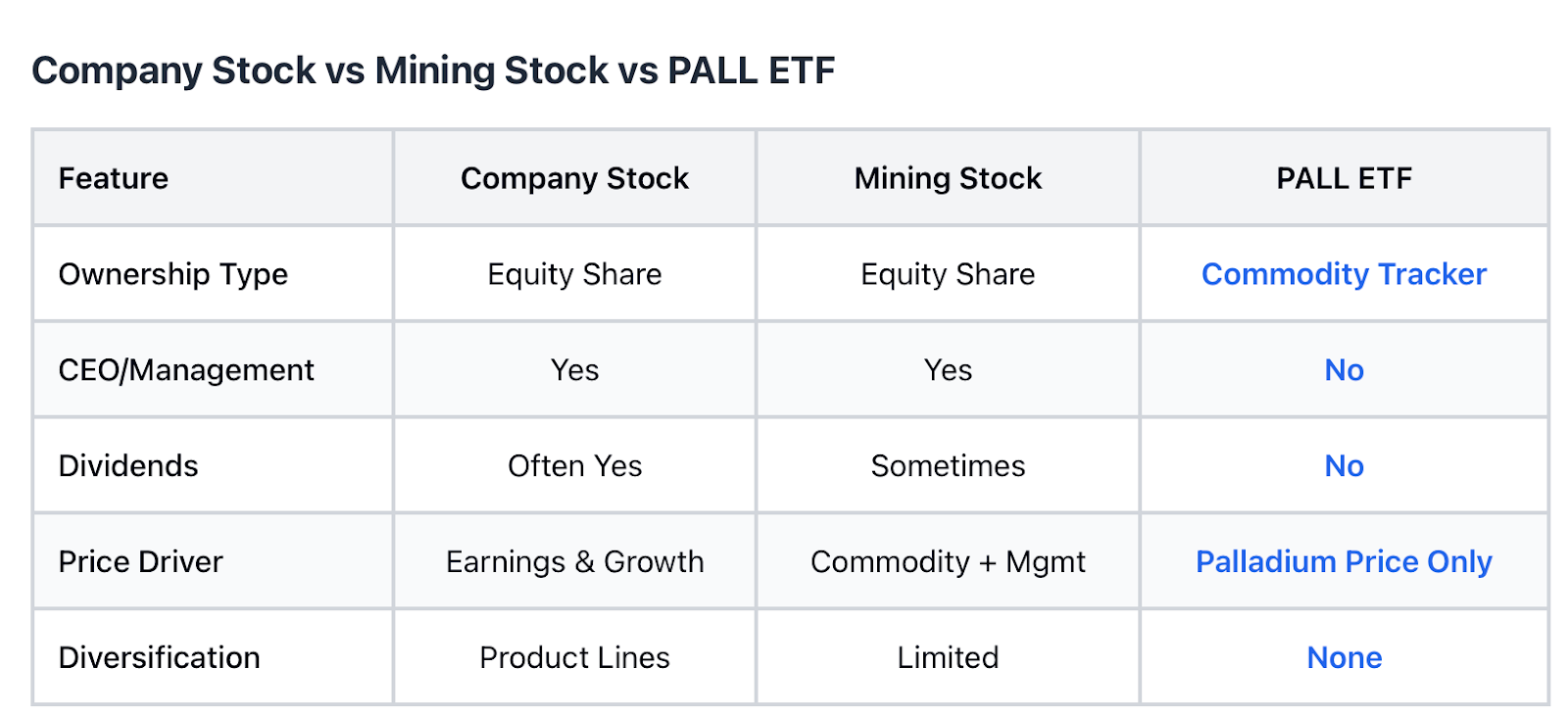
In essence, you can think of a position in PALL as shorting or going long on palladium. You can buy or sell it as you please. A macro hedge fund may use it for short-term exposure to palladium without having to deal with futures contracts or physical delivery. And a novice investor may use it as a means to bet on increased demand for industrial metals without having to choose between individual mining companies.
The main takeaway: A PALL position (the ETF) does not constitute equity ownership in a company; it is a commodity tracking mechanism. Understanding this difference will help you avoid costly mistakes when investing in palladium.
Palladium Supply and Demand: How It Drives PALL Stock Prices
If you're trying to figure out why the price of palladium tends to fluctuate so much, then you need to understand the demand that is driving that price up and down.
Three main sectors generate most of the demand for palladium, as follows:
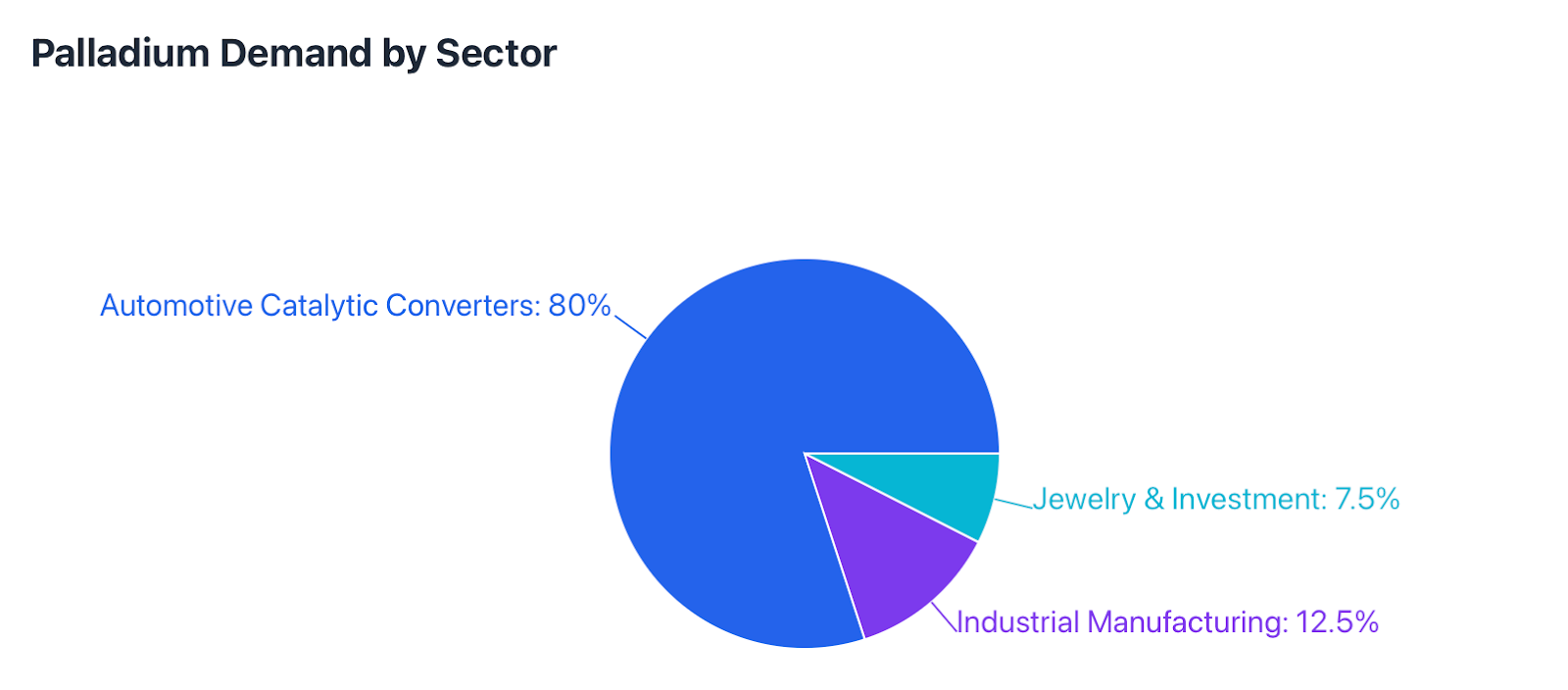
Automotive emissions reduction is by far the largest sector. Approximately 80% of the total amount of palladium used in the world is used in automotive catalytic converters. So, every time new emission laws come into effect, and the government increases emission requirements, they will also have to increase how much palladium is required for each of the vehicles produced.
For example, the Chinese government is tightening emissions regulations; therefore, the demand for palladium will increase. The European governments that are phasing out older diesel vehicles or older diesel cars will also increase the demand for gasoline vehicles, thus the demand for palladium will increase.
Industrial manufacturing accounts for around 10%-15% of the total usage of palladium in manufacturing. Palladium has a steady, consistent, stable demand and is less cyclical than the automotive sector.
Speciality uses such as producing jewellery and investment bars account for the remaining amount of palladium demand. This sector is very small in size but has the potential for creating short-term price movements when supply is tight.
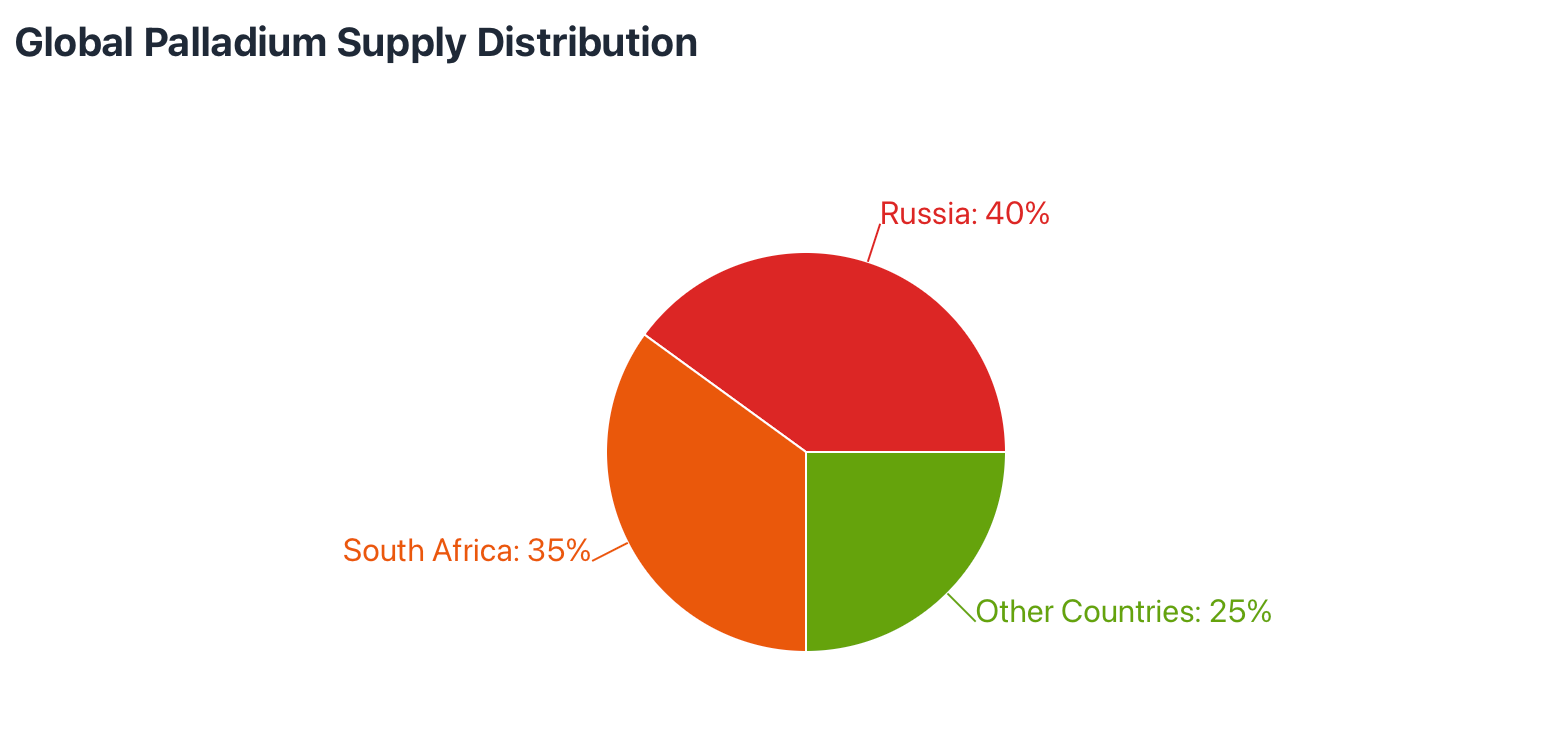
Palladium is gaining a great deal of interest because of its high level of extreme concentration and inflexible nature when it comes to supply.
Russia and South Africa together are producing 75% of the world’s supply of palladium. Russia itself is responsible for 40%. When there are any geopolitical conflicts or when any disruptions to mining operations occur, there is no immediate or relatively quick solution to supply. The development of a new palladium mine will take years, if not decades, and this metal is usually a byproduct of platinum and nickel mining. Thus, rising prices do not allow an immediate opportunity to produce more palladium.
This creates a straightforward yet powerful cyclical effect: increased demand, unchanged supply, rapidly rising spot prices, and consequently an immediate corresponding rise in the PALL stock price. PALL’s Net Asset Value (NAV) is calculated daily by using the spot palladium price on that specific day. If the palladium price increases 3% overnight, the next trading day will open the PALL ETF nearly 3% higher.
This is one of the reasons that palladium stock price volatility is so much greater than that of gold ETFs. Gold has had a long history of production - hundreds of mines worldwide, and decades of above-ground reserves, along with many different uses. Palladium is mostly used in industrial manufacturing and concentrated in a small area. Palladium is extremely sensitive to sudden news releases, such as Russian export prohibitions. A single news item can cause a 50% change in palladium prices.
Can PALL Stock Hedge Inflation? Why Palladium Differs from Gold
An example of a typical error is thinking that all PMs can act as a hedge against inflation.
The reason many people think of gold as a hedge against inflation is that it has been an accepted store of value for thousands of years, and historically, people have purchased gold when currency values decrease due to increased inflation. This is referred to as the "Classic Safe Haven" trade.
Another example of the difference between industrial and precious metal categorisation is with palladium. Palladium's main use is within the industrial sector. Approximately 85% of Palladium demand comes from the automotive industry, so it is much more affected by trends in the economy than by inflationary trends.
Let's look at three scenarios:
Economic expansion and inflation are two components of the market that which palladium thrives. With both elements being present, manufacturers are at a point of high production levels, due in part to increased factory activity and the new enforceable emission laws resulting from manufacturing on a global scale. Palladium now has a significantly higher level of demand than before, resulting in some outperforming gold during these periods of inflation and increased industrial activity.
Economic Recession and Inflation are where palladium's value starts to become distorted. When a recession begins occurring while inflation is happening due to supply shock from one or a combination of many different factors (in this case, the COVID-19 pandemic), that can create a situation where palladium's value diminishes as industrial activity declines and ultimately its demand also declines, yet nominal prices continue to rise. For this reason, palladium could underperform gold during this scenario due to the decline of automobile production and subsequently reduced end-user demand as well.
Low inflation levels, coupled with innovation from technology, represent the worst outcome for palladium. If demand ends up being eliminated from the market as a result of electric vehicles ramping up as fast as expected, and gasoline-powered vehicle production drops to levels that eliminate any remaining demand, palladium's value will experience such a significant decrease that the standard levels of inflation, if the inflation rate remains low compared to prior periods. will not be enough to support/elevate palladium.
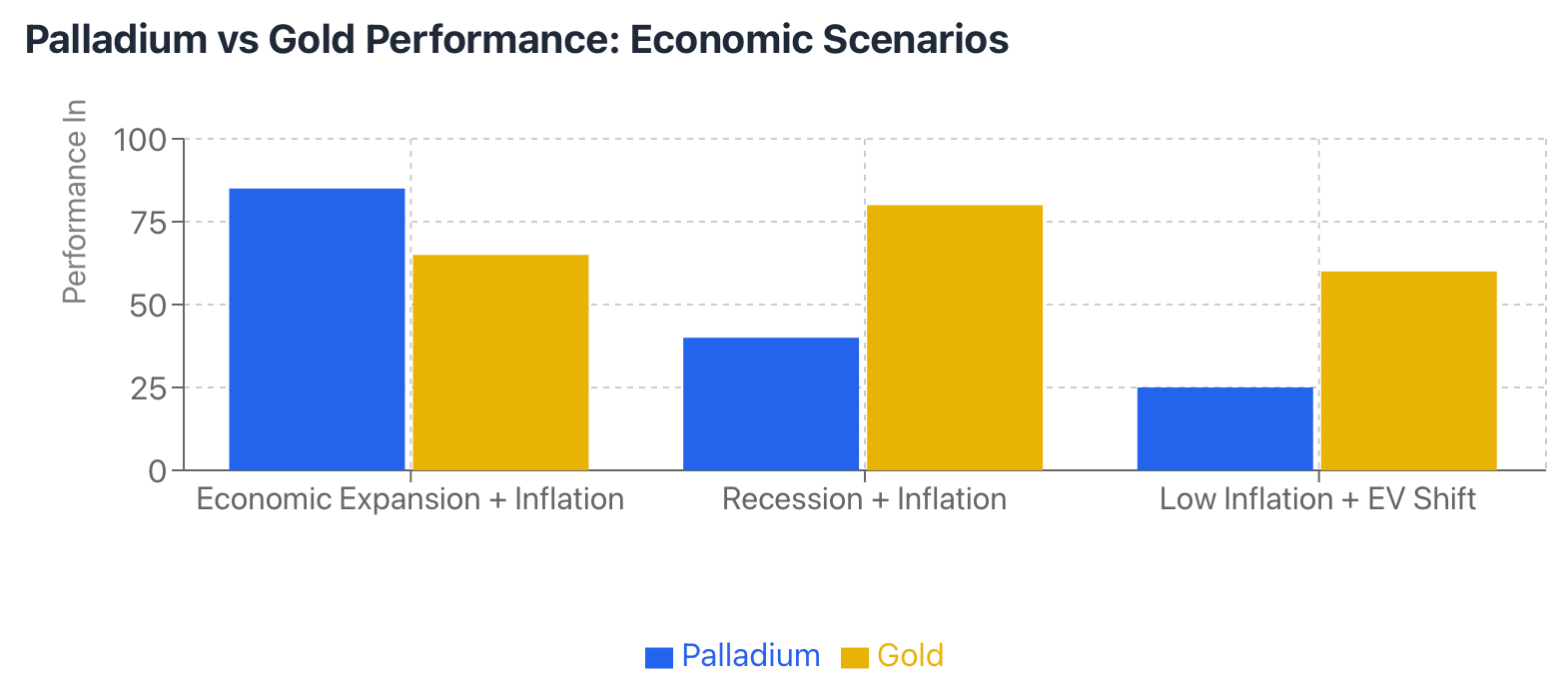
PALL represents a conditional hedge against inflation. When inflation and industrial activity levels remain high, and supply chains remain constrained, palladium has a higher probability of being a successful investment. If economic conditions deteriorate and the automotive industry shifts to electric, palladium will not perform well as a result of low industrial activities, low catalyst metal demands and a poor investment environment.
As mentioned, when trading palladium (PALL), remember there is a difference between palladium and gold. Gold reacts to fear, and debasement of currency; palladium reacts to manufacturing, automotive production, and new emissions requirements. A combination of these variables will dictate whether or not palladium can outperform gold.
Beyond Precious Metals: Why Palladium Matters in Hybrid Cars and Green Energy
There has been a misconception that the shift toward renewable energy will result in a total collapse of palladium demand. The conversion from gasoline to electric vehicles will be gradual over many decades, and hybrid vehicles are the transition technology that will dominate this time period. The thing to remember is that hybrids have catalytic converters to manage the emissions from their engines, which require palladium for continued effective operation.
Pure electric vehicles (EVs) do not have an exhaust system and therefore do not require the use of palladium. However, hybrids have both a gasoline engine and an electric motor so the gasoline engine produces emissions and therefore requires a catalytic converter to be compliant with current environmental regulations. In many instances, because of the way hybrids are marketed to consumers as "green", they need to meet higher standards than typical gasoline-powered vehicles and require advanced emissions control technology.
The reality is that the number of electric Vehicles (EVs) on the road is steadily growing, but will do so at a slower pace than that of hybrids. Most of the more recent projections are predicting that hybrids will see much higher levels of growth than pure electric vehicles (EVs) through 2030, as it relates to the United States, Japan, and parts of Europe, where there is still limited charging infrastructure available. China is aggressively moving towards automating electric vehicles (EVs); however, hybrids are a large percentage of new vehicles even there.
Additionally, emissions regulations will continue to get more stringent. The Euro 7 Emission Standards for Europe, California’s stricter Emission Standards and China's National VI Emission Standards all require automakers to utilize higher quantities of palladium than they currently do to comply with these regulations. Even if manufacturers maintain their current rate of production, the usage of palladium will continue to increase.
This dynamic creates a unique and structural demand for palladium, which many investors fail to consider. By purchasing palladium stocks, you are not merely speculating about the increasing number of automobiles being sold, but also the continued development of more stringent regulations that will require automakers to use higher levels of palladium in their vehicles over an extended period of time.
To summarise, the increasing number of restrictive emission regulations on automakers will mean that catalytic converters will be larger in size and more efficient than they currently are. Larger, more efficient catalytic converters require the use of larger quantities of palladium when compared to existing converters. As long as there continue to be restrictions placed on emissions, the demand for palladium will increase even in the face of an accelerating rate of electric vehicle adoption.
Palladium does not work against the green energy revolution but rather plays an essential role in achieving this revolution in a practical way.
From Pall to Danaher: Why Capital Bets on This "Invisible Industry"
Let’s look at the other side of Pall, which is the filtration business bought by Danaher for $13.8 billion in 2015.
Understanding Pall stock requires knowing why this purchase matters to understand the long-term value of companies operating in “invisible industries.” Danaher did not buy Pall because they wanted to grow rapidly; they purchased Pall because they saw the strategic value in it. They acquired a company whose filtration products support the pharmaceutical industry, aerospace, and food and beverage manufacturing and are considered “mission critical.”
Pall filtration products serve many different industries, including biopharmaceutical production, aerospace manufacturing, food and beverage processing, and the manufacturing of microelectronic products. While none of these industries may be perceived as glamorous, they are all essential to the overall economy.
You cannot produce an injectable drug in a sterile manner without a properly functioning filtration system. Likewise, you cannot produce a computer chip unless you have ultra-pure water. Finally, you cannot manufacture and bottle the beverages enjoyed by millions of consumers without the proper filtration systems in place.
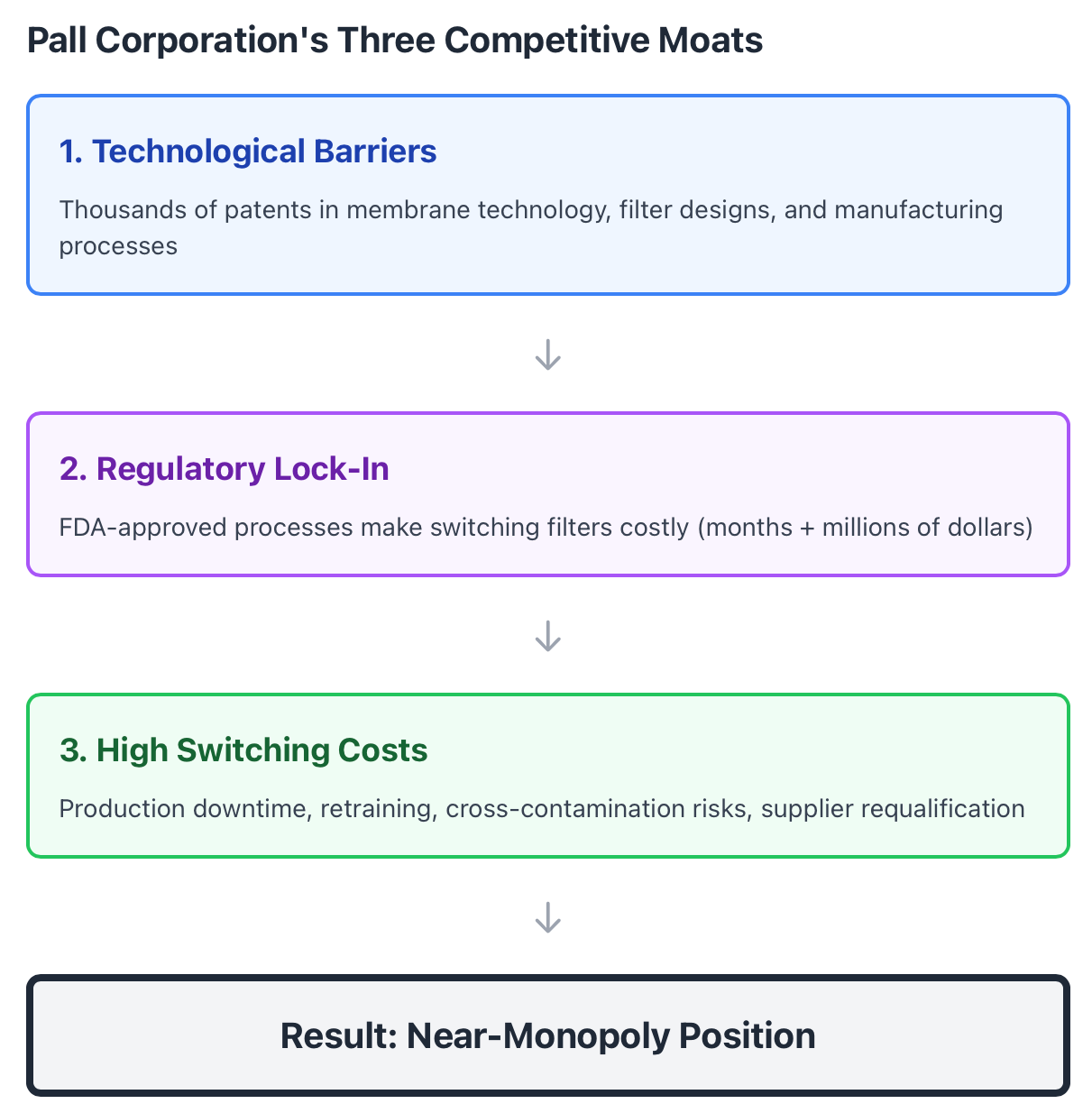
Three competitive moats make Pall nearly impossible to displace:
Technological barriers: Pall's extensive patent portfolio contains thousands of patents related to membrane technology, filter designs and manufacturing processes. It would be extremely costly and time-consuming for a competitor to develop a similar product.
Regulatory lock-in: Pharmaceutical companies submit their manufacturing processes to the US FDA. Once a specific filter from Pall has been included in an approved process by the FDA, a pharmaceutical company must submit a new application to use a different filter from a competing company. This process can take several months to complete and cost millions of dollars, and, if approved, may cause production delays. Therefore, no company want to switch unless they are absolutely forced to do so.
High switching costs: The high costs involved with changing from one filtration system to another are not limited to regulated industries. Consider the time spent on production while changing filtration systems, retraining workers, potential cross-contamination, and the need to requalify suppliers. Due to this, it is much easier to pay the price for the product from Pall than it is to switch to a different company.
Danaher believe that Pall is not a company that operates in cycles, but instead, an asset-level business that produces consistent cash flow regardless of the economic conditions. The healthcare industry requires sterile drugs during times of economic distress, semiconductor manufacturers require clean water during times of economic distress, and food production companies need filtration during times of economic distress.
The acquisition of Pall by Danaher demonstrates an important reality regarding the type of business long-term capital will invest in. Companies that are deemed and viewed as essential are more attractive to long-term capital than companies that are simply viewed as profitable. Pall's business is a perfect example of this.
Investing in "Life Science Source": Pall's Monopoly-Like Position in Biopharma
To get a better understanding of why Pall Corporation has dominated the biopharmaceutical marketplace, one must understand that the pharmaceutical industry is fixated on purity. A single contaminant can cost millions of dollars to produce and result in a contamination event that could go to the patient and lead to severe legal ramifications and regulatory sanctions from the FDA. The stakes are extremely high.
Filtration is at the peak of this business model. Filtration is used at every major step in the production process of biological drugs (cell line propagation, protein purity, sterile filling, and final product filtering). Today, Pall has the broadest portfolio of filtration systems within biopharma to hundreds of thousands of plants and facilities worldwide.
Pall is successful because filtration does not operate as a commodity; it cannot be replaced with something cheaper, as one would switch to generic office supplies. Each filter that is used must be validated as part of the manufacturing process. When replacing a filter, validation of the entire line must occur with regulatory agencies, which can take anywhere from 12 to 18 months and cost $5 to $10 million for each facility.
Because of the validation process, the biopharmaceutical company that selects Pall has a de facto obligation to use Pall for the duration of that production line. Facilities that grow and/or change cannot switch filter systems; the cost of switching is too great, and the risk of loss is too severe.
In a commodity business, we see different characteristics. For example, in commodity steel, if the price spikes, a customer can quickly find other steel suppliers in a couple of weeks. In the chemical market, if a producer of a chemical raises the price too high, competitors will move into the marketplace. Thus, there is price elasticity and active competition.
Pall operates in an environment where demand is inelastic; i.e., there’s a lack of competition in the marketplace. Therefore, customers do not shop around for filters. There are no easy paths for competitors to enter Pall's market. Pall continues to hold pricing power.
As with other business sectors, businesses that rely on infrastructure have a different view than those businesses that get significant publicity. The only time a business that sells or creates a sizeable amount of cash flow generates headlines is when the costs become too great to use the products of that company.
An understanding of this dynamic will assist investors in understanding why Danaher bought Pall at a premium and why Pall continues to generate a premium for investors. This asset is one that an investor should continue to own through the ups and downs of the economy. It is an asset that is going to produce a premium for many years.
The Two Meanings of PALL Stock: ETF vs Pall Business
So far, we've talked about two different kinds of "PALL stock": PALL as a palladium ETF and Pall as a filtration business. We want to eliminate confusion between these two separate entities.
PALL ETF is simply a publicly traded fund that invests in physical palladium and reflects the current spot price of palladium on stock exchanges, as it will fluctuate based on supply and demand for palladium at any point in time. The PALL ETF has no dividends because it holds physical metal only.
Pall Corporation was once a public company that produced filtration technologies, but it is no longer publicly traded since Danaher acquired it in 2015. After the acquisition, Pall Corporation became a business segment for Danaher's Life Sciences division, and the only way to gain exposure to Pall Corporation is through owning Danaher stock.
Although both assets have long-term growth potential, they are governed by two entirely different behaviours:
The PALL ETF is cyclical and very volatile in nature. This means the PALL ETF will rise or fall depending on prevailing industrial commodity cycles. If auto production falls or if Russia floods the global market with palladium, then the PALL ETF may drop dramatically. Conversely, if emissions rules become stricter across the globe, the PALL ETF may increase dramatically. The PALL ETF does not have management teams, earnings growth, or compound growth over extended periods.
The Pall Corporation, operating as a subsidiary under Danaher, is a stable and compound business model. The Pall Corporation has a steady growth trajectory, which primarily results from growth in new filters and in geographic territories, as well as through pricing power. Demand for filtration systems does not decrease during economic downturns. Revenue growth will compound over decades as the biopharma industry expands globally.
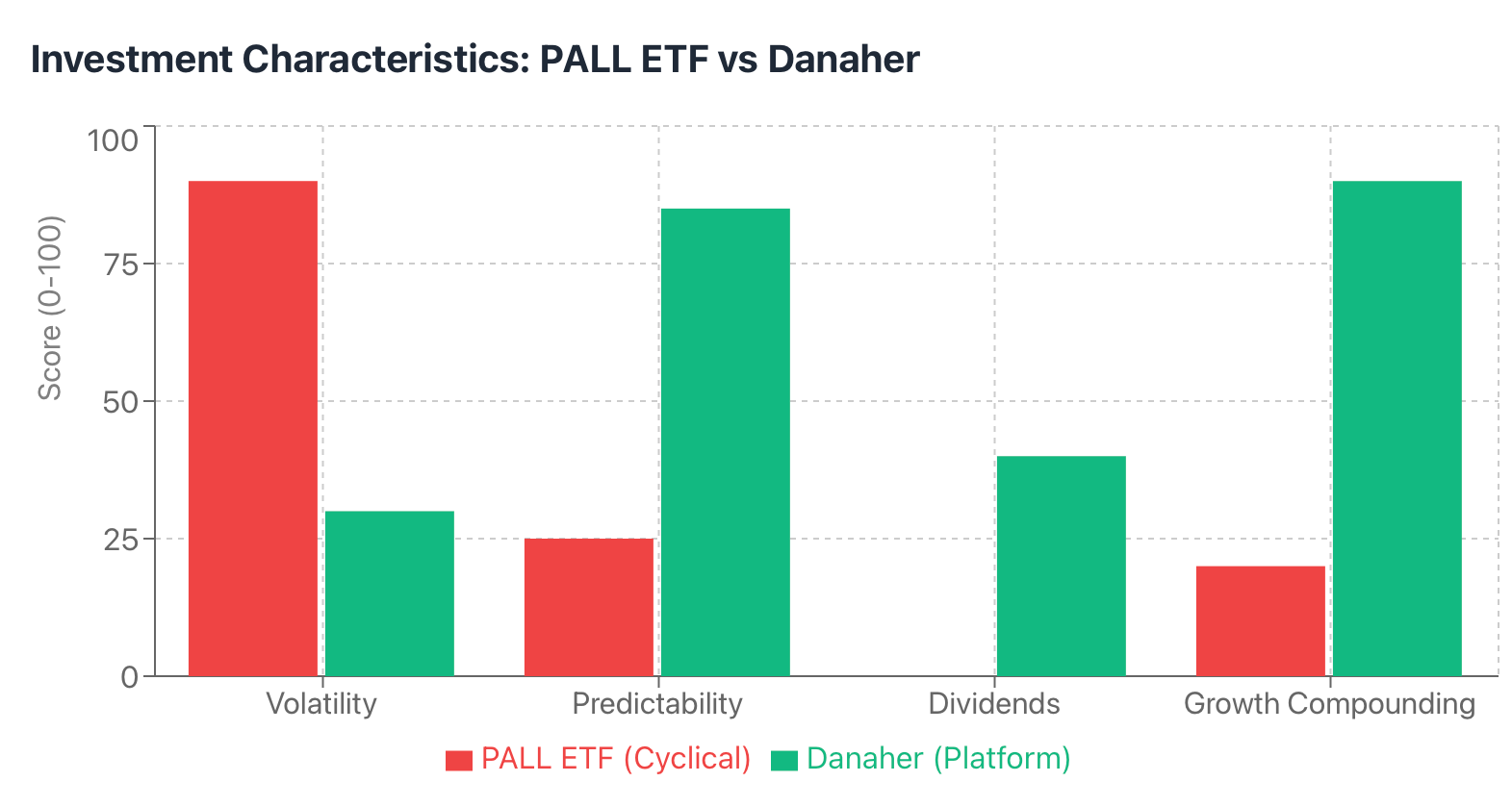
There is no direct relationship between the prices of these two types of "PALL stock", thus:
The price of the PALL ETF may drop by 20% in a month while Danaher stock remains relatively unchanged. Conversely, Danaher may underperform compared to the rest of the market during periods when the price of palladium is significantly rising.
The only thing that connects these two assets is that both of them benefit from long-term industrial trends. The pressure on industries to reduce emissions will increase demand for palladium as well as drive an increase in the need for filtration systems in the manufacturing process, which will help Pall Corporation. However, this connection is only a thematic relationship, and they do not correlate with one another as trade instruments.
It is vital to remember that when you buy shares of PALL stock, you are speculating on future palladium prices. When you purchase Danaher stock, you are investing in a diversified life sciences platform that just also happens to include filtration assets.
Commodity Cycles vs Platform Companies: Two Completely Different Ways to Make Money
Understanding how commodity cycles differ from platform companies will have an impact on your outlook on investing.
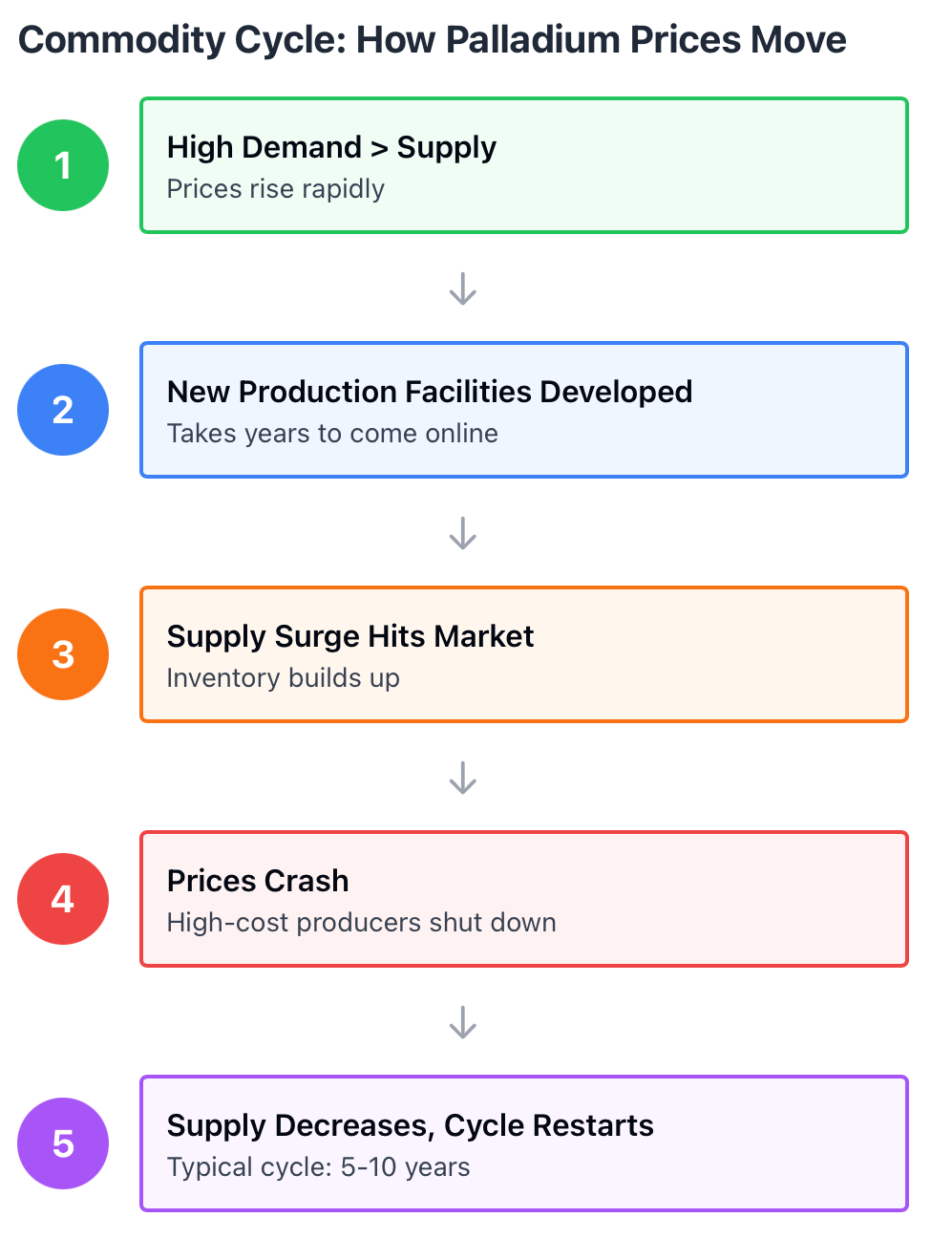
Cycles of commodities, such as palladium, are driven by supply and demand. When demand is higher than supply, prices rise, which encourages the development of new production facilities. Once these new production facilities are up and running, there tends to be a surge in production and a subsequent increase in inventory, resulting in a large decrease in price.
The significant decline in prices then forces the producers of these commodities that have higher production costs to shut down their facilities and produce less than they did previously. This then creates another cycle that usually lasts between 5 to 10 years.
Palladium stock is primarily a commodity-based investment. In this example, one will be investing in palladium's commodity cycle. The best time to purchase shares would be at or near the cycle low and then sell near the cycle high. It's all about timing. Waiting too long to sell could result in losing all your profit as the price moves lower, and on the other hand, if you haven’t been patient enough to wait to buy in on or around the cycle low, you will purchase at or near the cycle high.
Platform companies are based on an entirely different model from commodities. A platform company earns and has the potential to generate recurring revenue for mission-critical products. The platform company continues to grow earnings steadily over time through compounding earn in small increments each year, by reinvesting what they earn.
An example of a platform company would be Danaher, which participates in a business improvement system called the Danaher Business System (DBS), which helps to maximise the efficiencies of any acquired companies through continuous improvement.
Danaher purchased Pall not because Danaher was betting on commodity cycles but because it saw value in having a steady stream of reliable cash flow generated by the filtration products. The important distinction is the reliability of the income stream versus the volatility of the price.
This distinction matters when building a portfolio:
Cyclical stocks like PALL are used for tactical trading strategies based on a trader's macroeconomic opinion about the commodity market. For example, a trader may think, "I believe demand for cars will increase significantly over the coming year," so he will increase his investment in PALL.
When using this stock for tactical trading, traders must be very careful about the amount of capital they invest, as the downside potential is often very high. Traders also have to set stop losses and take profits immediately if the market moves against them.
Platform stocks such as Danaher are examples of core investments. An investor buys the shares of these companies primarily as a long-term investment to build wealth. An investor will want to look at the management team, competitive advantage within the industry, and the rate at which a company reinvests capital when determining whether to invest in Danaher.
In trading stocks like PALL, which are cyclical, holding the stock during a downturn will result in a substantial loss of capital. In contrast, the compounding effect of holding Danaher stock creates a long-term value-added proposition.
The point is, an investor must align his or her trading strategy to the stock he or she is trading. PALL stock is an example of a tactical trading vehicle, while a Danaher investment represents a long-term commitment to a growing company. The two cannot be treated in the same manner, or an investor will incur significant losses.
Traders vs Long-Term Investors: How to Use PALL Stock Effectively
Short-term traders are to concentrate on supply shocks and demand catalysts and look for the events that will increase palladium prices quickly, i.e., Russian export restrictions, South African mining strikes, unexpected changes in Chinese auto production, and large changes to emissions regulations. These events will be your entry signals.
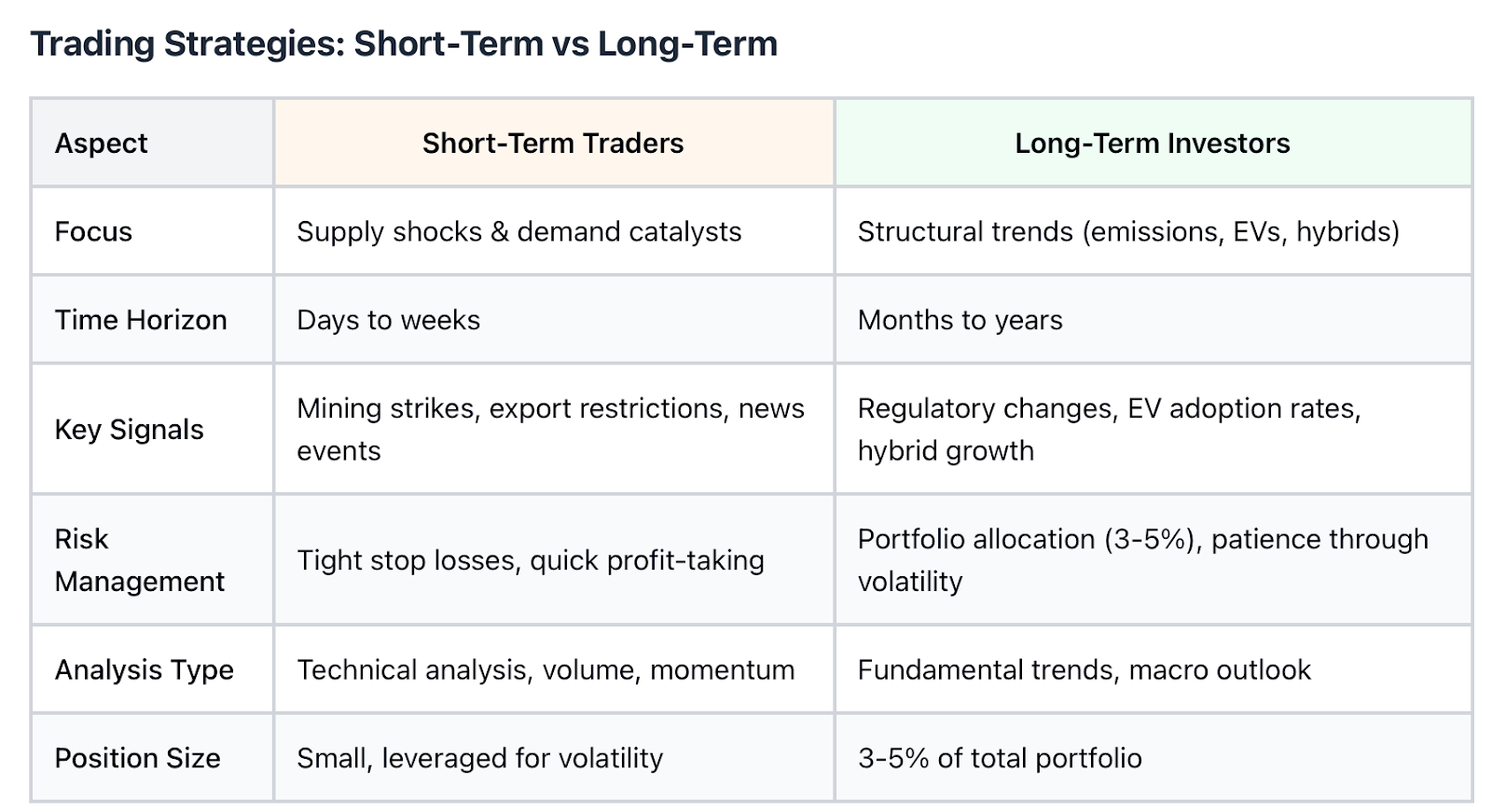
In this case, volatility works to your advantage. When the news hits, PALL stock is likely to move 5-10% in a week. You will utilise tight stop losses, take profit at predetermined targets and not hold through uncertainty. Managing the position size of your PALL stock is crucial to prevent it from being wiped out during a large swing from being over-leveraged.
For short-term trades, technical analysis plays an important role. You will need to pay attention to support and resistance levels on your PALL stock chart and pay attention to trading volume to look for signs of accumulation or distribution. Also, be sure to use momentum indicators to help avoid buying into a falling knife.
Mid-to-long-term investors should take an overall view of structural trends. For example, are hybrid vehicles starting to take market share away? Are the emissions rules becoming more stringent, and is there any increase or decrease in palladium supply? All of these trends take weeks, months, and years to develop.
Your advantage with a long-term perspective is being patient. The majority of traders panic during short-term volatility; however, structural trends require time to develop. If you truly believe the move to EVs is taking longer than the market anticipates, take advantage of this time by being patient and benefiting from sustained demand for palladium.
Long-term risk management is approached differently than for short-term time frames. Long-term investors do not worry as much about daily volatility and rather focus on the size of their positions in relation to their total portfolio. For example, a retail investor may only have PALL stock constitute 3-5% of their total portfolio, meaning it serves a purpose as a commodity diversification vehicle, rather than being held as a core holding.
One common pitfall: Many new traders confuse having high volatility with having a high win rate.
PALL stock experiences extreme swings; however, these swings are not always predictable. Many traders have lost their accounts due to trying to capture every single swing. The pros that can trade PALL stock successfully have either an institutional edge through superior macro research or have developed incredibly strong discipline related to position size and risk management.
For the majority of retail investors, you should only allocate a small tactical position to PALL stock vs. making it a long-term buy-and-hold core holding. If you are looking to demonstrate a specific viewpoint about industrial metals, you can use it for that purpose; however, do not go “all-in.”
Turn PALL Stock Knowledge Into Smart Trading on Tradewill
As an investor, you've reached a much deeper level of understanding of PALL stock than most other investors. You now know that PALL is an ETF that tracks the price of palladium and that it's not a company that manufactures anything. You've learned how the supply and demand of palladium affects its price, and inherently, that palladium is an industrial metal, not simply an inflation hedge.
You also understand the significance of palladium during the transition to the green energy industry, and how it compares to platform businesses, such as the Pall filtration unit that falls under Danaher.
Nonetheless, understanding PALL stock does not mean that you should rush out and buy a massive amount of shares immediately. While gaining knowledge decreases uncertainty, it does not eliminate the possibility of risk. Prices of palladium could crash or increase dramatically overnight due to unanticipated events, such as supply chain disruptions or other unexpected technological changes. This is why being aware of risk management should come before conviction.
Now that you understand how to trade in PALL stock, what should you do? Tradewill can give you the ability to take a shot at your intuition while limiting your risk. By using CFD, you can either go long or short on PALL stock. If you think that palladium will increase in price, then you can go long on PALL stock; likewise, if you feel that the demand for palladium will decrease, then you may wish to short sell.
For those of you new to the world of trading PALL stock, you should begin with a demo account through Tradewill. Examine how PALL reacts to several different news events, such as new vehicle production, mining interruptions, and new regulatory demands. Determine how much PALL stock you would like to invest in after experiencing how volatile PALL is before investing real money. Once you feel confident enough to invest in PALL stock, you'll want to restrict your investment size for now, starting with 2-3% of your total portfolio.
For those experienced traders, one possibility to diversify your commodity exposure could be through utilising PALL stock within a broader industrial metals strategy via Tradewill. You may consider purchasing PALL stock along with your existing stocks in copper and/or platinum to enhance your overall exposure to the industrial metal market. Furthermore, PALL stock could serve as a hedge against inflation during periods of sustained growth in industrial activity.
Now that you have the understanding, go open an account at Tradewill to enable you to put your research into action and be able to exploit the volatility of palladium as it applies to you with precision.
Disclaimer: The content of the blog does not represent any position of Trade W, does not serve as any trading-related decision advice, and does not endorse any third-party.