

 Trade W
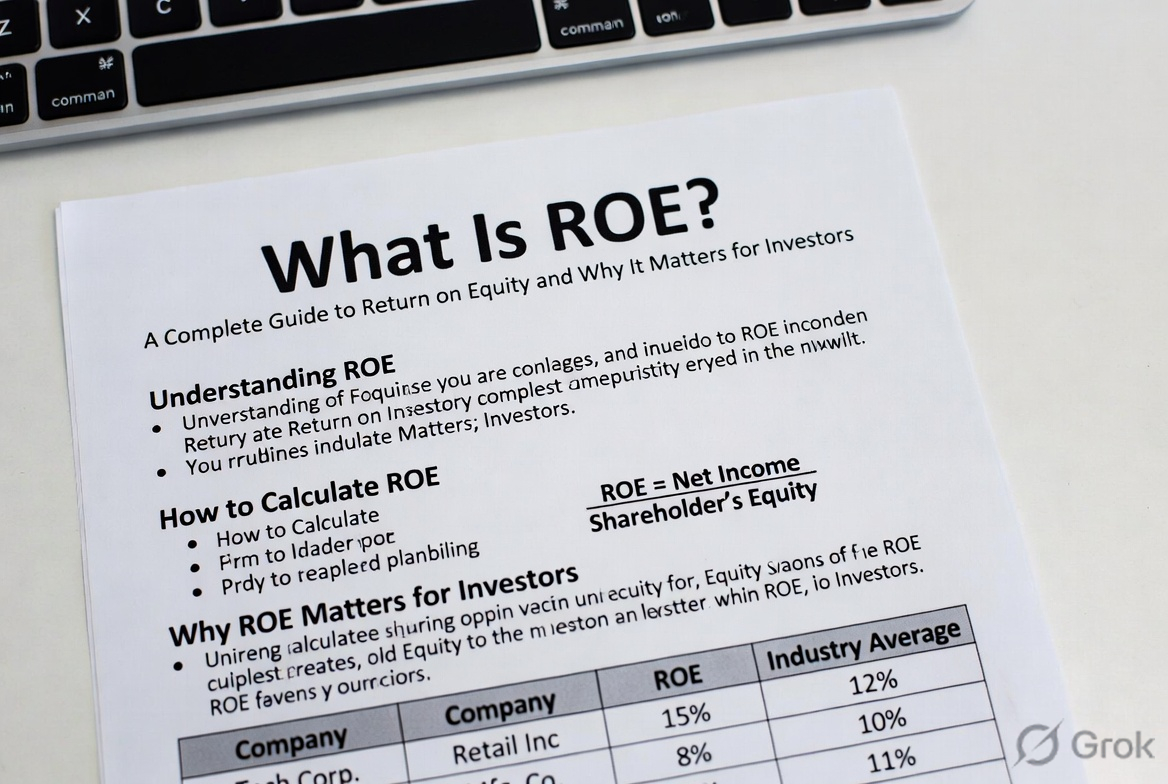
Some companies turn every dollar of shareholder money into steadily growing wealth. Others spin their wheels for years. The difference often comes down to one number.
Two businesses both enter into business with one million dollars each from outside sources. One company generates two hundred thousand dollars more in profit than the other. Although both companies had the same initial investment, the amount returned in profit cannot be compared because of the difference in the profitability of each entity.
The ratio of profit earned by the company to the amount invested in the company by its shareholders is called Return on Equity or ROE. This return on equity effectively shows the investor how effectively the company's management has utilised its capital to create profit for itself and its shareholders through operating results.
Return on Equity serves as a tool for investors to answer one question: "Is this company doing good things?" The rest of this guide will explain the meaning and application of ROE and provide guidelines on the proper use of ROE to facilitate investing decisions based upon your investment strategies and objectives.
What Is ROE (Return on Equity)?
Return on Equity reflects the number of dollars earned in net income for each dollar invested by shareholders. Return on Equity is expressed in percentages, like other ratios, and higher numbers generally indicate that management has done more with what was provided to them.
ROE = Net Income ÷ Shareholders' Equity × 100
A corporation with $20 million of net income and a $100 million of equity will generate 20% return on equity (ROE). In comparison, a company's REO with the same earnings of $20 million and $200 million of equity would be only 10%. Therefore, both companies generate the same amount of profit. However, the corporation's equity returns will be twice as efficient as its competitors.
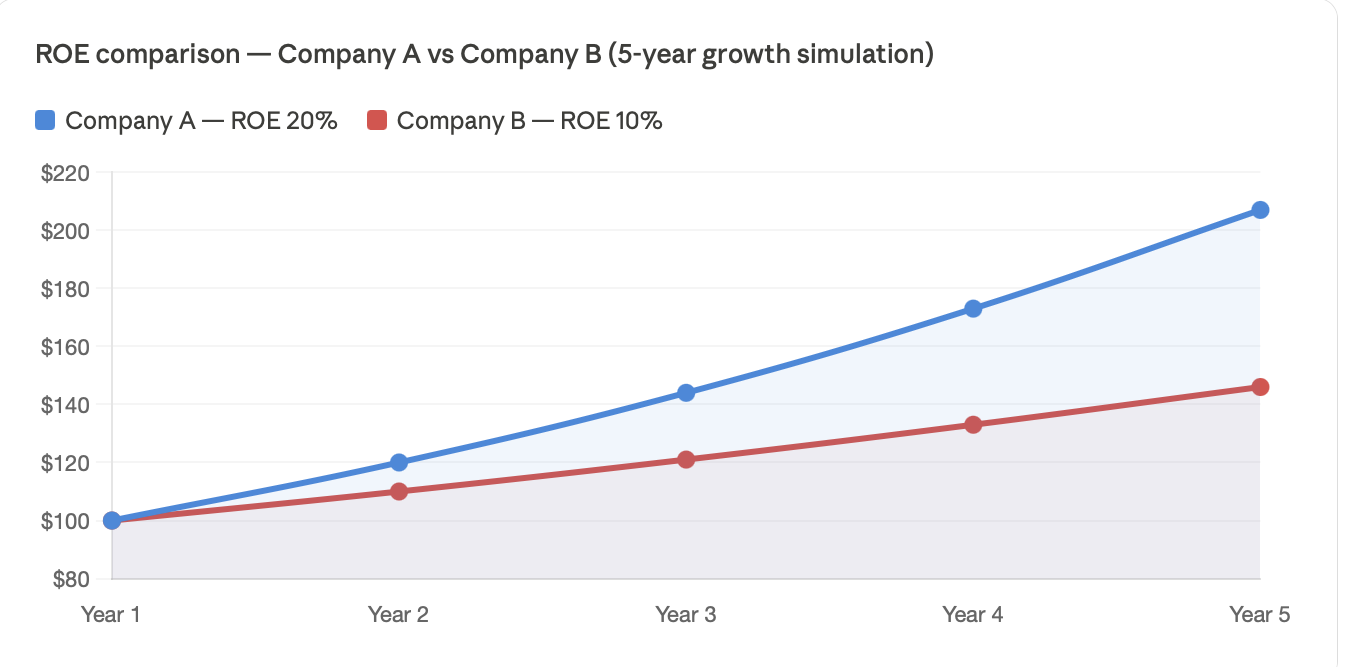
As time goes on, this gap increases exponentially. Companies that reinvest their earnings at a return on equity of 20% will build equity faster than those with a return on equity of 10%. This is one reason Warren Buffett has always preferred investing in companies with high returns on equity over the long-term instead of companies with high returns on equity for only a single quarter.

Breaking Down the ROE Formula: Three Drivers Behind the Number
A single ROE number can mask multiple different stories. For example, both companies can generate 18% ROE, but one is doing it from profits and another from volume; this is where we use DuPont Analysis, which breaks down ROE into its 3 parts and shows each company’s contribution to the total return.
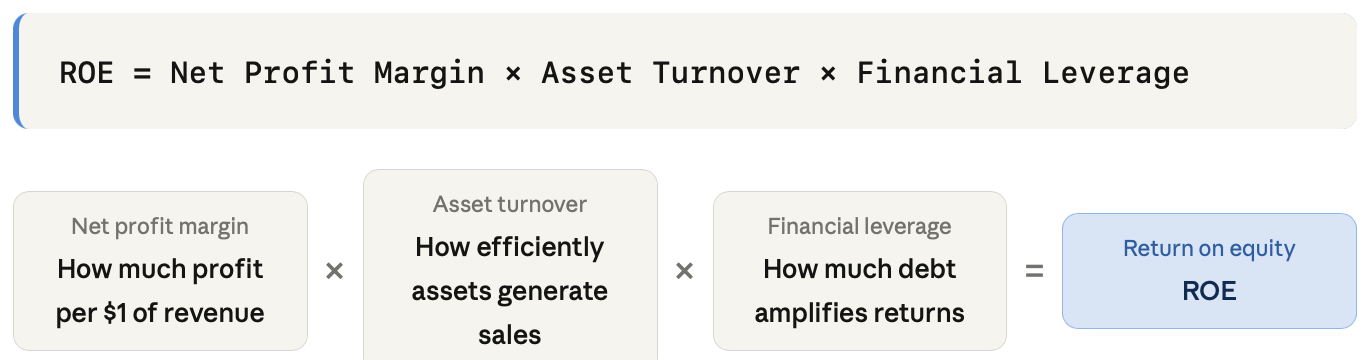
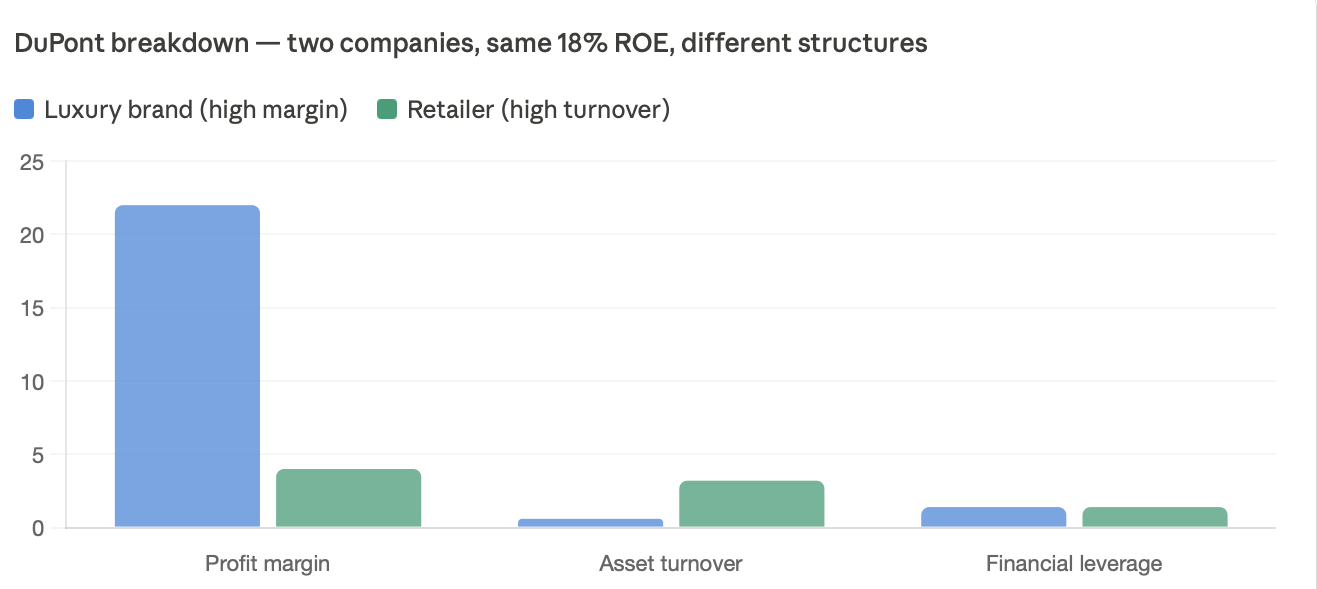
A luxury merchandise business can attain 18% return on equity via high profit margins; the volume of items sold will be much lower while generating much more revenue per unit. A supermarket could achieve a similar ROE using volume and extreme asset turnover. Understanding what influences ROE will provide insight into how to assess the quality of the business and how long the returns will last.
Why ROE Matters: The Key to Long-Term Investment Success
ROE is essentially the measuring tool for compounding. An organisation that consistently generates a higher ROE and reinvests those profits will compound its equity base at a greater rate over time, thus generating more profits as well. This is the same compounding "flywheel" effect that long-term investors are after.
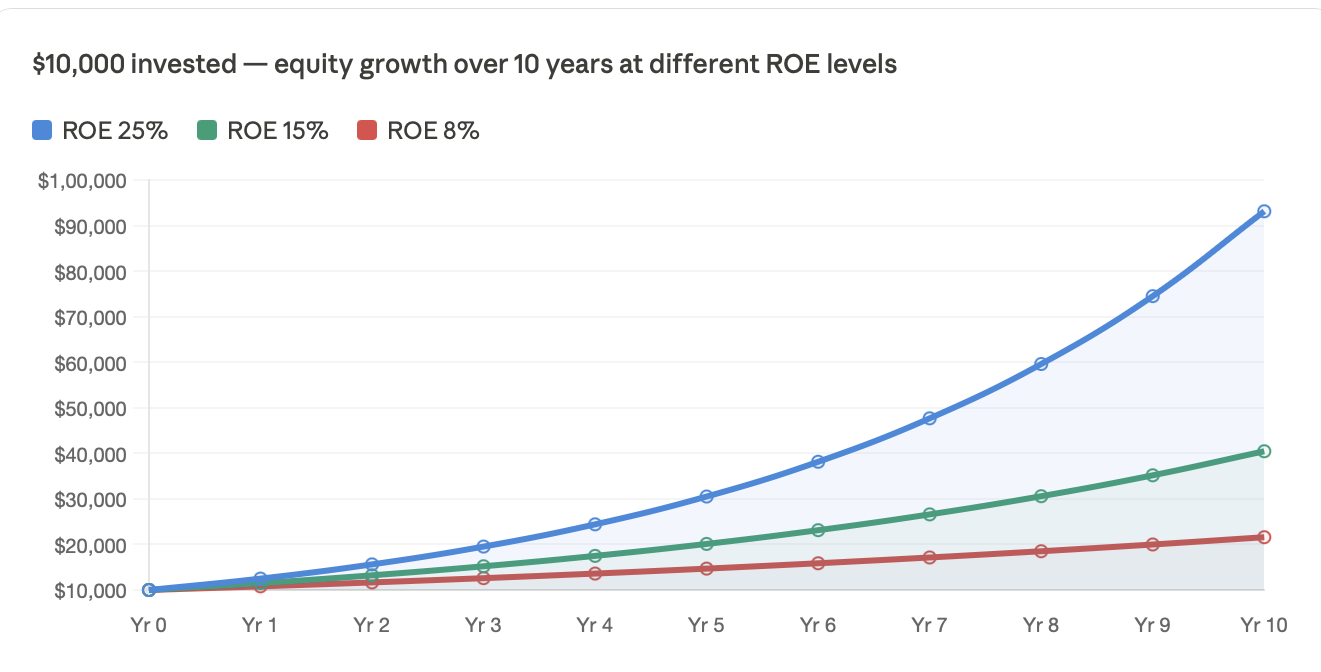
According to multiple independent research studies, it is possible to establish that a high ROE will typically produce superior returns than the popular equity market calculated over timeframes of Multiple Years. Simple: When a business generates 20% ROE annually, meaning it will approximately double an investor’s capital in a three to four-year period, the stock market will eventually reflect these economics by marking up the value of that share price.
ROE serves as a quality measurement for an organisation. In addition, companies that can efficiently use their invested capital can grow their business without the need to issue subsequent shares of stock that dilute existing shareholders’ investments, or without incurring excessive amounts of debt with the capital they borrow to fund the growth of their business. These businesses are generating their own fuel.
Is High ROE Always Good? Common Mistakes Investors Make
Not always — and this is where many investors get tripped up. A 30% ROE looks impressive on a screener, but it demands closer inspection before you act on it.
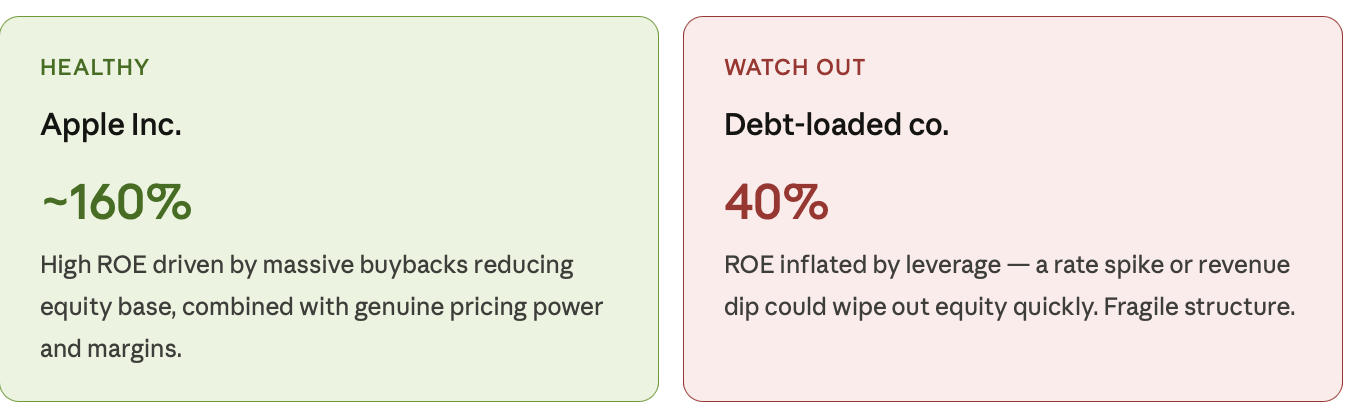
When looking at very high ROE, there are four red flags to note. Having a lot of debt can make equity smaller than it really is, leading to an inflated ROE. Therefore, you should compare a company's debt-to-equity ratio and its ROE.
One-time asset sales or tax benefits can create a spike in net income for that one year only, so you should analyse the company's ROE over a time period of at least three to five years, not just at a given point in time. Lastly, accounting methods related to how the company recognises depreciation and revenue can also create discrepancies in the financial statement.
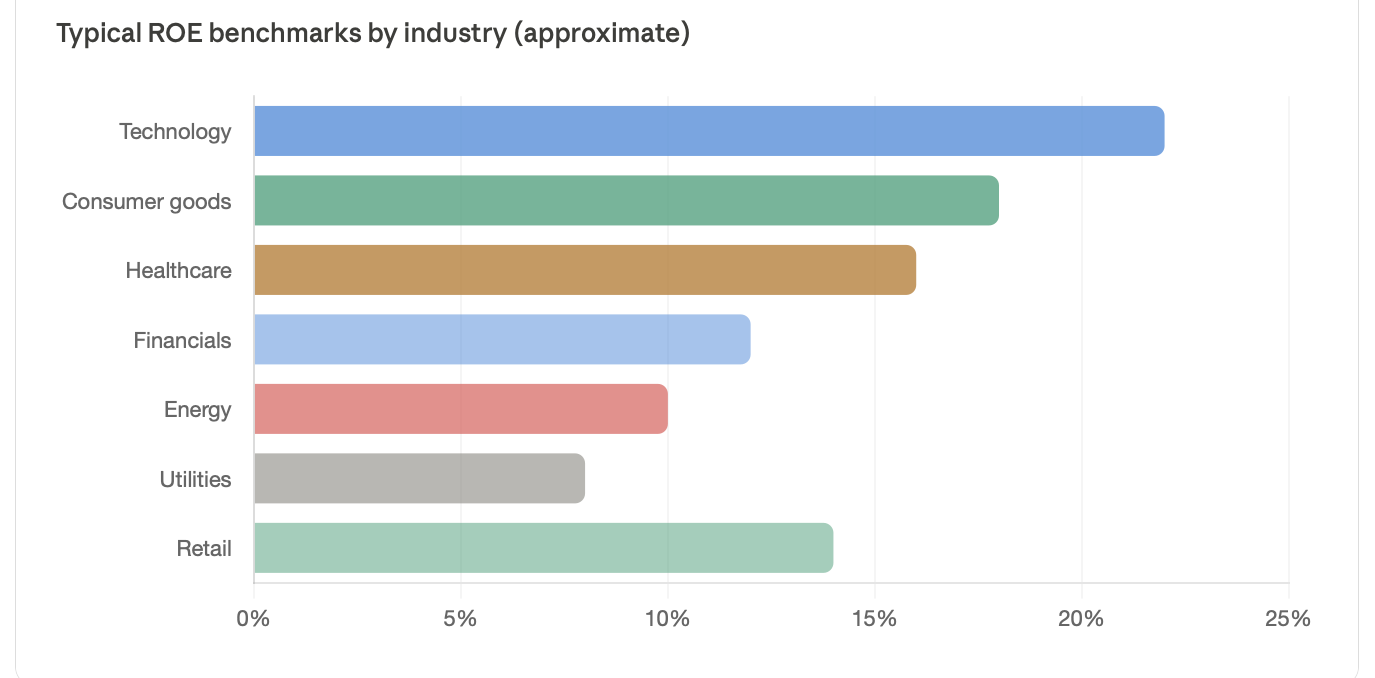
When comparing businesses, it is important to look at where those companies are within their given industries. Banks typically enjoy 10% - 15% ROEs and are considered to be operating strongly as a result. Technology companies generally need 20% + ROE in order to be viewed as strong businesses. Retailers should not be compared to software businesses because their ROEs are as different as apples and oil rigs.
How to Use ROE in Stock and CFD Trading
The performance of an investment cannot be evaluated in isolation from other factors. The best investors evaluate their options by using additional indicators, such as fundamental and technical analysis, before making an investment decision.
If you want to know if the quality of a stock has been factored into its market value, you can compare the stock's ROE to its Price-to-Earnings ratio. For example, a company with a high ROE that is trading at a P/E ratio of 35 may be overvalued or may be fairly valued for its performance. To determine whether or not the company's performance is due to business growth or to financial engineering, you could compare the stock's revenue growth against the stock's ROE.
CFDs provide traders with a different use for the ROE indicator. Since CFD trades are typically of short duration, ROE is used by traders as a filter for quality companies and not as a pure price or performance indicator when making trade decisions.
Traders can create a watchlist of strong companies based on their ROE ranking, and then use technical indicators such as chart patterns, momentum, and volume to time their entries and exits into those stocks. By trading high ROE stocks that also have strong technical indicators, you have more confidence in the performance of that stock than if you were judging it solely based on technical or fundamental data only.
Using ROE filters keeps your trading positions in fundamentally strong companies. By using technical analysis, you will be able to determine the best time to enter or exit a position. By combining ROE filters and technical analysis, you will decrease the risk of holding a declining business or trying to chase" after a fundamentally weak business that is 'breaking out".
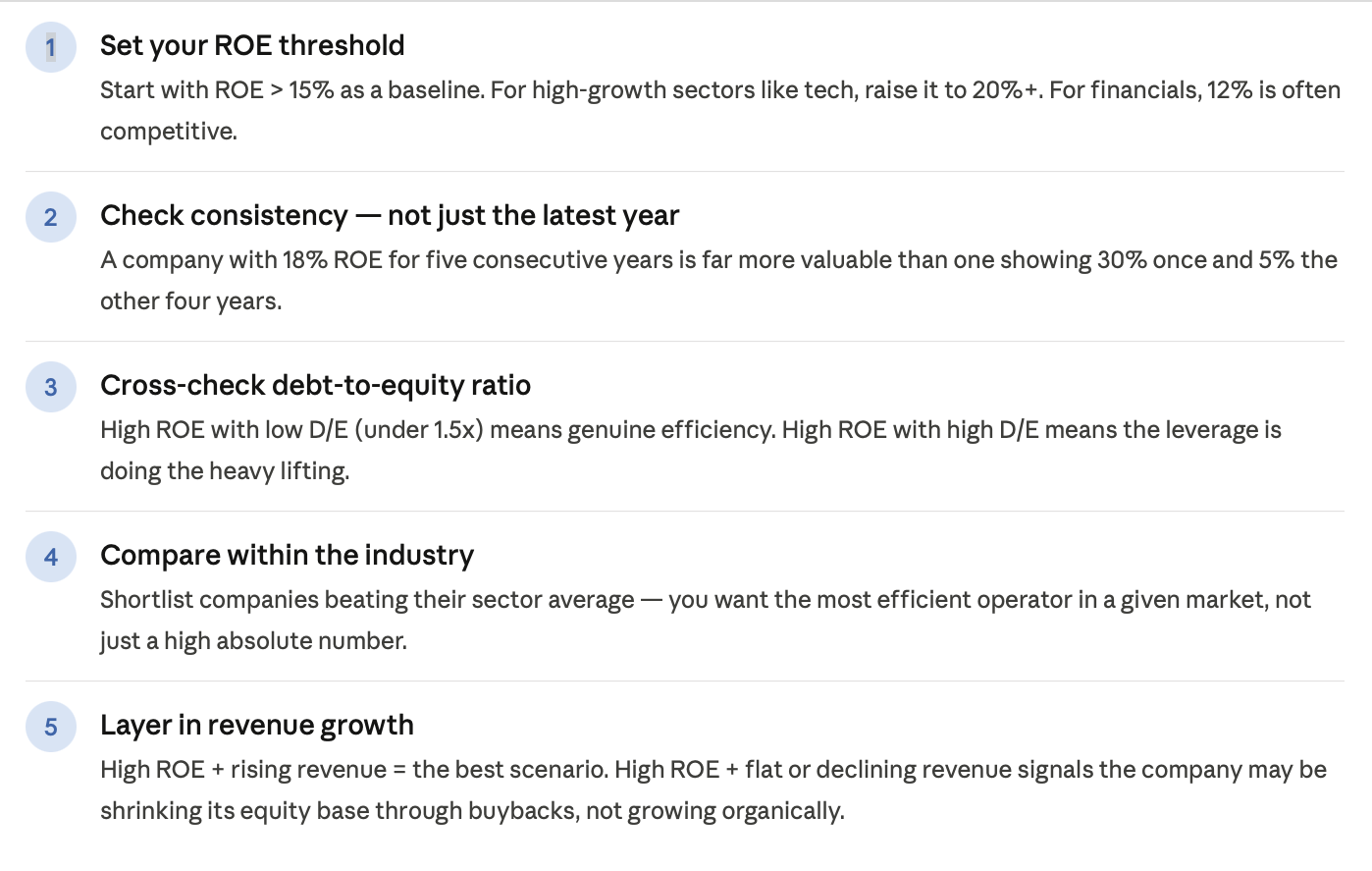
How to Find High-ROE Stocks: A Practical Screening Strategy
Screening for high-ROE stocks is more art than science; the filter is the start, not the finish line. Here's a reliable step-by-step approach.
How to Analyse ROE on TradeWill for Smarter Decisions
TradeWill's trading platform allows you to view both price charts and fundamental metrics together, so that as you develop your trading thesis,s you do not have to flip through your various trading tools. Here, we review how to incorporate ROE into your analysis using the TradeWill trading platform.
On the TradeWill trading platform, find a stock CFD that you're considering trading and go to the fundamentals tab. You will see ROE listed alongside net income, total equity and a five-year trend - this trend is the important data point. A stock's five-year trend of increasing ROE vs a stock that has flat or decreasing ROE in the five years can be very different, even if the current ROE of both stocks' five-year ROE is greater than 15%.
While on the fundamentals tab, when you have confirmed that there is a specific high ROE stock, flip to the technical candlestick price chart and find price action that confirms that the market is now aware of the good ROE: a breakout above a major resistance line, high volume on the earnings announcement day or a moving average crossover. When you have both a strong fundamental stock and a technical confirmation, you have a potential "high probability" trading opportunity.
You can also set alerts on the TradeWill trading platform for price levels and when a company's fundamental statistics change, so that you do not have to continually monitor the stock for high ROE before it has a significant price increase.
Frequently asked questions about ROE
What is a good ROE?
For most industries, anything above 15% is considered strong. Tech companies often run above 20%, while banks and utilities operate at lower thresholds. The key benchmark is outperforming your sector average consistently.
How is ROE calculated?
ROE = Net Income ÷ Shareholders' Equity × 100. Both figures come from a company's financial statements — net income from the income statement, shareholders' equity from the balance sheet.
Why is ROE important for investors?
ROE tells you how efficiently a company converts shareholder capital into profit. Businesses with consistently high ROE tend to compound wealth faster over time, which is ultimately what long-term investors are after.
Can ROE be misleading?
Yes. Heavy debt can artificially inflate ROE by shrinking the equity base. Share buybacks have the same effect. Always check the debt-to-equity ratio alongside ROE, and look at trends over at least three to five years rather than a single year.
How do traders use ROE in CFD trading?
ROE acts as a quality filter — it helps traders build a watchlist of fundamentally strong companies. They then layer in technical analysis to time entries. Combining both signals reduces exposure to deteriorating businesses and improves overall trade quality.
Stop guessing. Start with companies that actually earn their keep.
Screen for high-ROE stocks, analyse their fundamentals, and trade CFDs — all in one place on TradeWill. Your edge starts with better data.
Disclaimer: The content of the blog does not represent any position of Trade W, does not serve as any trading-related decision advice, and does not endorse any third-party.