

 Trade W
Most traders detest the sensation of going to sleep with an open trade or position. The anxieties that arise at 2 a.m. when you find yourself reaching for your phone to see how your position has fared since the market closed are exactly what scalping removes from the equation. Each scalping transaction takes place within just a few minutes (and in some cases, just seconds), meaning that every trading session is complete and flat. By extension, so too is your opportunity for loss during that time.
This is precisely why scalping is attractive. In 2026, increasing global volatility, especially in cryptocurrencies, has made the current day’s trading results increasingly difficult to read. For example, on just one piece of Fed news, Bitcoin has swung by $500 in a single minute. On just one CPI report, gold has gapped by 30 ticks. Furthermore, what appears to be a sideways chop on 1-day charts is, in fact, comprised of multiple tradable micro-waves visible on the 1-minute charts of those same stocks. The scalper thrives on that market “noise.”
In this guide, you will learn: how scalping works; how the mechanics of the bid/ask spread function; how to calculate the leverage needed to convert a 0.01% price change into a usable profit margin; and three real examples of setups utilised by professional traders to profit through scalping. Each example also contains an explanation of why most individuals who attempt scalping do so unsuccessfully and, finally, what kind of platform is needed for scalping to work effectively.
How scalpers actually make money: the bid-ask spread
The first step in implementing a fast-trading strategy is understanding how scalping generates profit through mathematical principles tied to the continuous gap that exists between two prices. These two prices are referred to as the bid and the ask. The bid is the highest price a buyer is willing to pay for an asset, while the ask is the lowest price at which a seller is willing to sell it.
In liquid markets such as currency pairs, the gap (or spread) between the bid and ask prices is generally very small. In illiquid markets, however, such as stocks in small-cap companies, the spread can become so wide that you may lose more to the spread than you would gain from executing a fast trade.
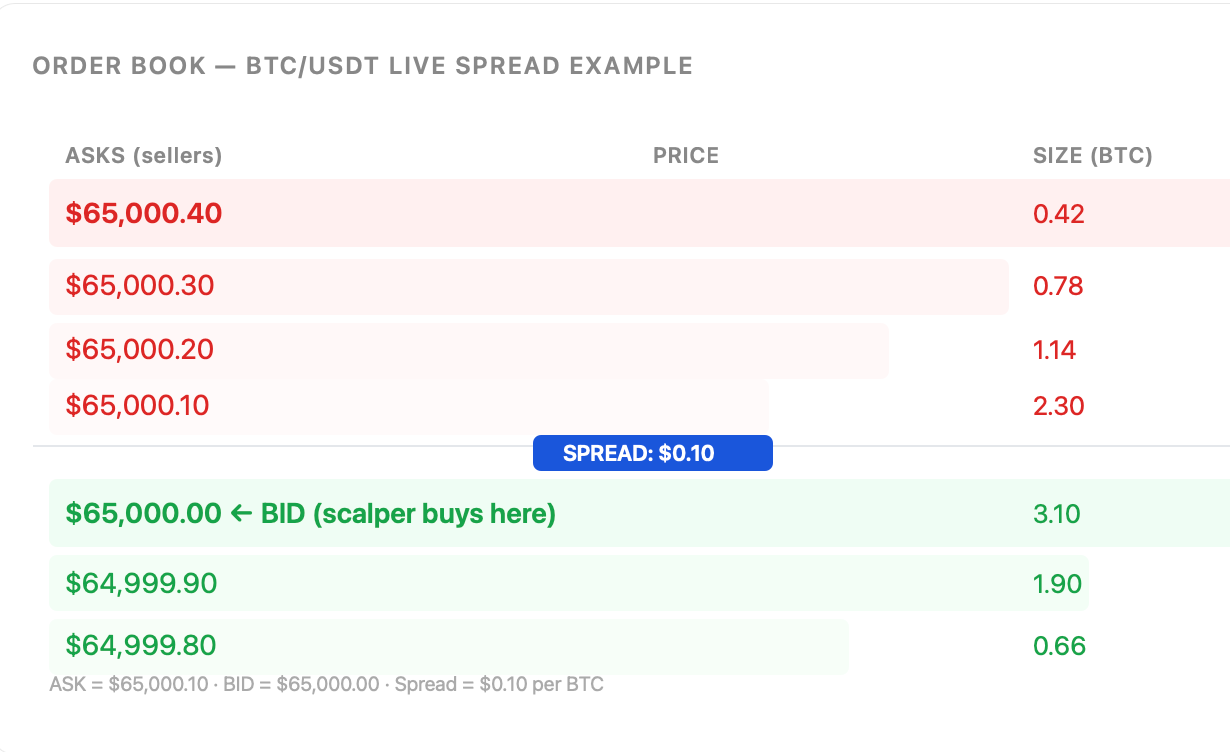
A Bitcoin/USD scalper sets a limit buy order on the USD/BTC order book (bid) at $65,000. He buys some coins, fills his order, and then immediately places a limit sell order on the BTC/USD order book (ask) at $65,000.10. The combination of BTC bought and sold generates $0.10 in profit after the purchase and sale of one BTC, resulting in a total profit of $4.00 from 40 trades per day.
Think of it as buying sneakers, a pair of Air Jordans on sale today for $100. Another person is willing to buy them from you for $102. In order for you to sell the sneakers for that amount, neither of you needs to wait for the sneakers to be worth $300; both of you simply need to be under pressure to act at the same time. This is essentially what a scalper does.
The only way to scalp effectively is to do so in an actively traded and liquid market. In a liquid and thinly traded market, slippage (which means receiving a worse fill or being executed at an unfavourable price) will eat into your profits before you can even close the position. Generally speaking, scalpers focus on USD/BTC, major FX pairs, and gold during periods of highest trading volume.
Market depth is also important. You want to see large order sizes in an exchange’s order book at each price level. This allows your order to be filled at the exact price you want, rather than two ticks away from your intended entry or exit. The liquidity of crypto markets in the future should be able to support this level of depth, particularly during periods of high trading volume in the US and EU markets.
High-leverage scalping in CFDs: the 1:500 multiplier
The inconvenient reality of scalping small market fluctuations is that, without leverage, the actual returns are negligible compared to the time required to earn them. If you have a $1,000 trading account, a 0.01% move would yield just $0.10, hardly enough for someone to quit their job. The introduction of leverage into the equation provides a solution to the mathematical limitations surrounding scalping.
For example, the availability of 1:500 leverage through CFD brokers can transform that same 0.01% move into a return equivalent to 5% of the trader’s margin on a 10-tick move in gold. This is what makes scalping a realistic option for many retail traders.
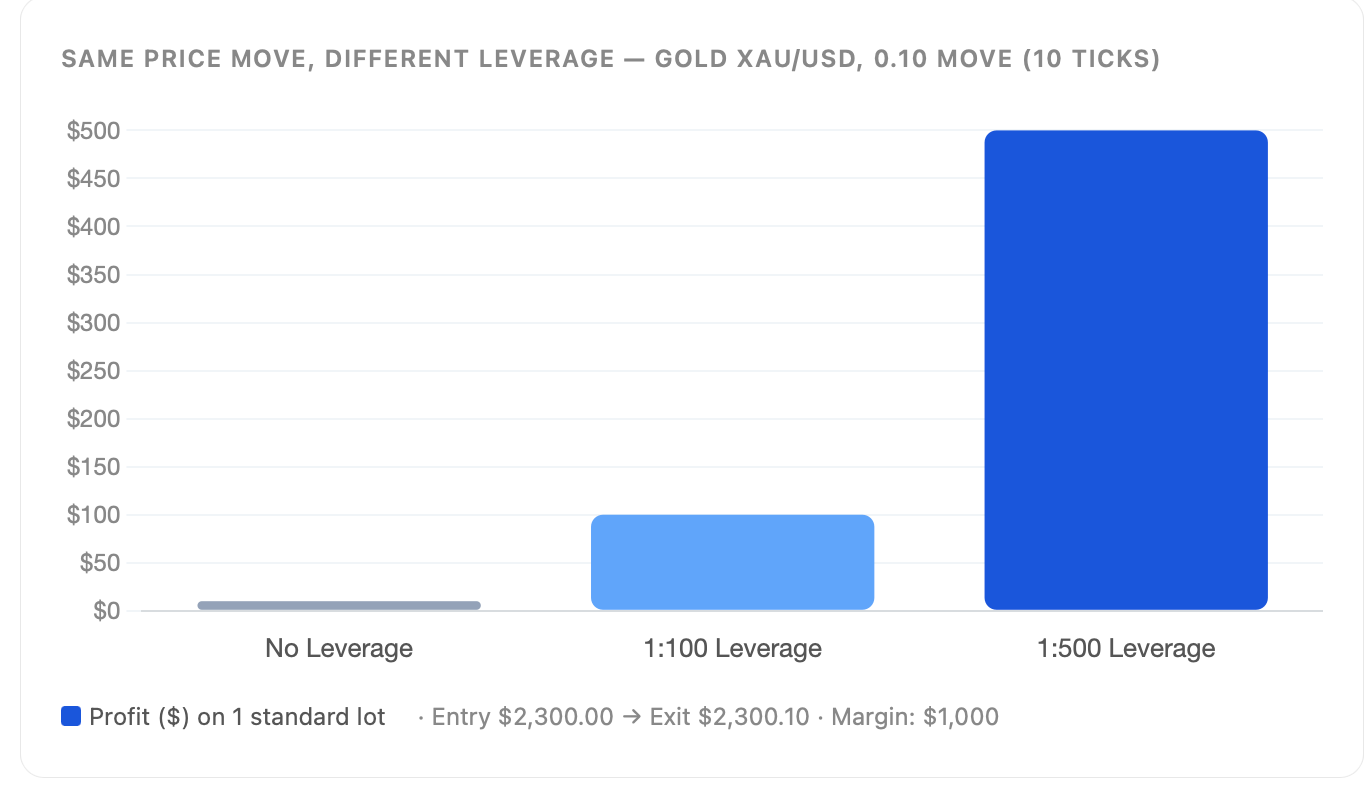
Trading gold involves a relatively simple mathematical calculation. If gold moved from $2,300 to $2,300.10 (10 ticks), you would make a $1 profit at 1:1 leverage with a $1,000 deposit. At 1:100 leverage, you would make approximately $100. At 1:500 leverage, you would make $500 from that same small price movement.
The bicycle analogy is useful because leverage is similar to a gear ratio. You would not have to push the pedal very hard to get the wheels spinning quickly if the market made a small but rapid movement in your favour. However, if you were climbing a hill in a high gear and the price moved against you, you would crash just as hard. For example, if the market moved $500 against you at 1:500 leverage, your entire $1,000 margin could be wiped out.
One pip in EUR/USD is worth approximately $10 per standard lot. Gold (XAU/USD) trades in 10-cent ticks, and each tick on a standard lot is therefore worth $1.00. If you had a trade open in EUR/USD and the price moved by 5 pips at 1:500 leverage, you would earn a profit of $50 on a margin commitment of just $20. If you placed 10 trades per hour, you can begin to understand why many professional traders view latency as a primary edge in this style of trading, rather than market direction itself.
When trading in this manner, negative balance protection becomes critically important. Certain events, such as the release of a CPI report or a Fed rate announcement, can move the price of gold by $5.00 within seconds.
Top 3 pro-level scalping setups
These strategies are not theoretical concepts taken from books. They are used by professional traders every day on 1-minute and 5-minute charts, and each has a specific logic behind it.
A. 1-Minute EMA Cross (Trend-Following)
This strategy uses three EMAs: the 9-period EMA, the 20-period EMA, and the 200-period EMA. The 200 EMA acts as the directional filter. If the price is above the 200 EMA, you only take long trades. If the price is below the 200 EMA, you only take short trades.
The entry signal is triggered when the 9 EMA crosses above the 20 EMA while the price remains above the 200 EMA. This approach helps prevent trading against strong market trends.
Your stop loss should be placed below the 20 EMA. The target should generally be 1.5 to 2 times your risk.
B. Stochastics + Bollinger Bands (Contrarian)
This is a mean-reversion strategy and represents the opposite philosophy of Strategy A. Instead of following momentum, it attempts to capture overextended price movements returning to the mean.
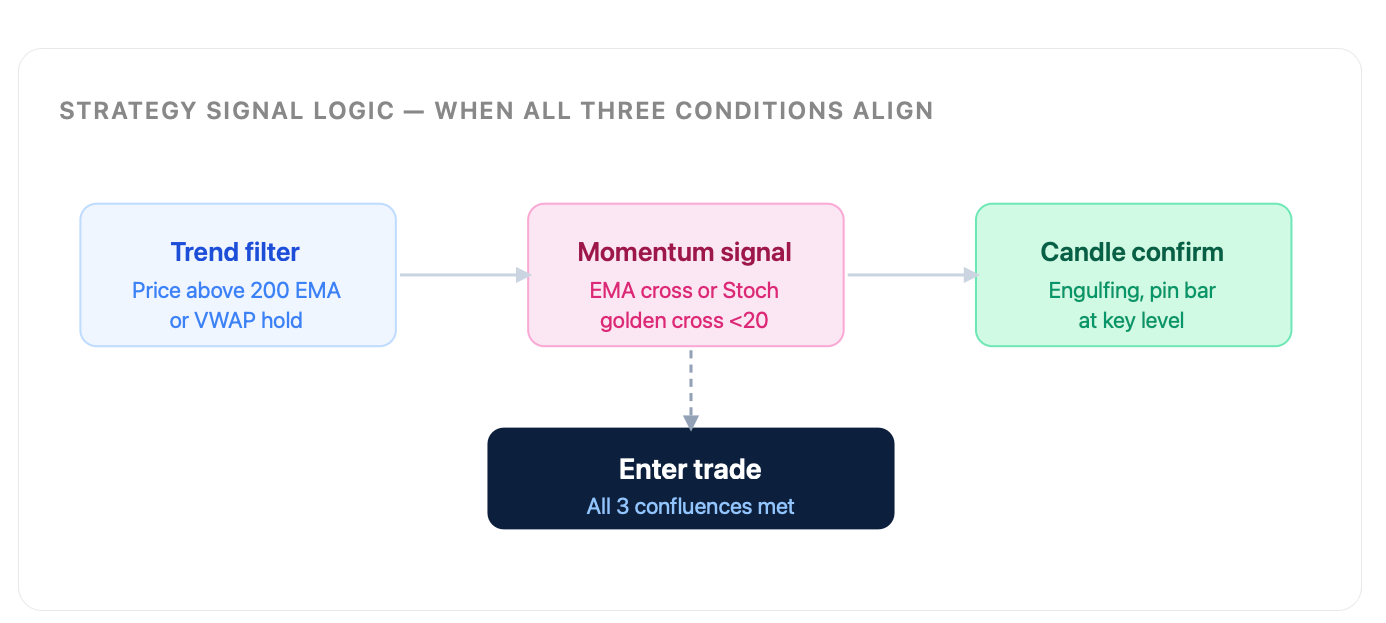
Wait for the price to touch the lower Bollinger Band while simultaneously checking for a bullish crossover on the Stochastic oscillator (14,3,3). The Stochastic will often cross below 20 at roughly the same time the price touches the lower band, suggesting that price may be statistically overextended and likely to revert toward the mean (the middle Bollinger Band).
If you also observe a bullish candlestick pattern such as a bullish engulfing candle or a pin bar at or near the lower band, you then have three converging signals indicating a potentially high-probability trade.
A similar analysis can be applied to short trades by using the upper Bollinger Band and looking for a bearish crossover on the Stochastic above the 80 level.
C. VWAP Scalping (Institutional Anchor)
When it comes to institutional order flow, the VWAP (Volume Weighted Average Price) is often where the majority of large firm orders are concentrated. A large institution that has accumulated a position either below or above the session VWAP pays close attention to that level. Therefore, when price retraces back to VWAP after trading above it, a clear rejection or bounce from VWAP can create a textbook long scalping setup. The rejection at VWAP signals potential continuation in the direction of the prevailing trend.
Additionally, as price approaches VWAP from above, volume should generally decrease during the pullback and then increase again once the market bounces from VWAP. This shift in volume helps confirm that buyers are stepping back into the market.
This setup is common on 5-minute cryptocurrency charts, especially during the New York session open. It does not require complex indicators beyond VWAP and volume confirmation. In this case, less is often more.
Refer back to the analogy of a person stealing the basketball: you are not waiting for the clock to run out; you are watching for the exact moment your opponent loses control of the ball. Similarly, in trading, you are looking for the precise moment when momentum begins to shift. The Stochastic crosses below 20, the price touches the Bollinger Band, and volume begins tapering off. Once you recognise the market’s slip, you must act quickly. Hesitation often means the opportunity is already gone.
Why do 90% of scalpers blow up
The number-crunching is the easy part of trading. Where traders fail is in the area of mental and emotional limitations. Making 50-plus trades in a day can mentally drain you to the point of exhaustion, something you won't truly understand until you do it.
Each trade you make only has two choices (buy or sell, hold or close), but when you add up those small decisions made under extreme time pressure, what you find is that you will have made 50 small decisions by the time the market closes. Trading can lead to cognitive fatigue and, in the long run, will affect your judgement in the afternoon session. Many of the trades you would not take in the morning at 9 amm look good to you in the afternoon at 3 pmm.
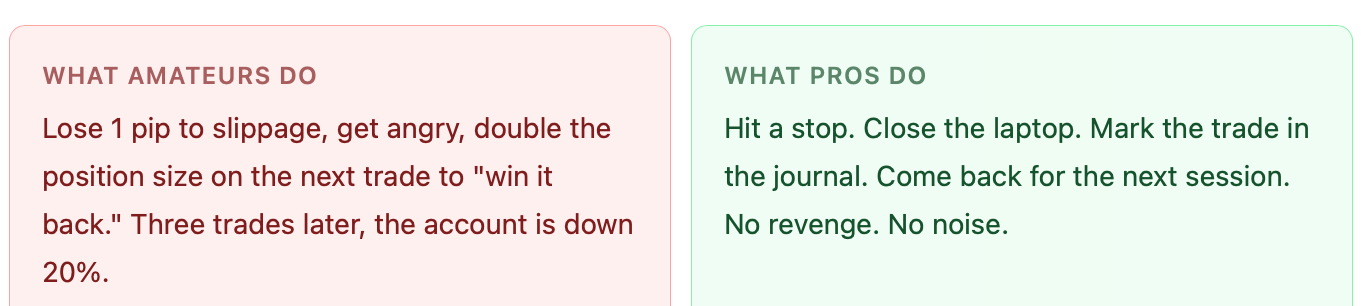
One of the reasons so many traders blow out their accounts is revenge trading. You lose a trade, and instead of viewing it as a statistical outcome, your mind reframes it as an injustice, and you make a larger trade to prove that you can do it better than before. This creates a psychological trap that consumes experienced traders as well as beginners.
Prior to each trading day, write down three things: your maximum daily loss, so you will know to stop trading if it reaches that point, your maximum number of trades you will make in a day, and what specific setups you will use for making trades. Post these on your screen for each trading day. The reason you are writing down this information is that when you have a bad day or a number of bad days, you can reference them and do better the next day than you did before. Having reference points and reminders of what happened prior to you stopping trading is a very important step in the trading process.
Your infrastructure: why the platform is not a footnote
There is no room for error with scalping. If your platform has a delay of 200ms, then your limit order will be filled at an inferior price. If the spreads widen due to high volatility, then you will get taken out of the trade before the market has even moved against your position. This is not theory. It has happened to countless scalpers. There are three things that count above all else when using a scalping platform. The first is execution speed. A millisecond or so is the expectation for order routing, not a platform that adds you to a queue on a loaded server before executing orders. The second point is the spread on the instruments you are trading. A platform with a 0.1 pip spread on majors would give scalpers an edge over a platform with a 0.5 pip spread. The difference between these two prices is your profit margin for short-horizon trades. Lastly, you need to have negative balance protection. Flash crashes during a CPI release, an ICO, or the delisting of a cryptocurrency can cause a movement of more than 3% of the asset value within 30 seconds. Therefore, if your leverage is 1:500, then you will have lost five times your deposit unless your account has negative balance protection. These events occur repeatedly multiple times each year. Test the speed of execution during an economic event before you deposit money with a CFD broker for scalping. You can do this by setting up a demo account and placing limit orders at the precise time of a major economic data release. If you are seeing consistent slippage in excess of 2 to 3 pips, then the broker is not built for scalping.
Frequently asked questions
What's the best timeframe for scalping?
One-minute and five-minute charts are the standard. Tick charts (where each bar represents a fixed number of transactions rather than a fixed time period) are more accurate but require specialised charting software. Start with one-minute charts. You can always graduate to faster timeframes once you've built consistency.
Can I automate a scalping strategy?
Yes, and plenty of traders do. Expert Advisors (EAs) in MetaTrader and custom bots via API can execute the mechanical entry/exit rules for setups like the EMA cross without the psychological friction. The challenge is building a bot that handles edge cases, like a news event mid-trade, as gracefully as a human trader. Automation removes emotion but adds engineering complexity.
How much capital do I need to start?
You can practice risk management and learn the psychological patterns with $50-$100 on a real account. The goal at this stage isn't profit; it's understanding how slippage feels, how fast decisions need to be made, and whether your mental framework holds up under live conditions. Scale capital only after you've demonstrated consistency in a journal over at least 100 trades.
Visit Tradewill. TradeWill gives you sub-millisecond execution, near-zero spreads on BTC and gold, and the negative balance protection that serious scalpers need on every trade.
Disclaimer: The content of the blog does not represent any position of Trade W, does not serve as any trading-related decision advice, and does not endorse any third-party.