

 Trade W

You had a great forecast for the market. Your prediction of where the stock would go was spot on with where it actually went. But when you went to your options account to review your trades, the account showed losses. If that's something you've experienced before, you're not alone in this world. The reason for these losses has a name, and that name is Theta Decay.
Knowing the reasons why your successful predictions become unsuccessful trades can cost you thousands of dollars. Let's take a closer look at this invisible force that is removing value from your options positions daily.
What Is Theta Decay? Understanding How Time Erodes Option Value
As time passes, an option loses value, or "decays in time", according to the following formula: Theta Decay = (Premium of Option at Expiration - Premium of Option Now) / Total Days Remaining until Expiration.
Theta measures the rate of the value of an option at the point of expiration, which rests on the notion that as time passes, the fewer opportunities there are for an option buyer to see their potential returns and profit (Delta). Therefore, Theta measures the amount that an option buyer is expected to lose over each day between now and expiration (Buying call options gives the buyer the "right" to purchase the stock, but the buyer has no obligation).
The focus here is to show the important role that time value plays in determining the pricing of call options. As we noted, call options contain both intrinsic value and temporal/intrinsic value (which reflects time); thus, options pricing is affected by both intrinsic value as well as the time that remains until expiration.
For instance, if the price of Apple stock is $160 and if you bought a call option ("an option" means you can purchase the stock) at $150 for three days in the future, then you would have a theoretical intrinsic value of $10 per call option.
We can think about time value as a "premium" that traders are willing to pay more than just the intrinsic value of an option due to the opportunity of achieving even better potential outcomes before the expiration of that option.
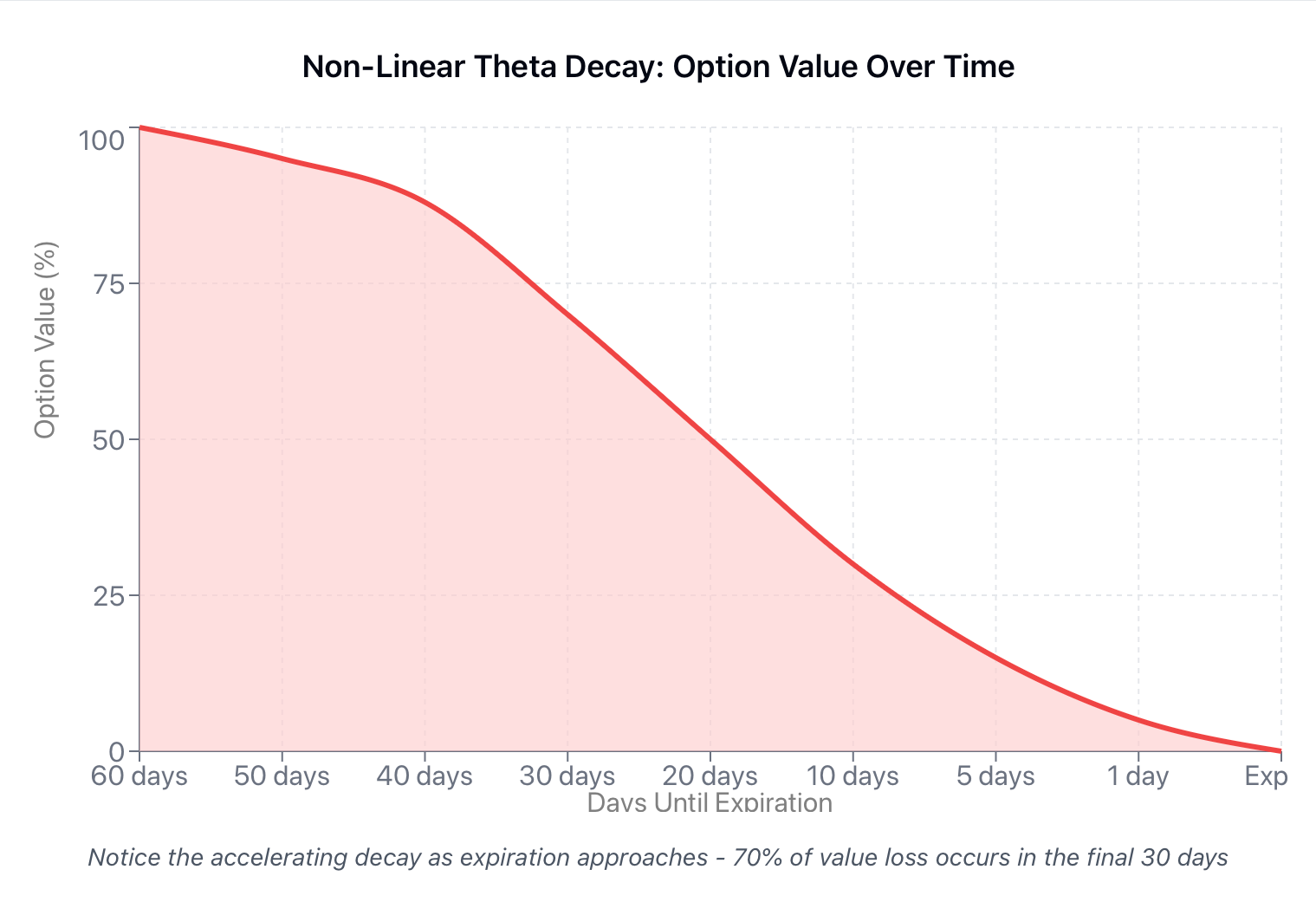
Time decay is the term used to describe how this time value decreases over time. As the expiration date approaches, the rate of decrease in time value increases accordingly. Further, this increasing rate of time decay creates a time decay curve that is initially very gradual, but becomes more steeply inclined as expiration approaches.
For example, if you choose to buy a long-term (ATM) SPY call option with a $5.00 price and -0.10 theta, meaning that, assuming everything else was constant (stock price and volatility), that option would lose $0.10 of value each day for the next seven days, resulting in a total of $0.70 loss of time value over one week, which is equivalent to $3.00 being lost based only on the time value component.
This means an option can lose approximately 60% of its value while the underlying assets do not move at all.
For you, as a newbie to the market, think about the movie ticket analogy. If you buy an advanced movie ticket three months in advance of the show, you can sell that ticket fairly easily at/near the price you originally paid for it because the buyer has so much flexibility about when to use it.
Now, if you try to sell that same ticket the day before the movie, its value will have dropped considerably because there is very little "option" available for them to use, due to the limitation of time. That is an example of theta decay.
All traders understand that this type of decay occurs due to mathematics. Many option/trading platforms will have a time decay curve chart to show how the option value will decay as time continues towards expiration.
Very few people understand or realize that it is not a linear decay; in other words, as an option is approaching the end of its lifecycle, it is not losing value at the same rate every single day but rather like at a slower decay early in the cycle to a very rapid decay later in the expiration cycle.
Real-world examples show how examples of non-linear decay naturally creates diminishing time value for every option very rapidly. For example, the 60-day ATM call option on AAPL, in the case above, where it is initially at a 30% time decay for the first 30 days, then has a 40% time decay over the next 20 days and finally has the last remaining 30% of its time value disappearing in the last ten days of the option's life. Most traders are surprised by this dramatic increase in the rate of time decay.
Theta decay provides an invisible cost to option buyers and must be overcome with favourable price movement. It is a certainty that each option buyer will bear it and is a guaranteed daily cost that occurs, at least to some extent, 24/5. Understanding theta decay is the first step in making better, more educated options.
How Theta Decay Affects Long Calls and Puts: Why Direction Alone Isn't Enough
A long call or long put is an upfront cost to avoid having to buy the value of a ticket is based on the idea that you can redeem the ticket anytime. As the expiration date approaches, the value of the ticket decreases because there will be no opportunity to redeem the ticket.
Theta's rate of depreciation occurs the same way on both calls and puts, for either bullish or bearish trades. Regardless of how much analysis you conducted on the stock, theta will degrade the value of your option every day. Therefore, you can think of theta as an unavoidable tax on your position.
For example, let's consider a SPY ATM call option that was just purchased. The first day after purchase has thirty days until expiration. On the first day, the optional price was $8.50, and the calculated theta was -0.08. After ten days, assuming SPY increased 1%, you expected to be profitable on the call option, but it sold for $8.20.
Why did this occur? SPY had increased $4.50, which accounted for approximately $4.50 of the option's value, but because theta eroded $0.80 (10 days * -0.08) and the implied volatility of the stock decreased approximately $4.00, the total was less than the expected value, even though you correctly anticipated the direction that the price movement would take.
Therefore, when trading options, it isn't just about predicting which way the market will go. You must also have enough directional movement in the market to replace both the theta drop and any other price drop that affects the time value of the option to profit. For example, as a call option, you must have enough movement from the current price to replace the theta erosion, and as a put option, you must have enough decline in the price for theta to become worth zero.
This is one reason that there is a high percentage of options that, at expiration, have no value. Approximately seventy-five per cent of all options will never be exercised, and a significant contributing factor is the depreciation caused by theta. Many times, traders will correctly predict the direction of the price, but they will not account for the large price movement needed to offset theta’s effects.
Why Correct Market Direction Doesn't Guarantee Profit: The Hidden Cost of Theta
Options trading can be frustrating for new traders for a number of reasons. After you've done your analysis on charts, done your due diligence on fundamentals, placed your wager on an option, and had price movement occur exactly how you anticipated, it's very disappointing to have to then watch your account balance drop or lose money altogether, especially since your price prediction turned out to be correct. Understanding Theta decay will help you understand why this happens and bridge the gap between prediction and actual profit.
Theta decay is the hidden cost of an option. When you purchase an option, you are not just purchasing a bet on the direction of the price of that underlying instrument, but also the magnitude of the change in price of that underlying instrument and the timing of that change.
For you to realise a profit or gain, the movement of the price of that underlying instrument must have enough movement to offset the theta decay that is lost every day, and also the price must move at a profit-generating pace for you to not be entirely eroded of your profits due to the time decay of the option.
All right, let’s start by examining the mathematics behind options pricing. Remember that option price consists of two separate components: intrinsic value and time value. The simplest way to determine the intrinsic value of an option is to determine what its value would be if it were exercised today.
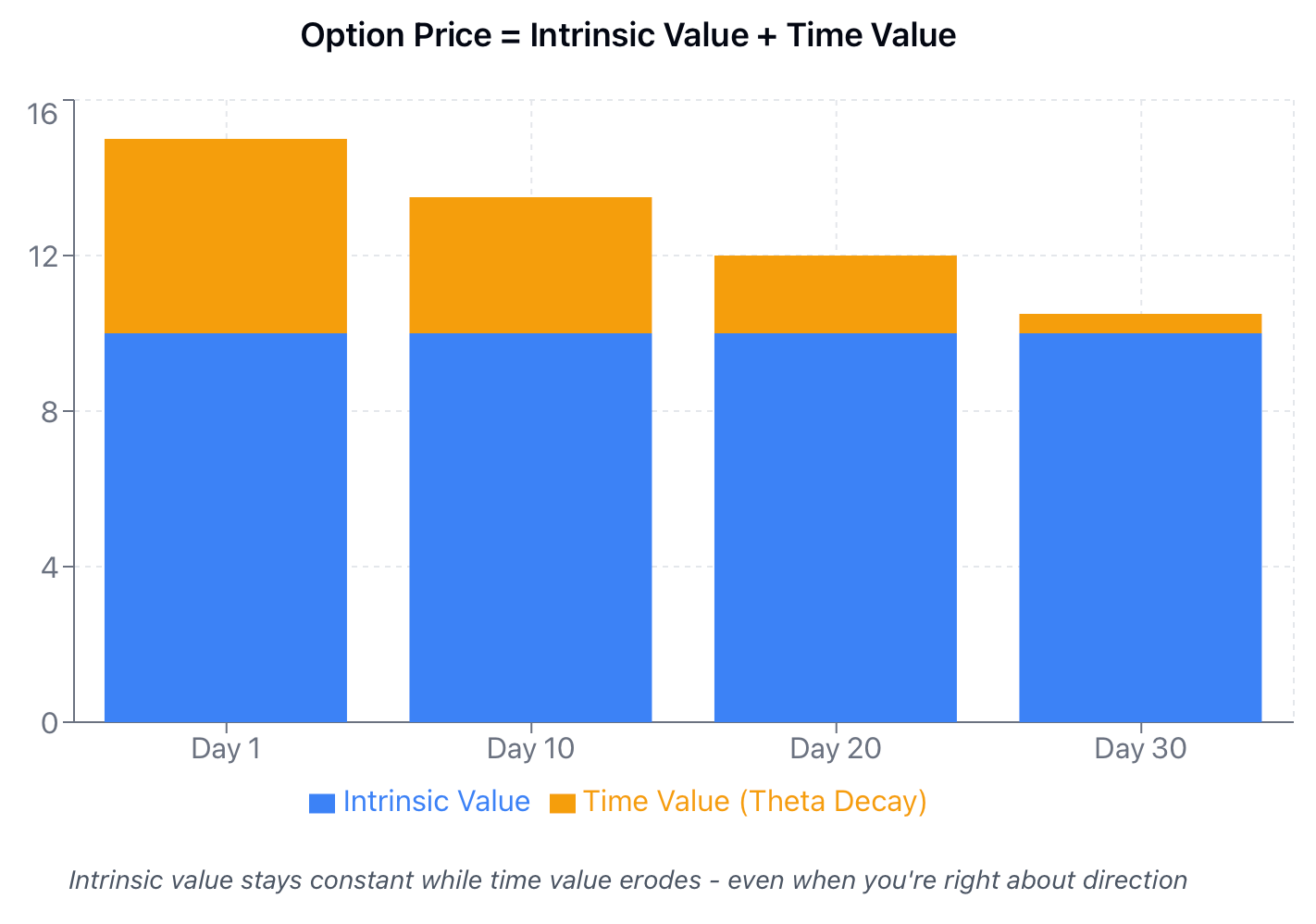
For example, a $150 call on a stock selling for $155 has a current intrinsic value of $5. Everything else you paid for this option represents the value of time that gives you a chance to have an even higher value than the intrinsic value.
As an option nears expiration, the time value does not shrink at a constant rate. Rather, the time value decreases at an increasing or accelerating rate. For instance, with 90 days to expiration, an at-the-money option can lose approximately 0.5% of its value each day. As it nears expiration, it could begin losing around 1% of its value each day or more!
Therefore, during the last week before expiration, that option might depreciate approximately 5% per day or possibly more. This increased rate of decay is also why many experienced traders often express increased theta risk intensifying after an option's expiration date.
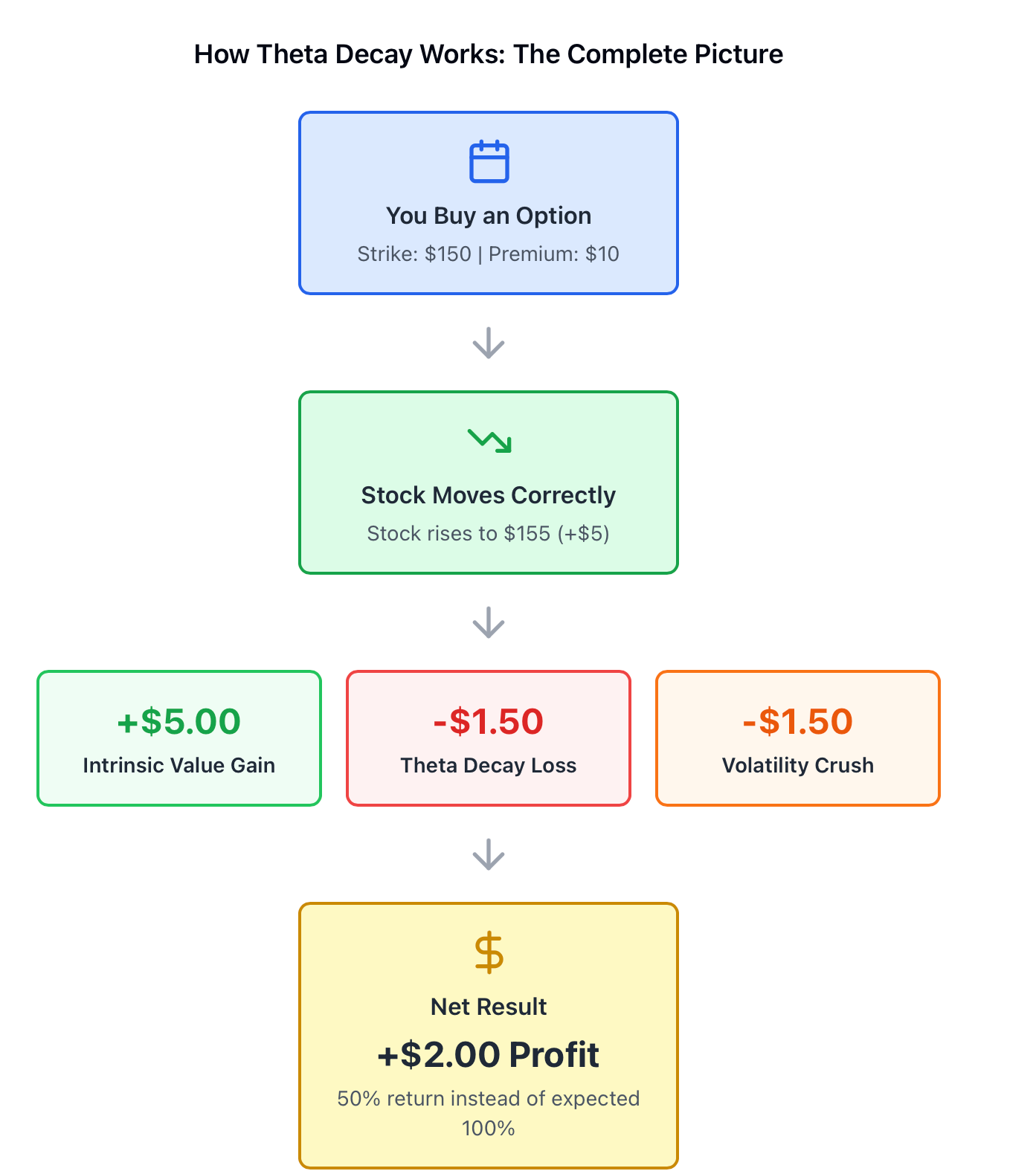
Now, let’s see what this means with an actual trade example. Imagine that you bought an at-the-money call option on the SPY ETF (an ETF tracking the S&P 500 Index) with a strike price of $480, and 10 days until expiration, for $4.00. That option has a theta of -$0.15.
Now, for the next 10 days, you might expect SPY to rise to $485 (1% increase). As SPY goes up, you would expect to make money. To understand how much you made, let’s calculate.
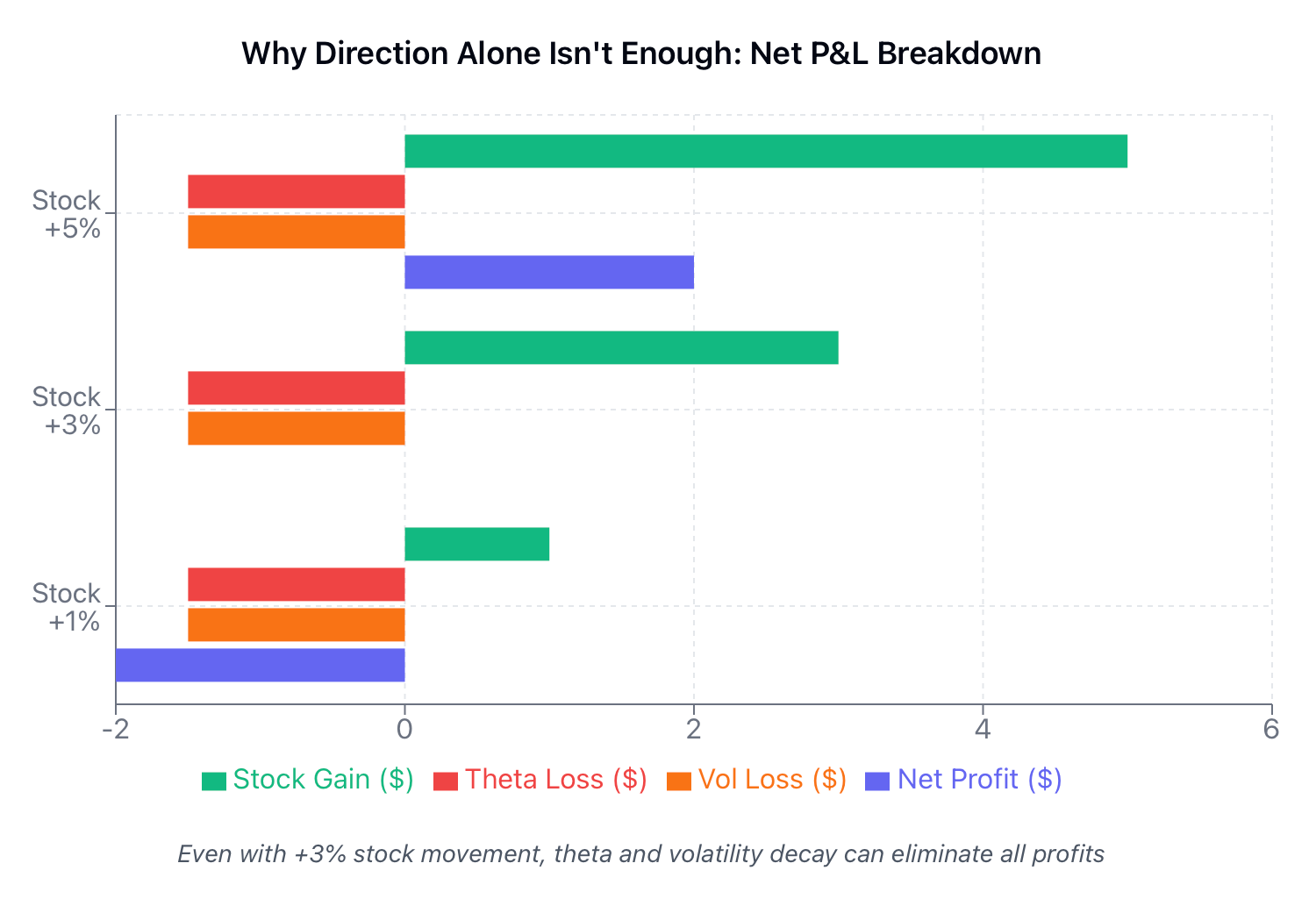
Your option gained intrinsic value because of the increase in the stock’s price by $5.00. However, during that same period, due to theta decay, your option would have lost approximately $1.50 worth of time value ($0.15 theta, multiplied by 10 days).
The value of implied volatility going from 15% to 13% would create an additional loss of approximately $1.50. Therefore, now your option trades at approximately $6.00. You paid $4.00 for it, so your profit/loss is approximately $2.00 or approximately 50%. Very nice, but a far smaller return than you expected from gaining the $5.00 in intrinsic value.
If SPY were to rise to $483 instead of $485, you would have gained $3.00 in intrinsic value but lost $3.00 because of theta decay or volatility. Therefore, you would have broken even or had a small loss even though you guessed correctly about the future direction of SPY.
To help you understand this concept as a beginner, think of it this way. You purchase a ticket for an event two weeks away. After you have purchased your ticket, a superstar player joins the team, which causes an increase in value for that ticket. However, as the date of the event approaches, the "flexibility" value also decreases.
By the day of the event, even though the team is now stronger, similar to stocks moving in your favour, your ticket may now be worth less or the same as you paid for it because the time value has evaporated.
Real-world trading data supports what I just described. Examining high-volatility, short-term ATM options on such stocks as Tesla or NVIDIA, there are situations where the price of the stock has moved 2% to 3% in the expected direction over a week, yet when you look at the price of the option you purchased, it has decreased in value. The movement of the stock does create intrinsic value; however, the loss of intrinsic value from theta decay and contraction of volatility is greater than the intrinsic value you gain from moving in the intended direction.
When you chart the stock price changes compared to the changes in the value of an option, there are large discrepancies. For example, a stock may go up 5% over three weeks after tracing a nice upward line on a price chart. In contrast, the line chart of the value of the call option may remain flat or continue declining due to theta decay consuming time value at a faster rate than the intrinsic value is being created.
Professional traders are obsessed with timing and often close out gaining trade positions sooner than they would typically do.
Traders understand that, should an option be held until expiration, they will incur theta decay every day and therefore, to prevent themselves from the accelerating theta decay risk in the last few days, they will more often than not take profits at 30-50% rather than waiting for all their intrinsic value to be extracted.
The danger of theta decay is compounded by its invisibility. When traders incur a loss due to the price of a stock moving against them, the reason behind that loss is easy to identify. However, when a trader incurs a loss despite being correct, that can be confusing and frustrating. Many traders attribute their lost opportunity to either bad luck or market manipulation, but fail to correctly attribute that loss to theta decay. Traders need to learn about this hidden cost to avoid the same disappointments in options trading repeatedly.
Practical Strategies to Manage Theta Decay
Options traders must grasp how theta decay affects positions when trading options. A trader's ability to manage and alleviate theta decay’s potential effects on their option helps relieve some trader frustration, thus maximising trader profits. Theta risk cannot be eliminated; however, there are ways for option traders to help offset theta decay's influence, both through their selection of strategy and the timing of their option purchase.
In comparing short-lived options to long-term options, you can see that all else being equal, the short-lived option will have a higher theta than the long-term option. For instance, if the price of an option, where weekly option prices at either option’s strike are equal, such as ($XX), then you would see that the weekly option has a theta of about -0.20 while the three-month option has an average theta of around -0.05.
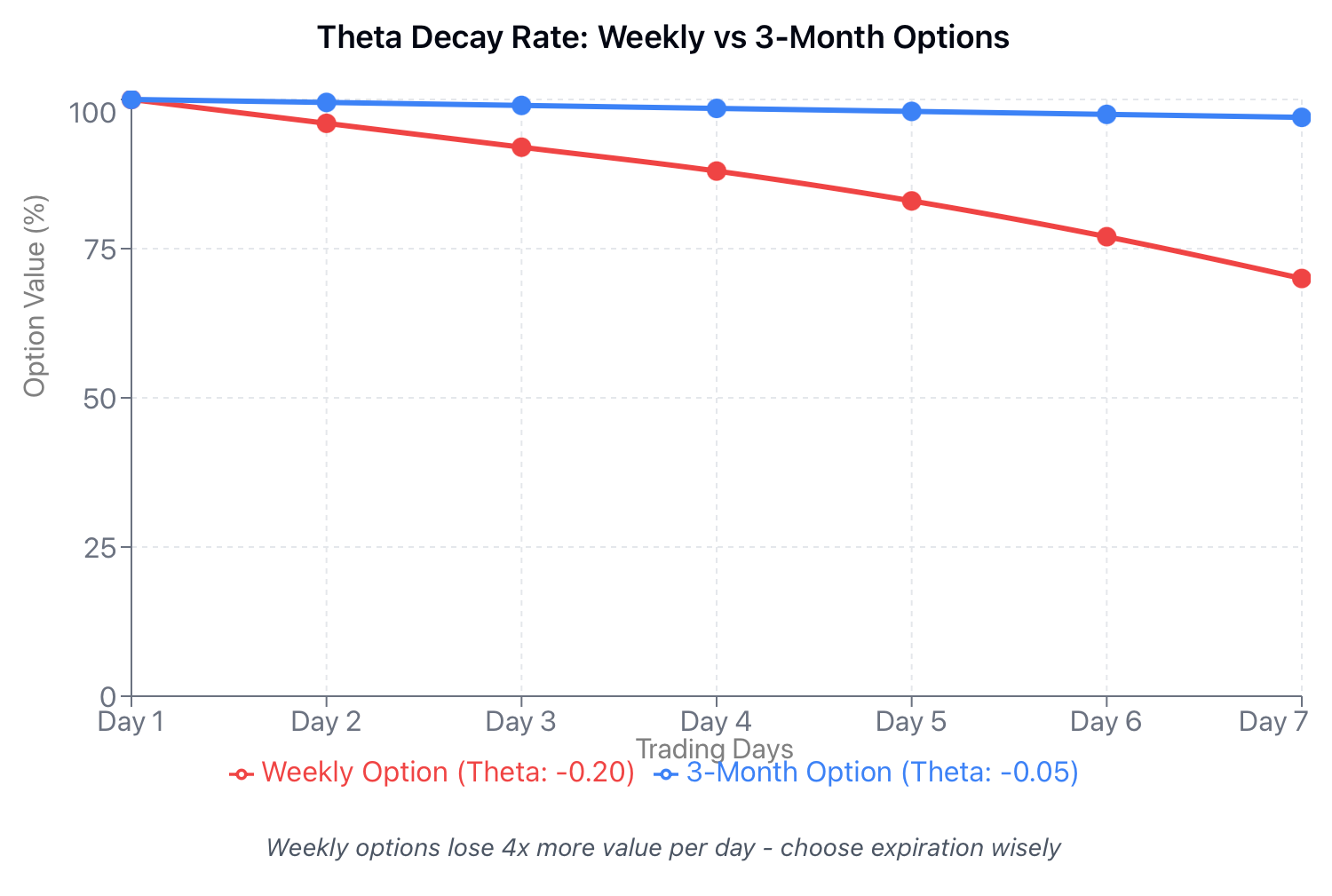
Thus, although at expiration the three-month options represent a very small daily % gain/loss until expiration, the weekly option will lose approximately 4% of the option’s value per day during its last week of life.
If your expectations about movement are very strong and immediate, you likely would not purchase the three-month option because you need to wait for the potential profit on the long-term option, while in the meantime, you would have already spent the money on the long-term option. Therefore, although many people tend to buy short-lived options, if they expect larger profits from a longer time frame, they may opt to purchase more expensive, long-term options.
One way to protect against and mitigate losses from theta decay that occurs when selling options is to buy a bullish call spread. A Bull Call Spread allows a trader to buy a slightly 'out-of-the-money' call option at a particular price with a lower strike price and sell one at a higher strike price. This will generate some offsetting profits from selling the option and reduce the theta from the option that was purchased.
Let’s say an option trader is bullish about Apple Inc., and Apple stock is trading at $160/share. The trader could choose to purchase a $160 call for $8 with an associated theta of -0.12 or take advantage of this position by selling a call option with a higher strike price (for example, $170) while simultaneously buying the lower strike price dying call (for a total of $5) and at the same time combining the long and short positions.
Therefore, by combining the two purchased and sold options, the trader has now created the ability to minimise half of the total theta decay from the combined long and legally-sold options.
A second way to protect against theta decay is the use of calendar spreads. Calendar spreads involve selling options with shorter expiration dates and purchasing options of a particular strike price with an expiration timeline longer than that of the sold option. This strategy works best for long-term options that experience high volatility.
For newbies entering the world of options trading, you might envision doing a Bull Call Spread like this: You purchase a cheap movie ticket for admission into a movie on a certain date, then you turn around and sell another ticket for that same movie at a later date to someone else.
As a result, the proceeds from selling the second ticket offset part of the initial cost of the first ticket. With this transaction, you have managed to establish some value while reducing the level of "flexibility" you have lost due to the reduction in time until the movie is shown.
The most aggressive way to trade around theta decay is to take on a seller's role instead of a buyer's role. By utilising selling strategies such as selling covered call options and selling cash-secured put options, you are taking advantage of theta decay when you, as the seller, benefit from this phenomenon of theta decay occurring. Each day an option exists and does not go against you, you remain in possession of more than what you sold for.
The short call strategy is where you sell a call option to a buyer who then gets the right to purchase your owned stock from you. In return for that sale, you receive premiums from the buyer. It is these same premiums that decay and ultimately provide you with the profit. In addition, should the stock remain below your strike price, you retain all of your premium.
The disadvantage is that your stock will be called away from you should it rise above the strike price; however, you have likely earned extra income for the transaction's risk associated with your stock being called away.
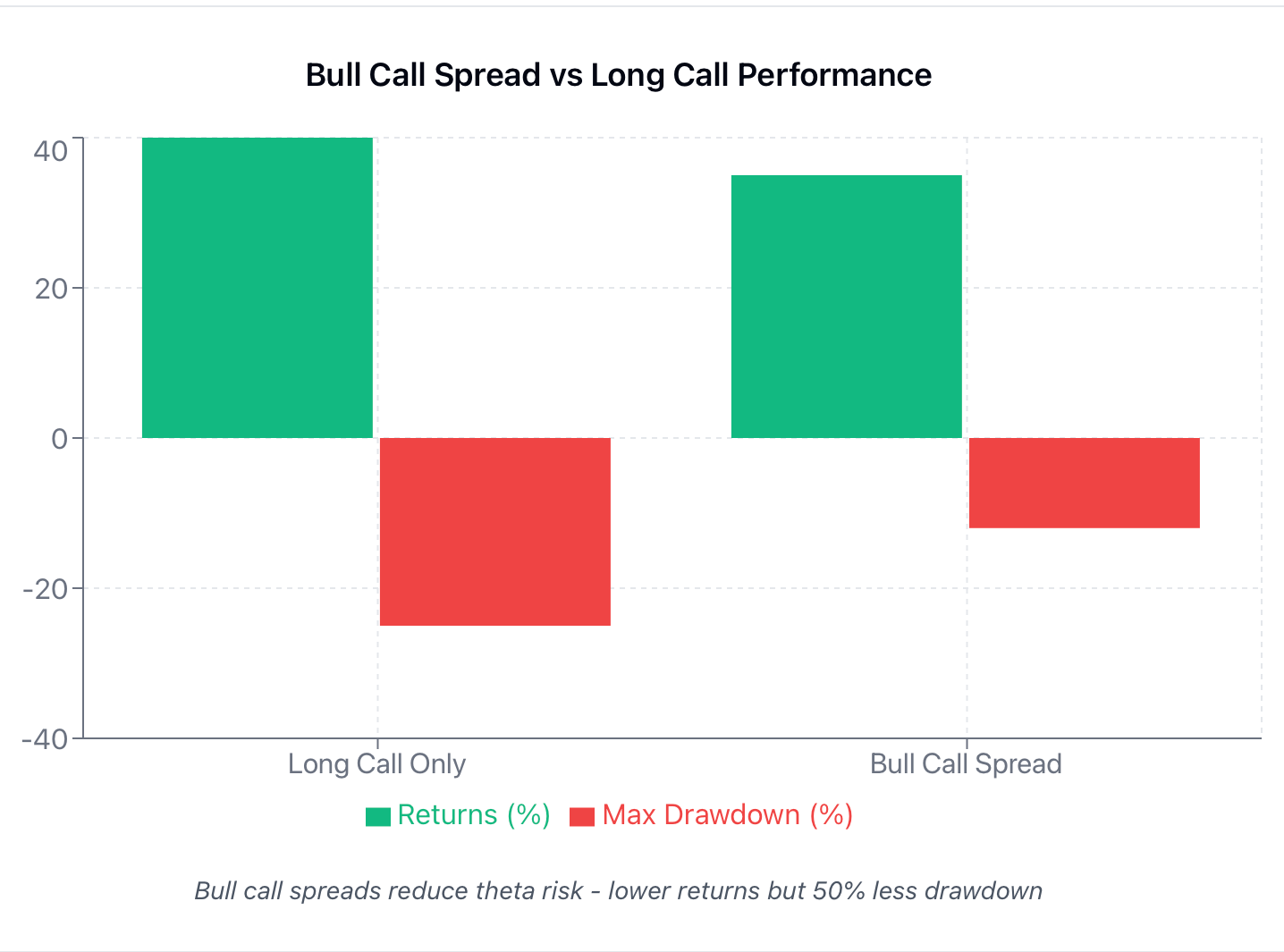
Recent examples of Bull call spreads for both Apple and Tesla have highlighted the advantages of this strategy. Over a three-week time frame in which Apple Shares rose by 3%, a stand-alone long call gave a 40% return, but sustained a 25% maximum drawdown during the period of decline. On the other hand, a Bull call spread produced a 35% return, yet had a maximum drawdown of 12%. Therefore, although the bull call spread produced less upside in return, it was far less volatile than the simple long call, as it helped to mitigate the risks associated with theta decay.
Expert traders utilise a variety of combination strategies. They may use long-dated options as core positions, while using spreads for trades in which they have moderate conviction, and finally, they may also sell options for income when volatility is low. What these strategies all have in common is that the expert traders actively manage the agent of decay, theta, instead of just ignoring it.
In addition to element number one, position sizing is another element to consider as it relates to the overall success of any long-term options trading strategy. As theta decay is an event that occurs, prudent traders always leave adequate capital space when utilising strategies that have a significant negative theta.
They understand that although they are accurate with their analysis, the timing associated with a volatility event or the potential for a time decay of an option could occur prior to their trade being realised as profitable. By utilising modest position sizes, they are preventing any single occurrence of a negative theta decay loss from becoming an unmanageable loss.
Therefore, the conclusion is that the concept of theta decay does not need to be accepted as a certainty with respect to the overall success of option trading. By utilising well-researched strategies, identifying appropriate time horizons, and managing any theta decay risks through discipline, traders can implement trades in a manner that minimises potential losses associated with theta decay. Understanding how to utilise these strategies is critical for the long-term success of any trader who wants to be successful at options trading.
Visit TradeTill.com to get started with options trading by using real-time Greeks analysis, strategy back-testing tools and educational resources so that you can turn theory into profitable options trades.
Disclaimer: The content of the blog does not represent any position of Trade W, does not serve as any trading-related decision advice, and does not endorse any third-party.