
 Trade W
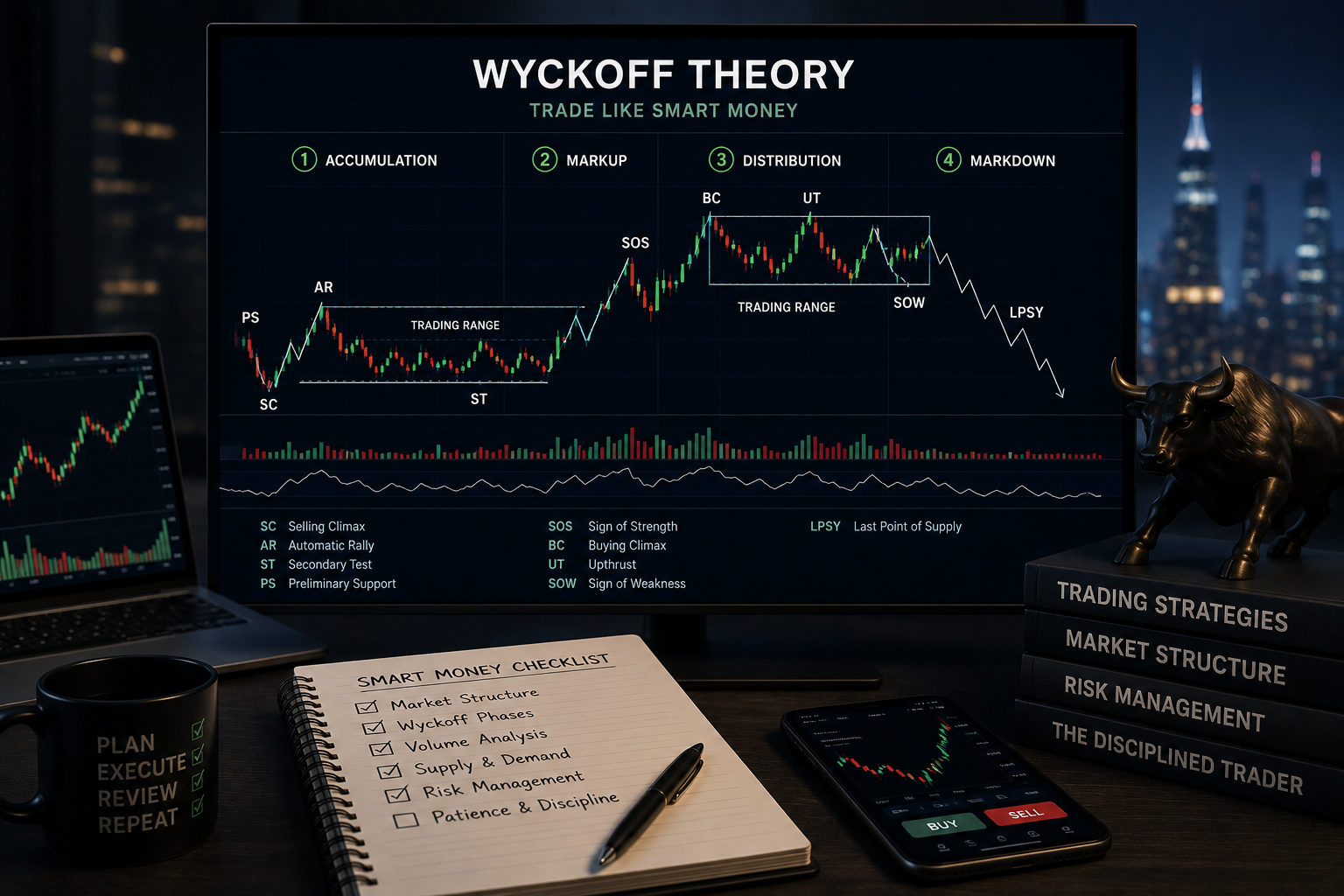
1. What is Wyckoff’s Theory?
Richard Wyckoff’s research into the movement of market prices by large market players began in the early twentieth century. The essential concept of his methodology was based on Wyckoff recognizing that markets are not unpredictable and can be analyzed in cycles, which are dominated by institutional capital flow. This institutional capital flows into the markets much like retail capital, however, the results often place retail traders in the wrong phase of the cycle.
The Wyckoff theory is based on four laws that are still applicable to many market sectors today, including Bitcoin, foreign exchange, and commodities.
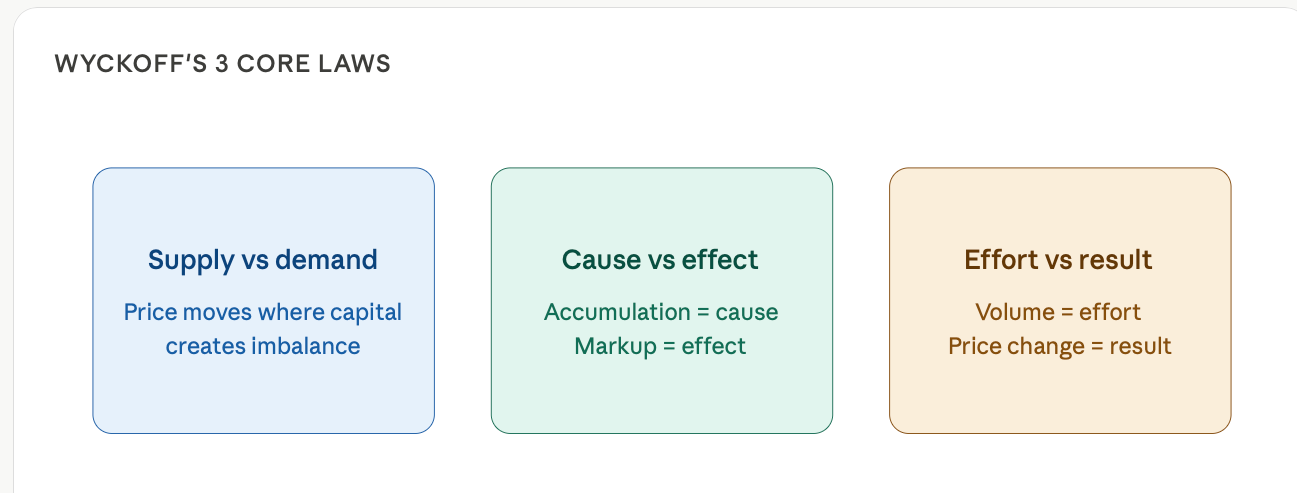
To illustrate the concept of supply and demand working together, picture a wholesale supplier stocking up before a seasonal increase in demand. The expected demand increase as a result of the supply build (the cause) would be an example of the two concepts working together. If the wholesaler invested the time and money necessary to plan in advance but does not see a positive result, it would indicate a flaw in the plan; the time and money invested for this specific purpose would not produce the expected return.
The true nature of the market and capital is that it is based on capital and not luck. By understanding who has the capital and how much there is, the way you approach trading will change dramatically.
2. Wyckoff's "Composite Man": All Smart Money as One Unified Force
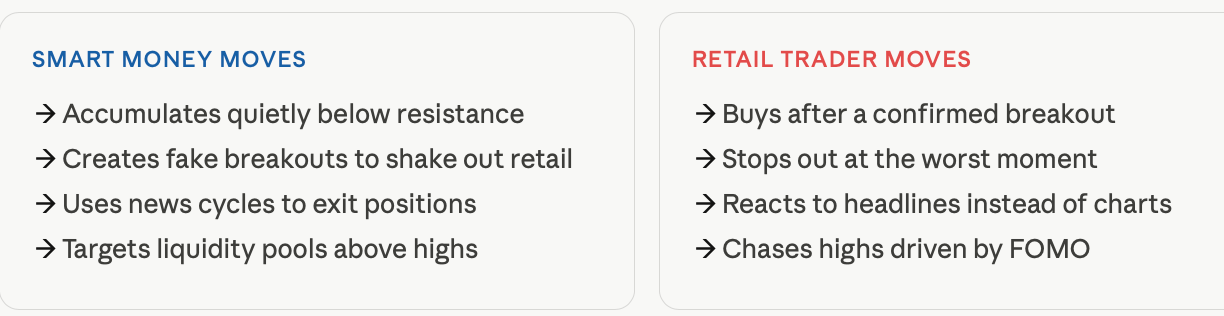
Richard Wyckoff’s definition of the Composite Man describes a mental model where all institutional participants are viewed as one single force. Rather than working in a corporate boardroom, institutional participants act toward a common objective: buy low and sell high. They use crowd psychology as a tool to achieve their goals.
One of the most common traps in trading is what some traders see as false breakouts, also known as upthrusts. After price breaks out above a major level and many retail traders jump in, price often makes a sharp reversal, causing many retail traders to exit their positions. Smart money creates this market disruption by selling into the breakout and providing retail traders with the liquidity necessary to exit their positions.
Smart money has been able to profit from retail traders by deceiving them, and once you become aware of this happening on charts, it will be very difficult not to notice it the next time you see it.
3. The Wyckoff Market Cycle: 4 Phases Every Trader Must Know
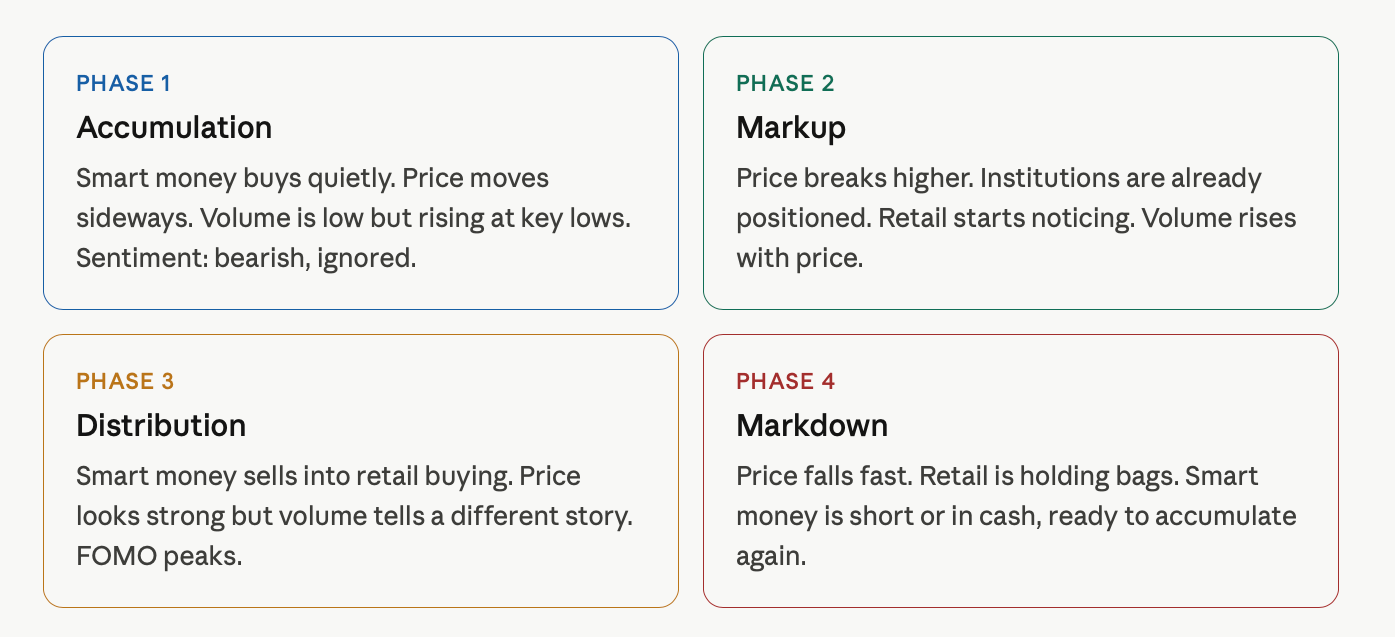
The Wyckoff Market Cycle comprises four distinct phases. Markets do not move randomly; instead, they progress through these four phases, and each has specific characteristics with respect to price and volume.
Fake breakouts (also known as “upthrusts”) are arguably one of the most common traps that occur in trading. However, price will break out above a significant level, forcing many retail traders to jump in before a sharp reversal pushes it back down again. The “smart money” will have sold into this breakout as a way of cashing out by providing retail traders with the liquidity they need to exit their positions.
The smart money makes money by tricking retail traders, and once you start noticing this happening on charts, it will be hard for you not to notice it again.
The Wyckoff Market Cycle is comprised of four distinct phases. Markets do not move randomly; instead, they progress through these four phases, and each phase has its own specific characteristics with respect to price and volume.
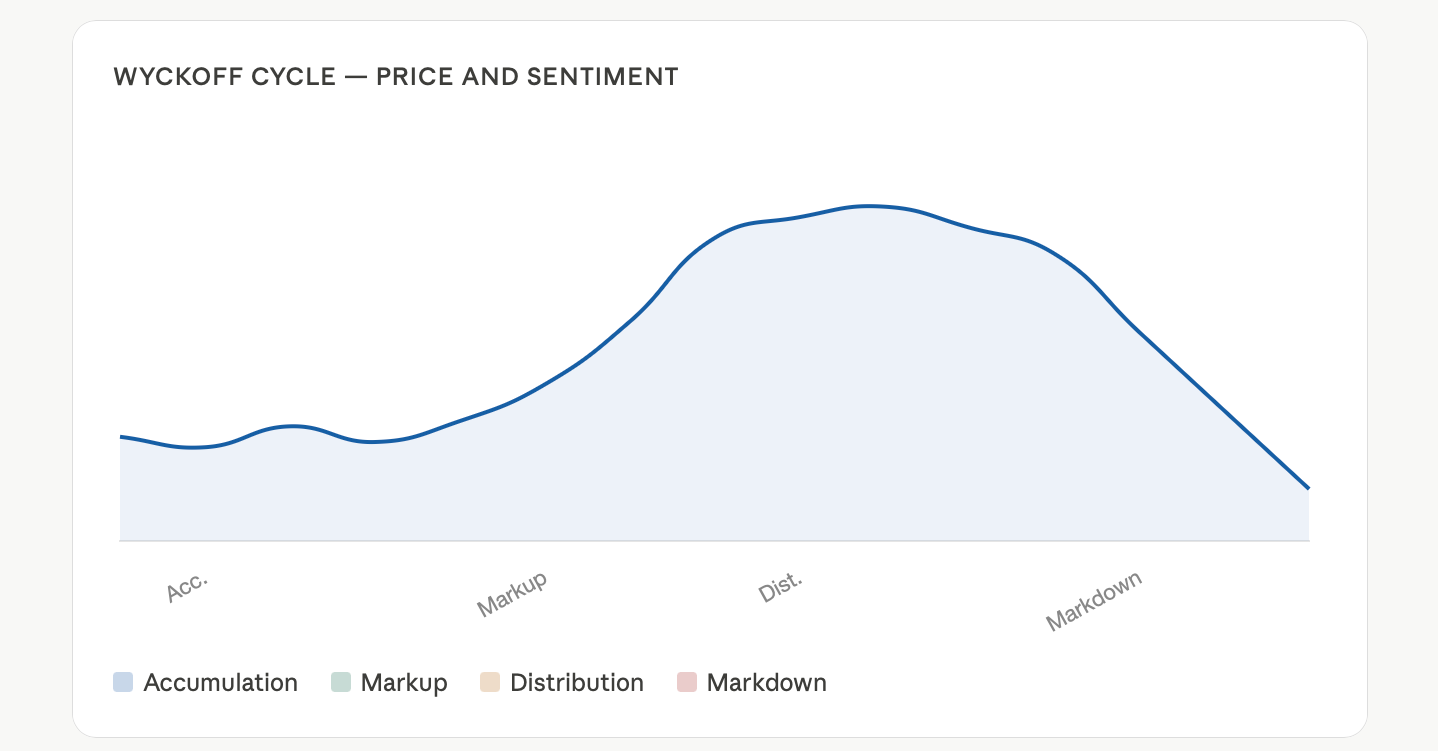
The 2019–2021 Bitcoin price cycle is one of the most well-known examples of modern crypto market cycles. It consists of four stages:
-
A long, slow sideways grind (accumulation)
-
A near-vertical increase that most people were unaware of (markup)
-
An exaggerated move toward perceived “ideal” levels (distribution)
-
A sharp decline of 70% or more in price (markdown)
Each of these stages is associated with identifying Wyckoff’s Market Structure.
The market cycle is essentially an inventory cycle of smart money. While smart money is accumulating inventory (where demand exceeds supply), the market is quiet. While they are distributing inventory (where supply exceeds demand), the market becomes highly active.
4. Accumulation Phase: Where the Real Trades Live
Accumulation is uncomfortable to trade. Price does not move much, and there is negative media coverage or generally pessimistic sentiment. No one is talking about it or paying attention. The fact that it feels so uncomfortable is exactly what smart money is looking for.
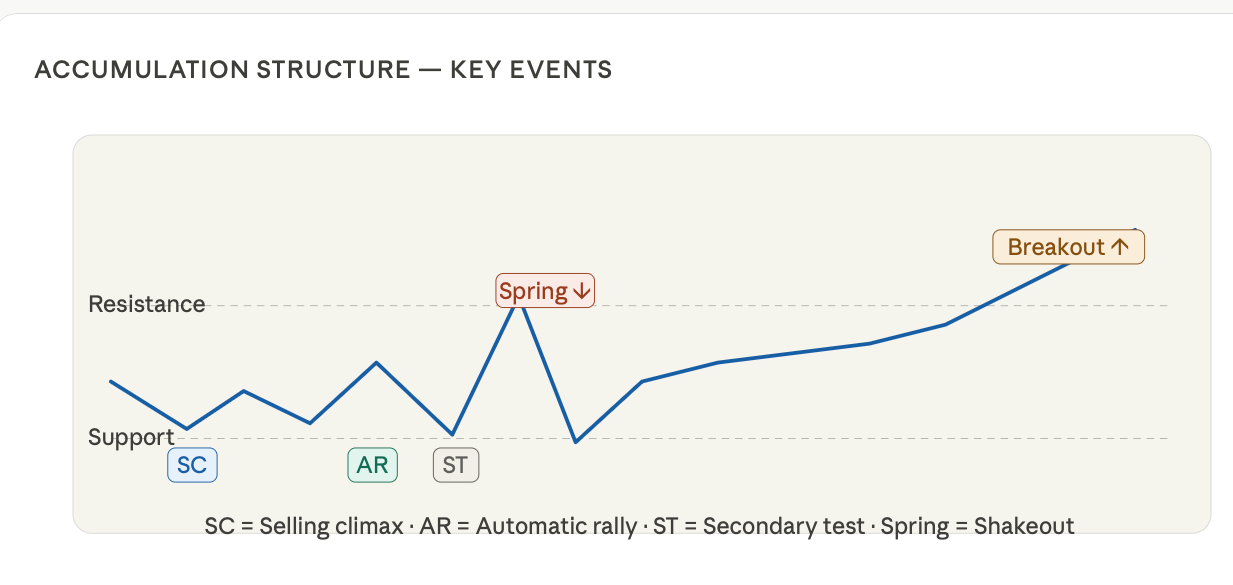
Smart money uses the “spring” as one of the most powerful entry signals in Wyckoff theory. A dip in price occurs, resulting in support being broken and retail stop losses being triggered, only for price to snap back violently. Smart money uses the spring as an opportunity to obtain liquidity below the range, setting up the real move upward once accumulation is complete. If price fails to remain below support and reverses on a strong volume bar (which is typically the case), the spring is confirmed.
The best trades often occur when no one is watching. By nature, accumulation phase trading appears boring because there is little visible price movement.
5. Distribution Phase: Why Retail Buys the Top Every Time
The distribution phase is the opposite of accumulation and is therefore far more dangerous, as it often appears strong (e.g., peak media attention, spiking prices, and widespread discussion).
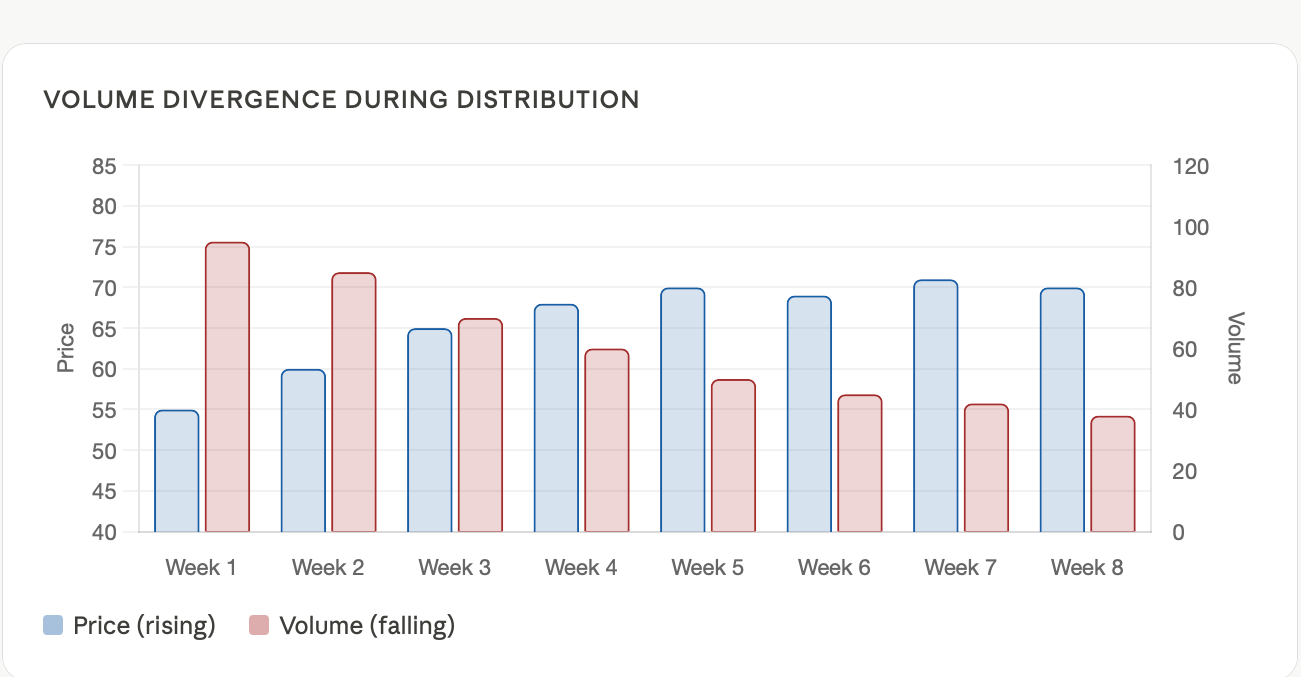
The principal sign of distribution is known as an “Upthrust After Distribution” (UTAD). Price moves above the previous trading range, causing breakout buyers to enter the market, then reverses abruptly, providing smart money with the liquidity needed to exit their long positions. The upthrust is thus smart money’s exit.
The clearest indication of distribution is high volume combined with weak price movement (i.e., no acceleration in price or buying pressure). This suggests that institutional traders are absorbing buying pressure while distributing their holdings.
Markets that appear safest often carry the greatest risk. If the overall market is bullish, it is worth asking: who are these buyers buying from?
6. How to Trade Wyckoff in Crypto, Forex, and CFDs
Wyckoff can be viewed as a means of defining what stage of the market cycle one is in and how to behave accordingly.
Wyckoff works in cryptocurrency markets because of the impact of large institutional money flows. Each major bull market is preceded by a lengthy foundation being built beforehand — this is not a coincidence. In Forex, money managers build their positions primarily around economic data releases, and Wyckoff can assist in interpreting the resulting footprint. CFDs that replicate larger indices (e.g., NASDAQ) will show accumulation and distribution events on multiple timeframes simultaneously.
The Six Most Common Wyckoff Errors That Cause Traders to Lose Money
Below are the most common types of mistakes:
-
Labelling every sideways price move as “accumulation.” Accumulation has a specific structure and clearly identifiable components. Simply being in a range does not mean it is an accumulation.
-
Trying to use Wyckoff to predict exact price levels. Wyckoff is not designed for precise forecasting. It is a probabilistic framework focused on direction, not exact targets.
-
Ignoring the broader trend. A spring during a distribution phase will not be a buy signal.
-
Using too many technical indicators, which overcomplicates Wyckoff analysis. Wyckoff is primarily based on price and volume. Adding RSI, MACD, or Bollinger Bands often introduces noise rather than clarity.
-
Misusing Wyckoff entirely, which can be worse than not using it at all. Confidence in a wrongly interpreted phase may lead traders to take oversized positions at exactly the wrong time.
Concluding Thoughts: Use Smart Money Thinking
The Wyckoff Method does not provide an easy path. The reason it gives you a new perspective is that you will be looking at smart money’s footprint in every market to anticipate moves before they occur instead of reacting to price movements after they happen.
Moving away from a reactive trading style and toward an anticipatory style of trading is where your true edge lies. You are no longer asking yourself, “Why did prices move this way?” Instead, you will begin to ask: “What is the next scenario for price based on the current period’s structure and volume characteristics?” false breakouts
If you do not understand smart money, you will simply be the liquidity that allows them to continue their trades. Begin using Wyckoff now.
Stop being exit liquidity for smart money, begin understanding cycles before you start trading.
Use Wyckoff-style charting tools that are made for serious traders and use them on Tradewill.
Disclaimer: The content of the blog does not represent any position of Trade W, does not serve as any trading-related decision advice, and does not endorse any third-party.