

 Trade W
Why Understanding XAG/USD Matters
If you've ever thought about how silver is quoted in global markets, the answer is XAG/USD. This trading pair specifies the price of silver in terms of the US dollar, and it is one of the most liquid, or actively traded, precious metals pairs in the forex and CFD market.
Silver is more than just another shiny metal. It is a legitimate investment asset that has a two-sided purpose. On one side, it is an industrial workload used from electronics to solar panels. On the other side, it is a historical store of value that investors tend to buy during times of economic uncertainty. XAG/USD takes both sides of the equation into one quote, making it a useful trading tool for hedging, speculating, and diversification.
To put it differently, if you are a professional trader, when XAG/USD often moves in rallies together with XAU/USD (gold) and provides a rough measure of actions going on regarding inflation and the strength of the US dollar. In other words, when inflation fears spur or the dollar weakens, silver often will rally as well with gold (or often an amplified price movement).
For those who are new to this, here's an easier way to visualise it. Think of it like this: You have a silver coin. The US dollar got stronger, so the price of that coin in dollars usually goes down. The value of your silver hasn't changed; it's just that the dollar got stronger against the silver. Alternatively, if the dollar gets weaker, that silver coin is now worth more dollars. That's what XAG/USD is.
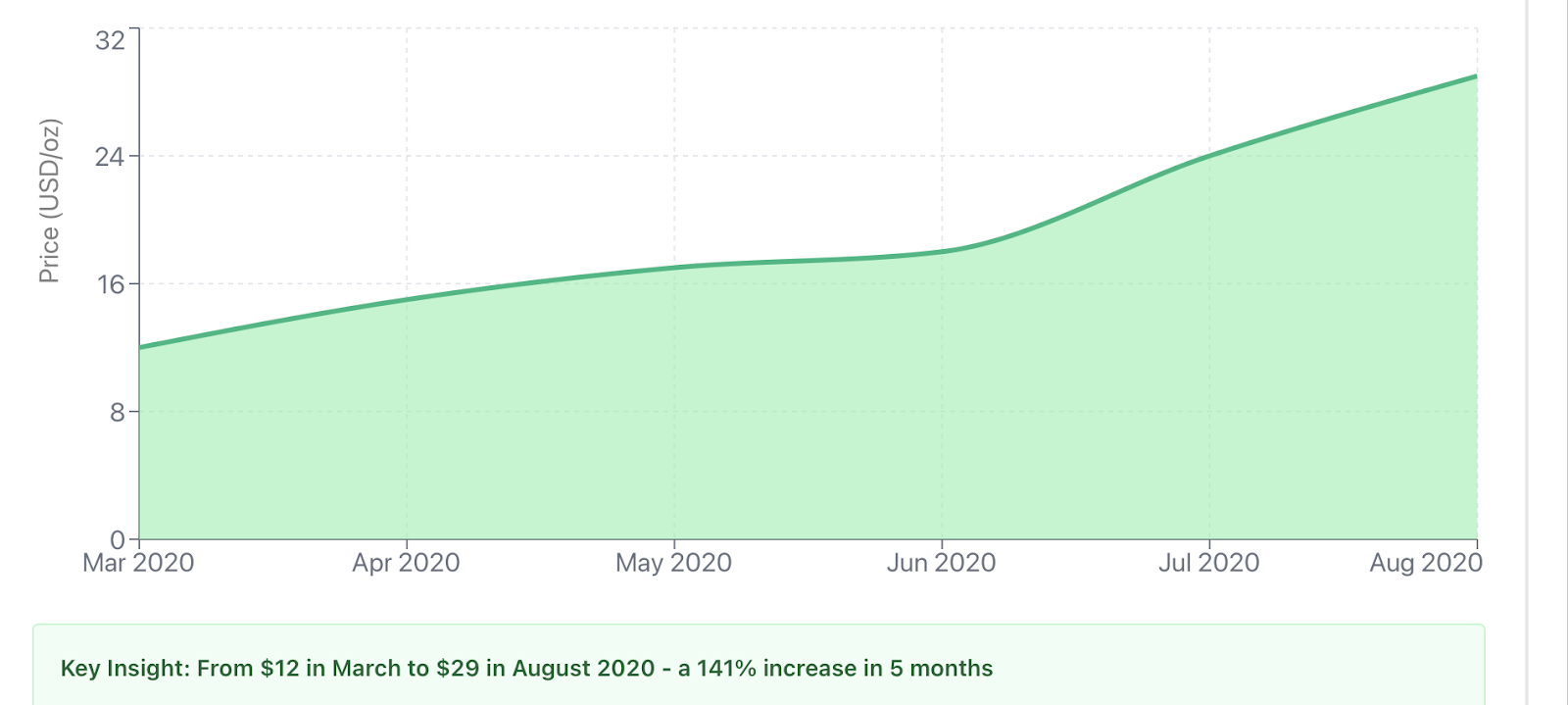
The period from 2020 until early 2021 is a fantastic case study. The dollar gave up its strength when the pandemic occurred, and the Federal Reserve flooded the world with liquidity. What happened to silver? The price went from about $12 per ounce in March 2020 to nearly $30 per ounce by August 2020. That's a gain of 150% in a five-month period. Traders who understood the basic principles of XAG/USD and took positions before the price move were able to take a profit from this situation.
Remember, silver is not just a commodity that trades off of supply and demand curves. It is a component of the global monetary system we live in. The actions of central bankers, geopolitical events, innovations in industry, and inflation expectations all start to leave their fingerprints on the chart of XAG/USD. If you can understand this pair, then you can have a reasonable understanding of what the world's economy is doing at any given time.
The Basics of XAG/USD: What Does It Really Mean?
Let's dissect the code. XAG is an ISO currency code for silver (its Latin name is "argentum"), whereas USD stands for US dollars. XAG/USD indicates how much 1 troy ounce of silver costs in US dollars.
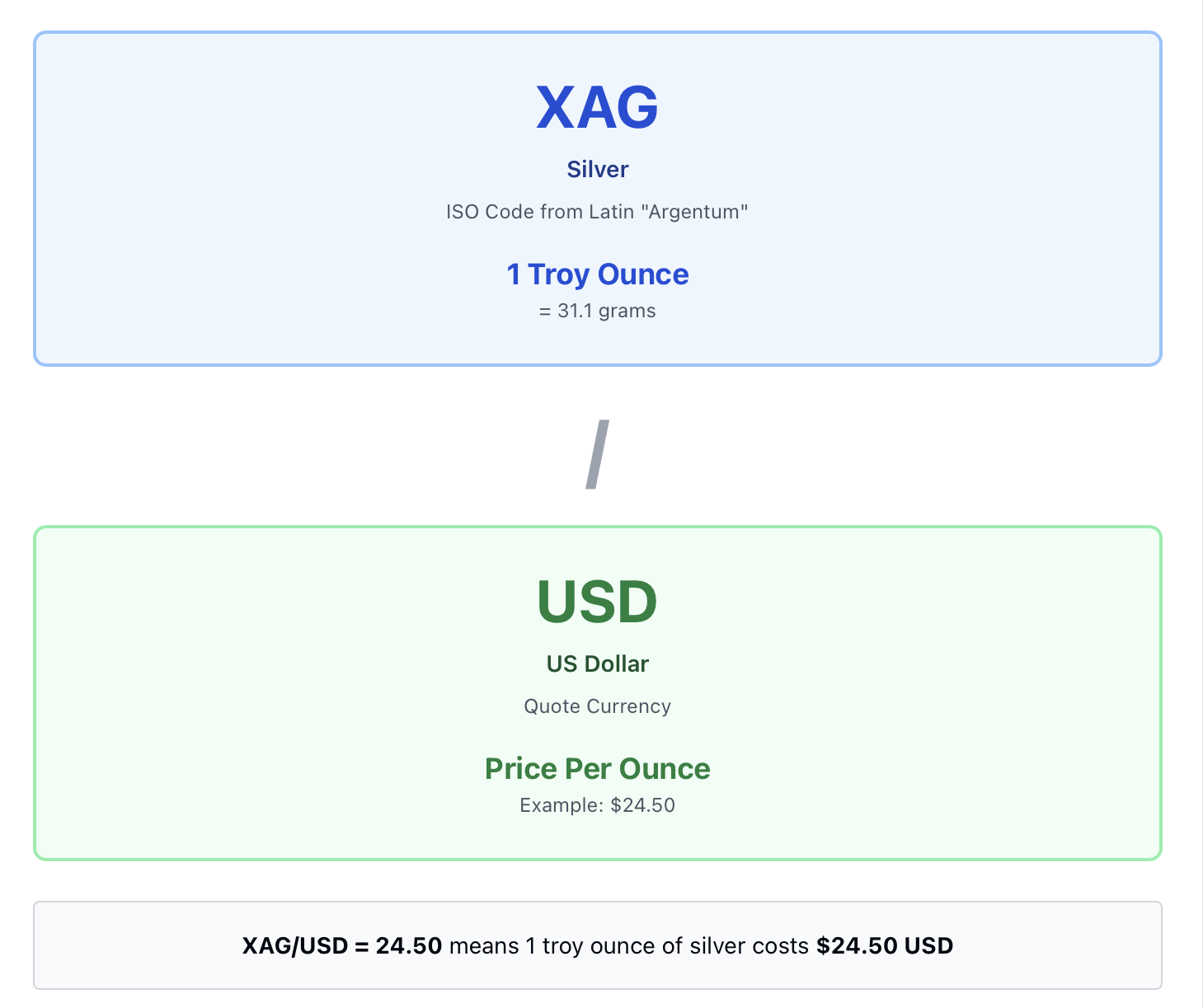
If you see that XAG/USD = 24.50 on the trading screen, this indicates that 1 ounce of silver costs $24.50, quite simple. However, when trading, there's more to it!
In traditional commodity markets, silver commonly trades in standard lots. A standard lot is 5,000 troy ounces, which is an enormous amount of silver, which is why retail traders often trade through CFDs (Contracts For Difference) that allow for much smaller position sizes, for example, micro-lots, or even fractional amounts of silver with CFDs that make it available without the use of a warehouse space and capital.
Moreover, it’s quoted in line with forex conventions. Therefore, you will see a bid price (the price buyers will pay) and an ask price (the price sellers want for the silver). The difference is called spread, which is your trading cost. An XAG/USD spread might be typical somewhere in the range of 3, 4, or 5 cents in normal market conditions.
Here's an example of how profit works in practice. Suppose, for example, you're a professional trader and buy XAG/USD at 24.50. The price moves up to 25.00, and you close your position. You have made $0.50 per ounce. If you traded one standard lot (5,000 ounces), you made $2,500. Of course, if the price moved against you at the same price, you'd be looking at a $2,500 loss.
For real beginners, you can think of it this way. Yesterday, you purchased a silver bar for $25. Today, someone offers you $26 for it. You sell and put the $1 difference in your pocket. Simple enough. That's profit. XAG/USD trading works under the same principles, just with much larger quantities and the option to employ leverage to increase your position.
One important note: silver trades in troy ounces, not standard ounces (also referred to as long ounces). A troy ounce is equal to about 31.1 grams, while a standard ounce is 28.35 grams. This is important when comparing prices across lenses, or if you wish to calculate how much physical silver is represented by that contract.
One of the great advantages of XAG/USD, as a trading instrument, is its versatility. You may take a long position (bet on prices going higher) if you think the silver price will strengthen against the dollar, or a short position (bet on prices going lower) if you expect the price to fall. You don't have to ever own physical silver to benefit from the price movements. You are only speculating on the price direction, and this is the appeal of CFD trading for traders in modern markets.
What Influences the Price of Silver (XAG/USD)?
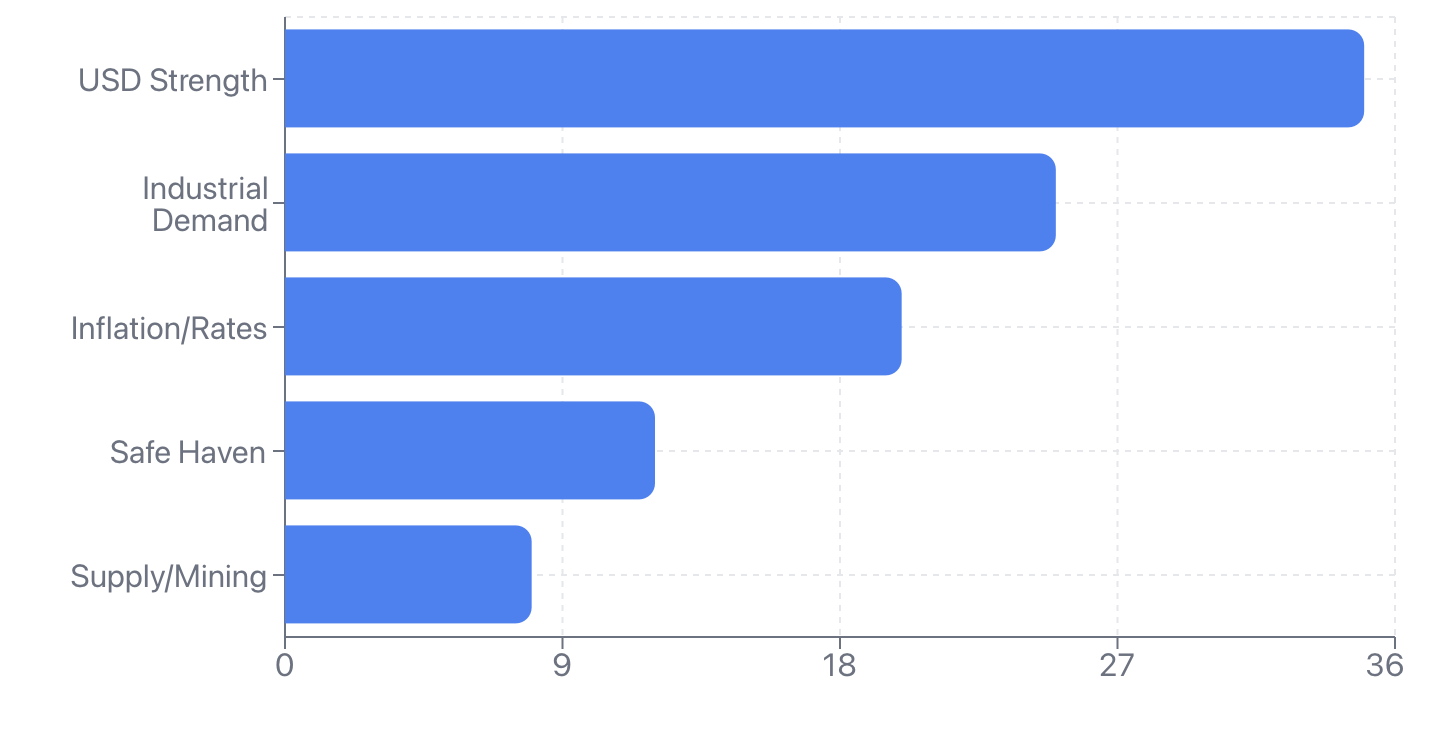
Silver does not move in a vacuum; it is pulled in multiple directions by multiple forces and occasionally at the same time. Understanding these drivers is important if you plan to have any level of success trading XAG/USD.
US Dollar Strength: The Driver
Because silver is dollar-denominated, the correlation of XAG/USD to the dollar is inverse. So when the US Dollar Index (DXY) goes up, silver goes down, and when the DXY goes down, silver goes up. Why? A stronger dollar makes silver more expensive for international buyers, which ultimately decreases demand for silver. A weaker dollar makes silver cheaper in other currencies, which ultimately increases the global demand.
Inflation and Interest Rates: The Economic Weather
Silver does well in inflationary environments. When customer prices are rising and purchasing power erodes away, investors want to find real assets to store their value. Silver is a real asset, tangible, scarce, and given it has thousands of years of monetary history behind it.
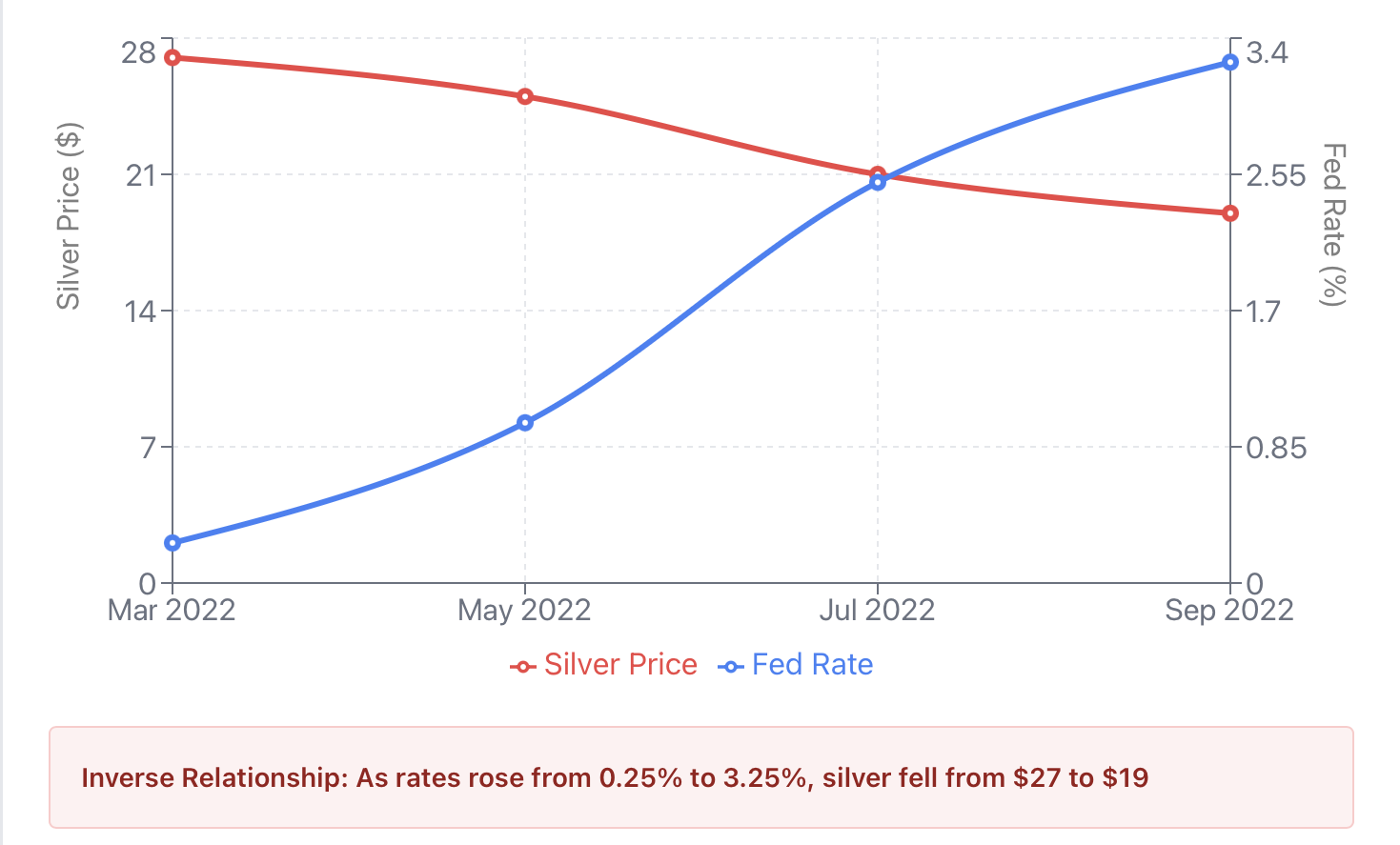
Interest rates are the counterbalance to this relationship. When the Federal Reserve actively raises rates, the opportunity cost of holding a non-yielding asset such as silver increases. Why hold silver when I can hold borrowed money (a “risk-free” investment) in Treasury bonds that are earning 5% per year? This was very clear during the tightening cycle in 2022. As rates rose from near-zero to over 5%, the price of silver measured in XAG/USD fell from approximately $27 in March 2022 to under $19 by September 2022.
Industrial Demand: Silver’s Day Job
Unlike gold, which is mainly a monetary metal, silver has huge industrial uses. Approximately 50% of annual demand for silver is from industrial uses: electronics, solar panels, medical equipment, and electric vehicles. With the transition to green energy, silver demand has increased just from solar panel manufacturing. Each solar panel contains about 20 grams of silver.
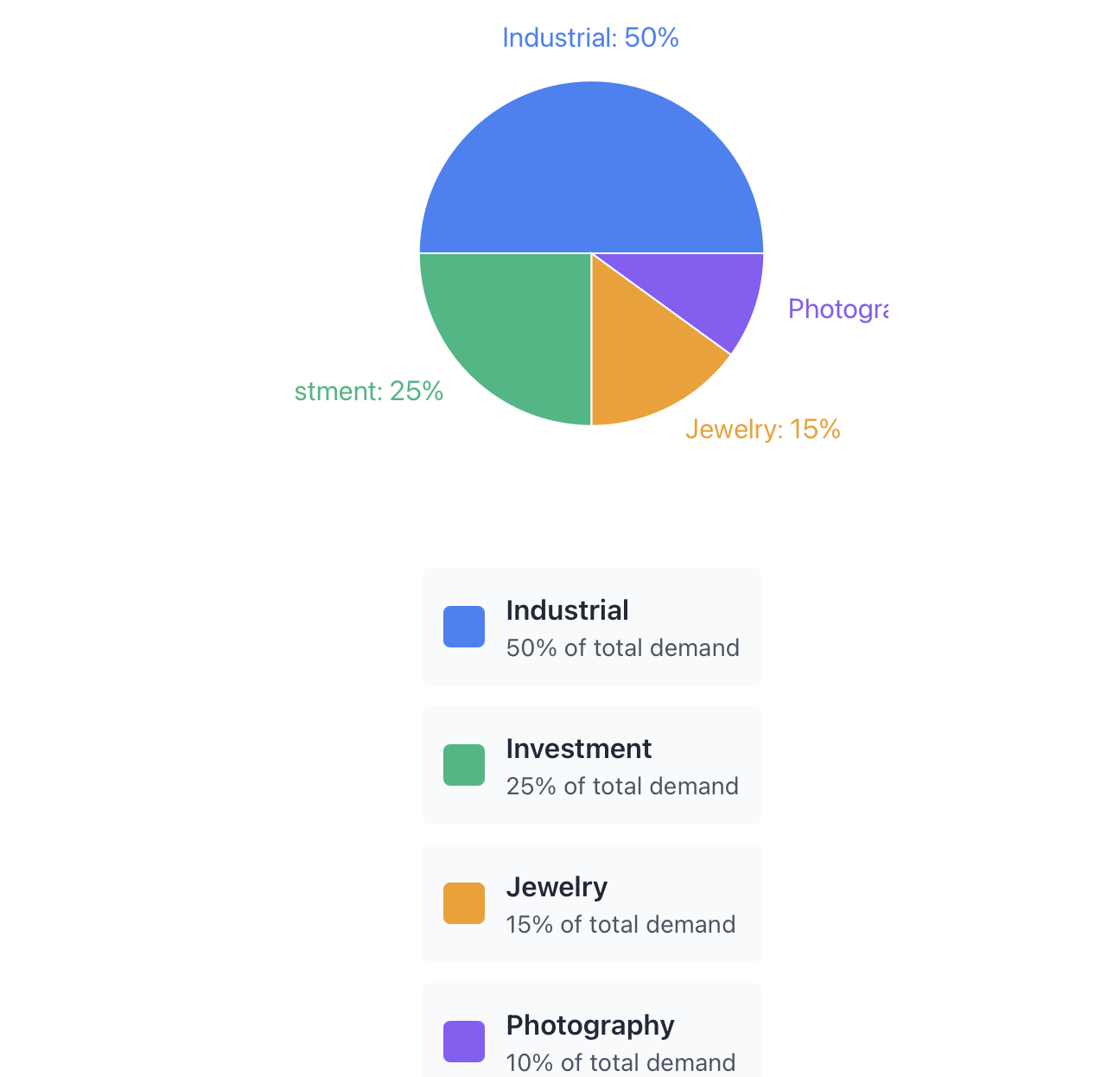
When global manufacturing increases, silver occupies this demand and indirectly supports prices. When the demand portion of industrial production decreases (like during recessionary moments), silver may underperform relative to gold because the demand piece is weaker.
Geopolitical Risk and Safe-Haven Flows
During crises (wars, financial market panics, political unrest), investors tend to run to safe-haven assets. Gold gets most of the attention, but silver typically follows. Silver is sometimes called "the poor man's gold," because it offers similar protection mechanisms at a lower cost.
There is a catch; however, silver's safe-haven premium is far less reliable than gold's. As a result of a more significant portion of silver demand being industrial in nature, during severe downturns in an economy when manufacturing stops, silver can decrease as well. This mix makes silver more volatile than gold.
The Gold/Silver Ratio: A Historical Measure
Professional traders keep a close eye on the gold-to-silver ratio. The gold-to-silver ratio tells you how many ounces of silver it takes to buy one ounce of gold. The historical average is 60-70, but it can swing wildly. For example, in the panic in March 2020, the gold-to-silver ratio reached 125, which means gold was very expensive relative to silver. Notably, professional traders saw this as an opportunity to bet silver would outperform gold, which they did, in the months that followed.
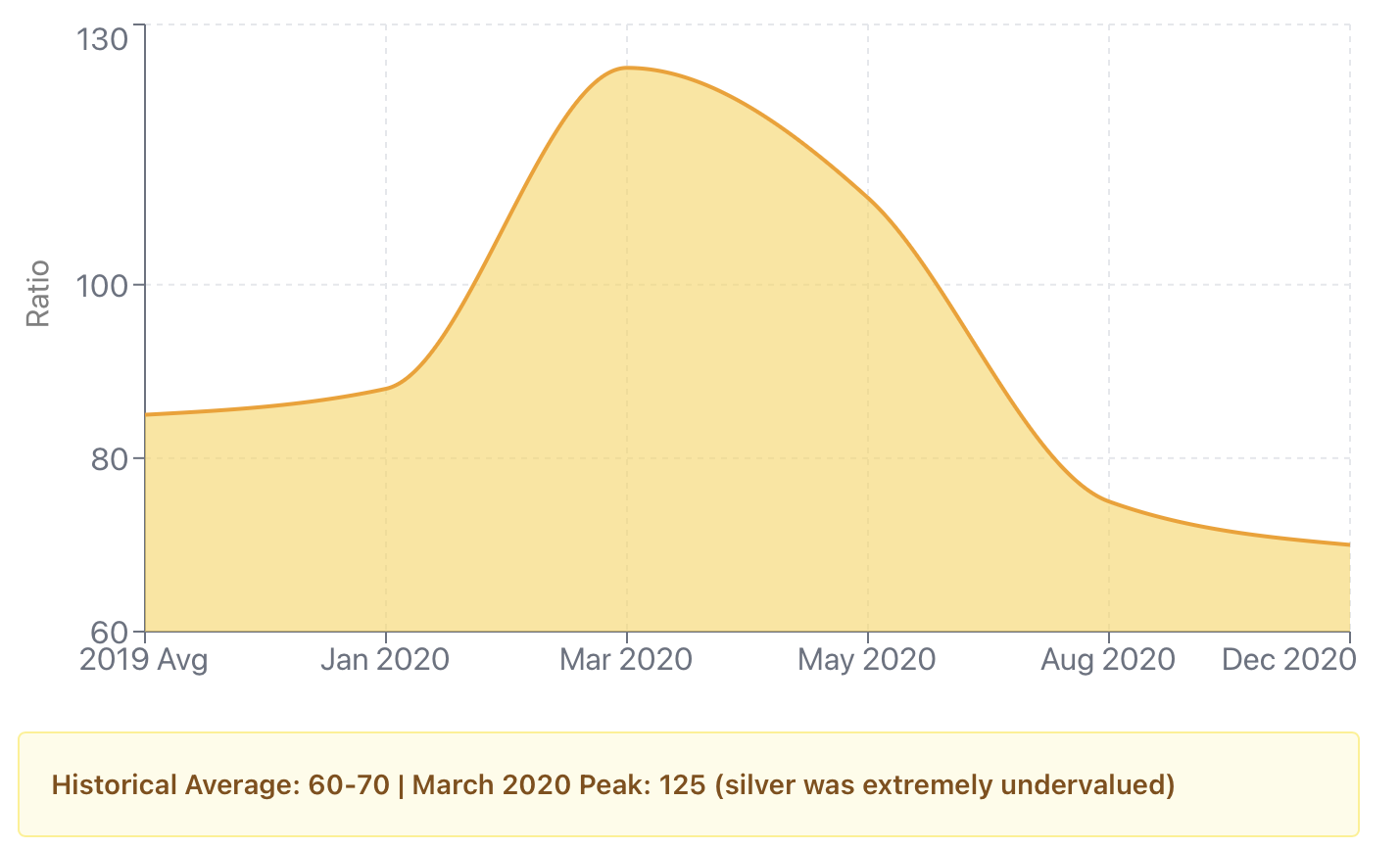
When the ratio is high, silver is comparatively inexpensive to gold. When it's low, silver is comparatively expensive to gold. Traders use this in pairs trading strategies of going long silver and short gold, believing that silver is underpriced.
Supply Dynamics and Mine Costs
About 75% of silver comes as a byproduct of other metals like copper, lead, and zinc. This means that the supply of silver won't react to the silver prices in the fashion you would expect. When the price of silver goes up, it doesn't necessarily mean that production will immediately increase because the mines are optimised for the primary precious metal and not the byproduct of silver.
Mining costs provide a backstop underneath prices. Once the silver price approaches all-in sustaining cost of about $15-17 per ounce for producers, mining silver becomes unprofitable, and the mines will eventually close, which reduces the supply of silver and assists the price.
For beginning traders, think of it this way: when the dollar "gets stronger," it's like silver is "becoming harder to afford" in dollar terms, so not as many people buy, and the price falls. When economic uncertainty rises, people want something real that they can hold, and silver (being cheaper than gold) looks appealing. When tech companies and solar panel manufacturers increase demand for silver in production, they compete for the supply of silver, which will raise prices.
Silver functions as not only an industrial commodity but also serves as a safe-haven asset. That dual identity creates unique price characteristics not seen in copper's pure industrial metal or gold's pure monetary metal. Understand these drivers, and you can more effectively predict XAG/USD movements.
How to Trade XAG/USD: Spot vs CFD
When it comes to trading silver, there are really two primary options: acquiring the physical metal (known as spot trading) or speculating on price changes via derivatives (known as CFD trading). Each offers specific benefits and drawbacks.
Spot Trading: Owning the Actual Metal
Spot trading is acquiring and taking possession of actual silver. This is typically done with silver coins, bars, or bullion. When you sell the silver, you will receive the market price (usually referred to as the “spot price”) less any dealer premium or fees.
The benefit is ownership of a physical asset. If the financial system collapses, you still have silver. It is tangible wealth that you can actually hold in your hand. The downside is storage, insurance, security, and dealer markups that take away your gains. Furthermore, selling physical silver is not as simple as clicking a button. You need to find a buyer, establish ownership legitimacy, and transport it.
Physical silver makes sense when you are a long-term investor interested in diversification of your investment portfolio and protection of wealth. Physical silver does not make sense when you want to be an active trader to capture market price fluctuations over the short term.
CFD Trading: Pure Price Speculation
CFDs or Contracts for Difference allow you to speculate on price fluctuations in XAG/USD without ever handling pesos of physical silver. When you trade a CFD, you are not trading silver; you are trading a contract that reflects the price of silver. You profit (or lose) based on the price difference when you entered the CFD and when you exited it.
The benefits are numerous. First, you can go long or short equally easily. You think silver is going up? Buy a CFD. You think silver is falling? Sell (sell short) a CFD. Second, traders have access to "leverage," meaning they can control a large position with a small amount of capital. Third, you can trade 24/5 (silver markets trade almost always, except for the weekends) with instant execution. Fourth, there are no storage costs, no insurance, and no authenticity issues.
The downside? Leverage cuts both ways. For example, if you use 1:10 leverage and silver moves 1% against you, you actually lose 10% of your margin. This is how traders blow up their accounts. Another downside, if you hold positions overnight, CFDs are charged overnight financing fees. Lastly, with CFDs, you do not take possession of the physical silver at all.
Working Example of Leverage
Let's explore a practical example. Assume that XAG/USD is trading at $25.00 and you feel that it is going to go up to $26.00. If you had leverage of 1:10, then you would control $10,000 worth of silver by putting down a margin of just $1,000. If silver rises from $25 to $26, this is a 4% gain on the notional value, meaning that it's a 40% gain on your $1,000 margin. Conversely, if silver went from $25 to $24, you would lose 40% of your margin.
Start simple: if you believed silver was going to go up by 10%, you would control $1,000 worth of silver with just $100 using 1:10 leverage as margin. If this were correct, you would then make $100 on your $100 investment and double your money. However, if silver instead went down by 10%, you would lose your $100. That is the power and that is the risk of leverage.
Essential Trading Components
Regardless of the strategy you select, you will need risk management elements. Using a stop-loss order, for example, will automatically close your position should the market move against you by an amount you have predetermined as part of your risk tolerance. A limit order will lock in the gain as soon as you reach a predetermined target price. Risk management elements are critical when using a margin account as they protect against catastrophic losses.
Trading Considerations
The majority of retail traders who want to trade silver CFDs do so using a forex-grade CFD broker, and the spreads on XAG/USD often range from 3 – 5 cents under normal market conditions. These spreads may widen, particularly when there are higher degrees of volatility or outside of the primary trading hours between major trading partners. The trading volume is generally highest when both the European and the US brokerage markets are open.
Trading using CFDs has democratized trading in silver. You no longer need to have a $100,000 account to trade silver productively. Forex brokers and their associated markets provide you the opportunity to begin trading silver CFDs with a few hundred dollars and get exposure to one of the world's most relevant commodity markets. However, remember that smaller capital requirements do not mean lower risks. If anything, the access to leverage increases the need for discipline and risk management.
Physical silver is meant for investors, and CFDs are meant for traders! Make sure you know which one you are, and trade accordingly.
Silver Trading Strategies and Risk Management
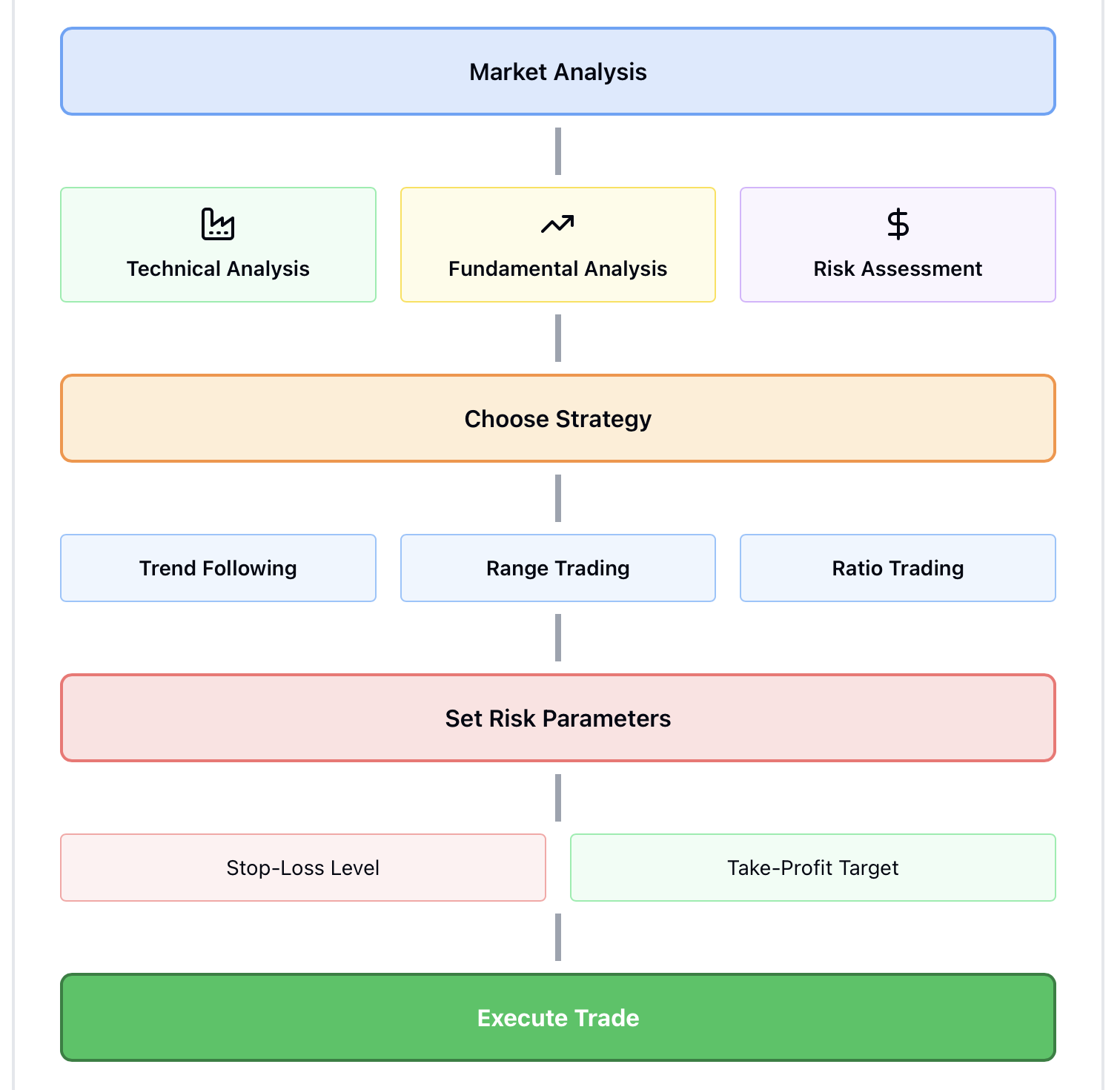
Trading silver profitably is not about predicting where the price will move next. Rather, it is about implementing a systematic approach, managing risk consistently, and accepting that losses are part of the equation. Here are actionable strategies and risk approaches that both novice and professional traders can adopt.
Trend Following: Go with the Flow
Trend following is probably the simplest method of trading silver. The concept is simple: identify whether silver is trending up or down, and then trade in accordance with that trend, until it stops trending.
Professional traders generally have some form of moving average crossovers that they employ to identify trends. Many use the 20-day and 50-day moving averages (MA20 and MA50). If the MA20 crosses above the MA50, that is a signal that there may be an upward momentum, and suggests a long position. Conversely, when the MA20 crosses below the MA50, that is a signal that there may be a downward momentum, and suggests a short.
During the 2020 silver rally, we saw the MA20/MA50 crossover in late May as an early indication that momentum was building. Traders who entered long positions and rode the trend until the crossover reversed in August were able to capture most of the rally from $18 to almost $30.
For novices, think of trends like weather patterns. If silver continues to rise for several days or weeks, it is a hot day. It may last for several days or weeks, but it could cool down very quickly. You want to ride a trend, but you always want to be prepared for reversals. This is why stop-losses are so important in trend following; they force you out of a position when the trend changes.
Range Trading: Profit When Markets Go Nowhere
Not all markets trend. Sometimes silver becomes stuck in range, moving between support and resistance levels. Range traders will buy near support (the bottom of the range) and sell near resistance (the top of the range), profiting from the oscillation.
To help trade the range, you can also use technical indicators like the Relative Strength Index (RSI). The RSI helps to indicate whether silver is overbought or oversold. If the RSI is below 30, silver may have fallen too far and have a chance to pop back up. Above 70, silver may be overbought and have a chance of falling back down.
Range trading is most effective in stable market conditions with low volatility. The silver market in 2019 spent several months giving multiple opportunities for range trading between around $14 and $16. The important consideration with trading ranges is when the traders think the range will break, because if it breaks, range traders can find themselves on the wrong side of a range trade.
Long/Short Gold/Silver Ratio: Relative Value Trading
The gold/silver ratio indicates how many ounces of silver it would take to buy one ounce of gold. If the ratio was at a historically high level, then it indicated that silver was cheap relative to gold, so traders would look to long silver with a corresponding short gold. If the ratio was at a historically low level, then it showed that gold was cheap relative to silver, and the trader would look to do the opposite.
In March 2020, the gold/silver ratio reached 125, a level not seen in decades. Traders who recognised the extreme reading got long silver and shorted gold (or essentially got long silver) as the ratio reverted back to a level that was more normalised around the level of 70 months later.
This approach necessitates identifying both metals along with their usual relationship. The historical average ratio is approximately 60-70, so significant shifts from that level (above 90 or below 50) often yield an opportunity to make a trade.
Risk Management Fundamentals: The real secret to staying in the game
No matter how good your strategies are, if you do not manage your risk, you will not be in the market for long. This is what you need to focus on:
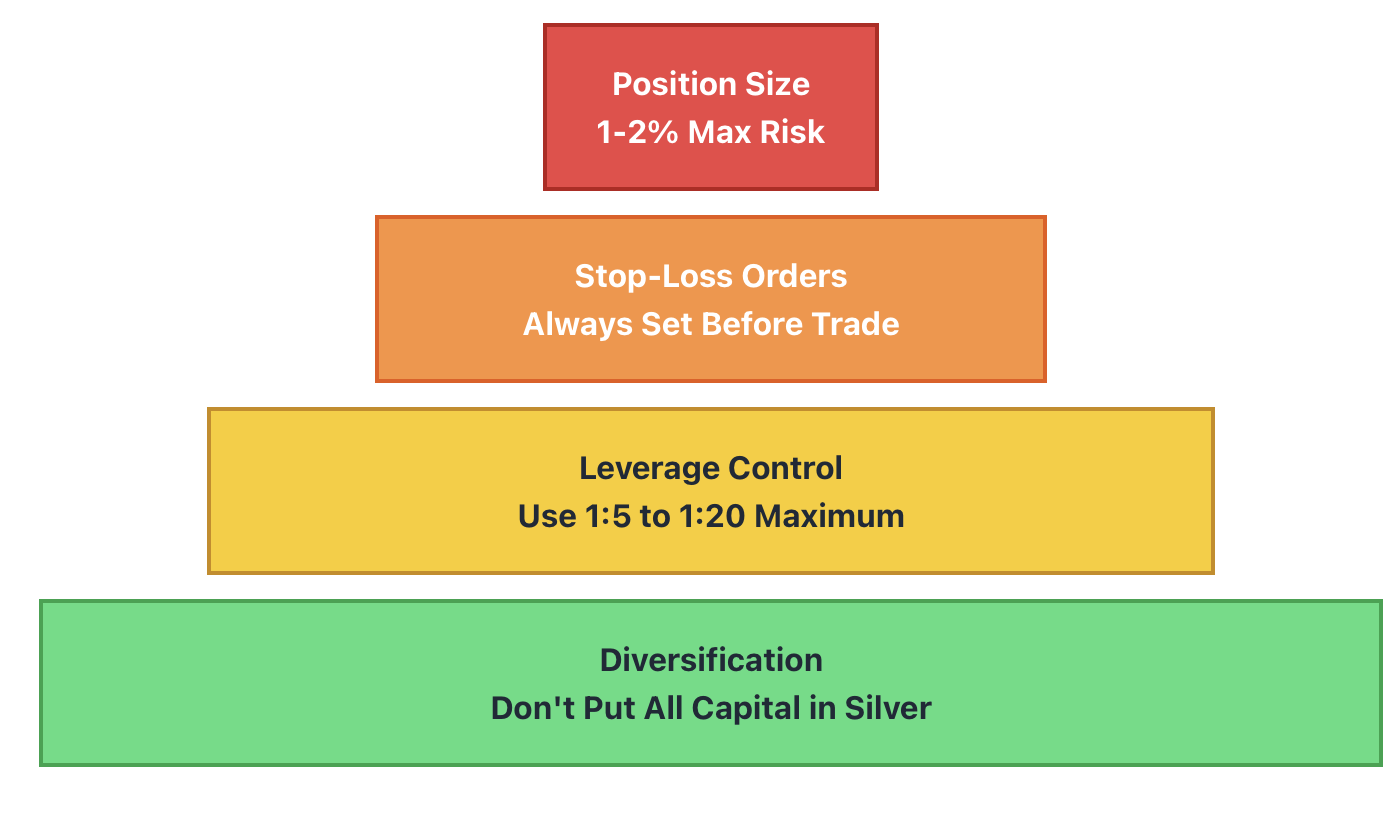
Position Size: Never risk more than 1-2% of your total trading capital on one trade. If your total capital is $10,000, you should never risk more than $100 to $200 on any one position. This will prevent chain reactions of losing trades from completely wiping you out.
Stop-Loss Orders: Always utilise them. You must establish your stop level before executing a trade; determine it based on technical levels or some percentage of your capital that you are willing to have at risk. If XAG/USD falls through your stop level, you need to accept your loss and move on with your trading plan. If you think that it will come back, you are no longer an investor but a trader hoping another "swing" will happen to save you. This is how a small loss turns into an account decline, and then, an account-destroying disaster.
Leverage: Just because your broker offers you 1:100 leverage, that does NOT mean you should use it. Most successful silver traders use leverage between 1:5 and 1:20 at maximum in trading silver. If you avoid using extreme levels of leverage, you will be able to sustain normal volatility in XAG/USD without being stopped out.
Take-Profit Levels: Greed has ended more trades than fear has. Have realistic profit levels based on technical analysis that suit your risk tolerance. You should not hesitate to take partial profits while a position is moving in your favour. For example, if you are up 50% on a position, you might want to take half off the table and move your stop up to breakeven on the remaining half.
Diversification: As a rule, you should not put all your trading capital in silver. You might want to consider diversifying across different instruments (forex pairs, indices, and even other metals) so that you do not get stuck in a market reliant on a single market's volatility deciding your fate as a trader.
Technical Analysis Tools You Should Know
Aside from moving averages and RSI, here are some helpful indicators for XAG/USD.
MACD (Moving Average Convergence Divergence): This tool helps you recognise possible momentum shifts and reversals. MACD signals bullish momentum when the MACD line crosses above the signal line, and bearish momentum for the opposite direction.
Bollinger Bands: With reference to general volatility and possible overbought/oversold scenarios, one can identify possible exhaustion in the trend when price shifts above or below its trailing averages. When XAG/USD touches the upper band, it may be overextended, and it may have been oversold if it touches the lower band.
Volume Analysis: Volume analysis is useful to confirm the strength of the price move. The trend is confirmed by the price move increasing in volume, while a decrease suggests that the trend is losing momentum.
The Beginner's Mindset
If you're just getting started with trading silver, stick with small trades. Trade in a demo account until you're able to trade your plan and strategy without any emotional reaction. When you do start trading with real money, only trade micro-lots or the smallest position size you can trade. Consider your first six months of trading silver to be an educational experience that you're paying for. Your goal during your first six months is not to become wealthy; you're main goal is to learn and survive.
Silver trading is not based on luck or gut feeling, but rather, it is based on discipline, analysis, risk control, and having the humility to accept that you're going to be wrong much of the time. The difference between successful and unsuccessful is not that they are more often correct; it is that the successful ones lose less and that they maximise gains.
Why Should You Be Paying Attention To XAG/USD
Silver has a unique position in the global marketplace. It is simultaneously an industrial metal and an investment asset, a safe-haven asset and a risk-on asset, a commodity and a monetary metal. This duality, which defines XAG/USD, makes this one of the most dynamic and opportunity-filled trading instruments available.
XAG/USD is a snapshot of global economic health. When inflation concerns increase, silver rises with it. When the dollar was positively on the rise, silver provided a context by which the strength of the dollar was to commodities. When industrial demand picks up or contracts, there is a silver price movement that happens in a way that prices will adjust based on future shifts before they appear in economic data.
The same volatility that scares some traders attracts others to silver. Silver prices move more rapidly than gold, thus creating more trading opportunities. The XAG/USD soared over 150% in five months during the 2020 rally. During a more normal year, the silver price moves +/- 20-30% every year. For traders with capital, volatility becomes potential.
The green energy transition will fundamentally change silver demand. Solar panel installations are reaching record highs, place after place around the world every year. Silver is needed to create photovoltaic cell-type panels. Electric vehicle production is scaling rapidly too, and these significantly distance cars use more silver than traditional cars. Quite simply, these are not trends; they are structural changes that move the needle for silver demand for years and years to come.
From a trading accessibility perspective, XAG/USD has never been more available. CFDs and modern trading platforms allow you to trade silver without large amounts of capital or any need to physically store silver. You can open a trading account with a small deposit, utilise reasonable leverage, and gain exposure to one of humanity's oldest forms of wealth.
Learning how to trade XAG/USD is like learning another language: the language of the global economy. You'll learn how currencies, commodities, inflation, interest rates, and trends in the industrial economy interrelate. Once you master trading silver, you can apply that knowledge to other markets.
Whether you are a beginner taking your first steps into commodity trading or a seasoned professional in search of additional diversification for your portfolio, XAG/USD offers something of value. A liquid, volatile, and fundamentals-driven market, this asset enables you to take advantage of high-quality decisions through your analysis and with your discipline.
Are you ready to trade silver on your terms? Open a Tradewill account today, trade silver XAG/USD in your own style with our competitive spreads, flexible leverage, robust trading tools for beginners and professionals that are available inclusive automated options. Your silver trading has just begun!
Disclaimer: The content of the blog does not represent any position of Trade W, does not serve as any trading-related decision advice, and does not endorse any third-party.