

 Trade W

Why 'XRP Turbo' Is Trending in 2026
The current buzz word in the cryptocurrency space is "XRP Turbo." This trending keyword is quickly becoming one of the most searched terms amongst 2026 traders.
On the European side of the house, XRP Turbo is a term used to describe the turbo certificate product, which allows for leveraged trading of XRP. The rest of the world, you don't have these. They give you more access to XRP trading than you could ever imagine.
In the crypto exchanges, XRP Turbo is the term for leveraged tokens that can magnify your profits (and your losses).
On social media, "XRP Turbo" is often simply shorthand for the extreme and fast-moving price bursts for XRP that seem to happen almost instantaneously.
The emergence of this trend can primarily be attributed to the fact that the regulatory environment has finally gotten clear for XRP, allowing for an overall increase in the volatility that traders take advantage of for the sake of XRP Turbo. You could think of the XRP turbo as fast-forwarding through XRP. Every price fluctuation that you see will be amplified to create a wave of profit potential depending on when you get in.
What exactly is XRP Turbo?
First thing’s first: Let’s summarize what it means to use XRP Turbo. XRP Turbo is a leveraged method of trading XRP. It has three primary products that exist globally.
Leveraged derivative products include contracts that derive their value from the price movement of XRP while providing investors the ability to earn significantly higher returns than trading XRP directly. When you trade these products, you're not purchasing your own XRP but rather entering into a contract with an issuer that pays you based on the price movement of XRP and provides you your return on that price movement.
Turbo certificates are most popular in Europe. These products are issued by Banks as Knock-out Products and typically offer investors between 3x and 10x leverage. Each Turbo certificate has a built-in knockout level, so if the price of XRP reaches that knockout level, the investor's position is automatically liquidated, and the investor will lose the entirety of the investment.
Leveraged tokens are tokenized positions of a fixed leverage ratio (often 2x or 3x) and maintain a fixed leverage ratio through daily rebalancing. Unlike Turbo certificates, leveraged tokens do not have knockout levels; however, the value of leveraged tokens can be reduced by volatility decay.
Turbo products, unlike leveraged tokens, are different due to their rebalancing and knockout mechanism. Turbo certificates continuously rebalance, while leveraged tokens do not. Instead, leveraged tokens can be thought of as rebalancing once daily in order to maintain their desired leverage.
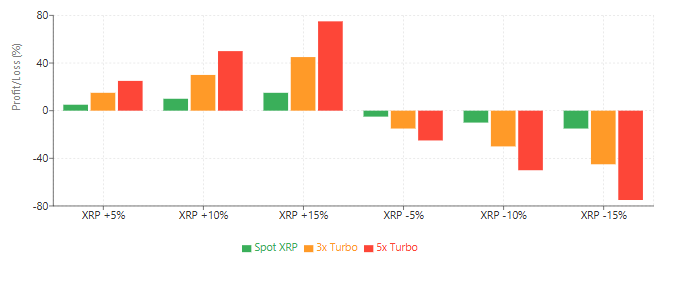
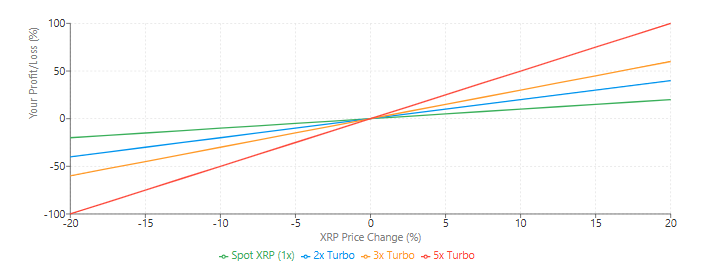
Instead of amplifying price fluctuations, as a magnifying glass would, turbo products provide a magnified price movement when the underlying asset has an increase in value (e.g., XRP increasing 5%) and can have a price movement that goes three times higher (or 15%) because of the investment in a 3x turbo product. While that sounds really good from an upside perspective, it also means that if the asset drops in price by the same percentage, the same number of points on the downside would occur with the corresponding product investment in this case.
As for the professional investors that we represent, the key to understanding the full ramifications of using turbo products is to understand Delta exposure. With a 3x turbo product, you are not only going to have three times the profit potential, but also three times the risk of losing money, as well as the associated funding cost that continues to diminish your overall profits over time.
How XRP Turbo Actually Works
The XPRTURBO Products contain a specialized concept; that of using leveraged trades. Where leverage can be a very effective tool in a trader's toolbox, it also has its drawbacks and is where many novice traders lose their money.
Leverage allows a trader to trade bigger amounts than what they have in their accounts. For example, if you buy $1,000 worth of XPRTURBO's 3x long XRP product and the price of XRP goes up 10%, your profit will be $300, not $100. However, the downside to leverage is it can work against you as well. If XRP drops by the same amount -10%- this will also cause your position to decrease by the same amount.
For leveraged tokens, Daily Rebalancing is extremely important! As such, every trading day, at the end of the trading day, the leverage tokens will automatically change their exposure so that they are back to rebalancing their leverage ratios. For instance, if you purchased a long 3x XRP token, and the price of XRP goes up 10% in that time frame, your leveraged 3x token will gained 30%. However, once again in order to maintain the same leverage, at the end of the trading day the token will once again need to increase its exposure to XRP and the purchase of additional XRP will once again occur automatically.
Volatility Decay is another important aspect of trading leveraged tokens in either a flat or sideways market (i.e., choppy market). If you hold on to a leveraged token and for instance XRP goes up by 10% then the next day it drops by 10%, therefore your spot XRP are in the same position basically; however your leveraged token is down by roughly 9% due to the way in which percentages work over time.
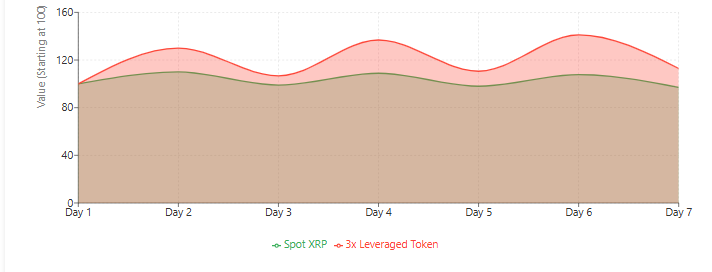
When you purchase a turbo certificate, there is a predefined knockout level. For XRP turbo certificates, the knockout level is defined as the knockout barrier. When XRP hits that price point, the turbo certificate is immediately rendered worthless to the holder; this means the issuer has protected itself from unlimited loss exposure.
The funding costs associated with leveraged products create another layer of complexity. When purchasing leveraged products, you are essentially borrowing funds from the issuer in order to increase your position size; you will incur an interest expense in the process. These costs can be included in the spread, charged daily or represented in the tracking error of the underlying product.
Here’s an example of how this plays out: suppose you purchased a 3x XRP turbo when XRP was priced at $2. Between the date of purchase and the date of breakout from a range between $1.90 and $2.10, XRP has essentially only been moving sideways. Hence, the turbo certificate suffers value decay as a result of volatility decay and funding costs, despite the XRP price itself being nearly unchanged during the same time frame. As such, you would have lower gains on your turbo certificate because you have accumulated these prepurchased funding costs.
Although converting the small waves to large waves may appear ideal, in an upward tidal wave, it would be difficult to maintain this momentum without consistent upward support as long as the rate remains within a small range.
XRP Turbo vs Spot XRP: What's the Difference?
This is where many novice traders make their first mistake. Spot XRP trading and trading XRP Turbo are two completely different things.
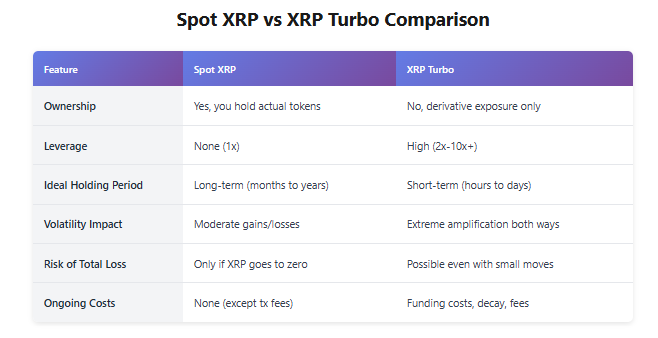
When you buy Spot XRP, you are purchasing the actual XRP tokens so that you can hold them in your own wallet, and stake them if desired, then send them to a friend, or keep them for an indefinite period of time. The only downside is the price of XRP could go down, and that's it. There are no funding fees, there are no expiration dates, and there are no knockout prices.
In contrast, with XRP Turbo, you are actually buying a derivative contract. You do not own the Underlying Asset (XRP) on the spot market; however, you are leveraging your position on the upside (buying on margin) and are making a leveraged bet on the price of XRP over a short period of time. The position you are trading with XRP Turbo can be Liquidated (activated) (if you go into Margin Call - which is not an option if you've bought Spot XRP) or completely knocked out, if the price action moves against you in the short term. So you are also going to incur continuous 'funding' costs for that leverage.
The risk profiles are an entirely different story. When Spot XRP trades down 50%, you still own the token(s), and the value of the token(s) can come back to you, either tomorrow or five years later. A 3x XRP Turbo trades down 50%, you will have lost the entire position if you always have sufficient funds to meet your Margin Call requirements, or be knocked out of the position well before that due to the nature of being a turbo certificate.
Spot XRP, which is not traded as frequently and only by a fraction of traders, is considered an investment for long-term investors who believe Ripple will be successful and see utility from XRP in the years to come. Conversely, XRP Turbo is designed for short-term traders looking for volatility, who want to take on a large amount of risk in hopes of achieving a large payoff.
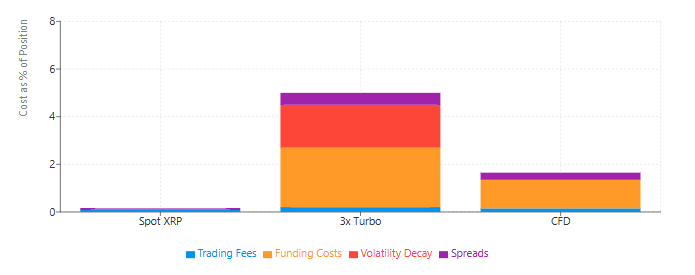
Professional traders should keep in mind that liquidity and spreads are very important when making trades as well. While spot XRP can be traded on many exchanges, with a very tight bid/ask spread, the Turbo products typically have a wider spread, less liquidity, and thus, greater expense to the trader (the "trader" being defined as the person who actually trades the Turbo product). When considering the Funding Rate on leveraged tokens (which can spike dramatically in a volatile market), the actual cost to trade the Turbo product will often be much greater than what was initially calculated.
XRP Turbo vs XRP CFDs: Which One Makes More Sense?
Now we're at the point where active traders must make an important decision. Both product offerings – XRP Turbo and XRP Contracts for Difference (CFDs) – provide leveraged exposure. However, they are essentially two different products.
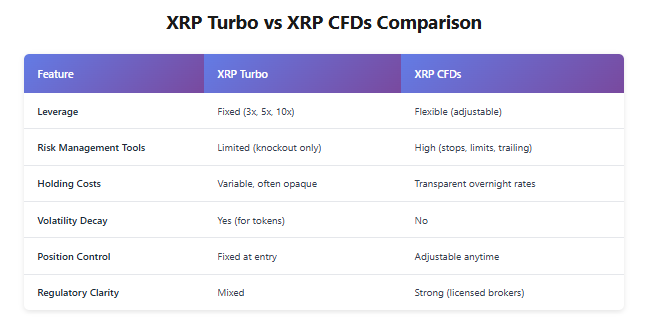
Flexibility of leverage is one of the main distinctions between Turbo products and CFDs. If you buy a 3x Turbo certificate, there will be no way to change the leverage ratio, which remains at 3x. CFDs, on the other hand, allow you to control your specific leverage ratio for each trade as well as to make adjustments to the size of your positions.
In addition, there is a considerable difference between the overall costs and fees associated with Turbo certificates and CFDs. Turbo certificates often include knockout premiums in their pricing structure, making it difficult to determine how much they truly cost. Conversely, leveraged tokens charge a variable funding rate based on current market conditions. In contrast, CFDs have a predictable spread and overnight financing amounts that you can calculate before opening a trade.
Risk management capabilities differ significantly. In the case of Turbo products, the best way to manage your risk is to hope the price will not hit the knockout threshold or to watch your position decline over time. Alternatively, CFDs allow you to set explicit stop-loss and take-profit prices, and thus, you can adjust your trading size dynamically. Essentially, with CFDs, you control your exit strategy rather than being subject to automated knockout limits.
Traders often overlook the impact of regulatory oversight. In Europe turbo certificates are offered by banks with some level of regulation, but availability varies by country. The regulatory environment is much less clear on leveraged tokens available on cryptocurrency exchanges. Established CFD brokers adhere to strict regulations governing their operations, including separate accounts for client funds as well as investor protection schemes.
A beginner might think of CFDs like an adjustable speed bicycle which allows you to modify speed and stop as needed. Turbo products are locked into a fixed speed and can be very thrilling when there’s no need to slow down. However, if you need to reduce your speed quickly, it can lead to disaster.
A professional trader would think about the difference in microstructural elements between these two types of products. Turbo products incorporate optioriality within them, creating uncertainty around the pricing of these products particularly in times of high volatility. Conversely, CFds are priced more closely to the spot market, which makes it easier to calculate both the Profit and Loss (P&L) on your CFDs. You will not experience volatility decay with CFD positions in flat or sideways markets, which can occur with leveraged tokens.
What's Driving XRP Turbo Popularity?
Anticipating future trends and opportunities depends on understanding why XRPs Turbo products are exploding in popularity.
The primary reason for the popularity of XRPs Turbo products is improved regulatory clarity regarding XRPs. As a result of the SEC lawsuit ending, institutional investors have begun providing liquidity into the XRP market and experiencing experience in trading XRPs. This has created a self-reinforcing cycle of liquidity, volatility, and leverage.
Ripple is rapidly growing its enterprise customer base, offering its services of RippleNet to many of the largest banks and financial services organizations globally for cross-border payments. Each time Ripple announces a new banking or financial service organisation partnership, it creates a tradable event, which results in increased demand for Ripple Turbo products as traders look to use leverage to increase their profits on these very short-term price movements.
The crypto risk-on cycle is incredibly important for XRP, as prior to a Bitcoin rally and the beginning of an altcoin season, traders are looking to trade a high beta altcoin like XRP. Because XRP has liquidity and volatility, it becomes one of the highest beta plays, and in addition to the liquidity of XRP, employing leverage makes XRPs Turbo products fly off the shelves.
XRP's market volatility also plays a significant role in the demand for XRPs Turbo products. XRP consistently experiences daily price fluctuations of 10%-20% during large market movements, and for a trader, this volatility is deemed 'golden'. Using leverage, XRPs Turbo products can be used to turn a 15% price movement into a 45% gain (or loss). The more volatile the market situation, the more attractive leveraged products become, even considering the risk associated with them.
There is no denying the influence of social media on cryptocurrency trading. When TikTok and Twitter influencers hype XRP before a rally, it creates a fear of missing out (FOMO) zone that attracts many new traders. This type of social hype is often followed by large short-term price surges, which is when turbo products provide traders with a great opportunity to make significant returns if they time their trades correctly.
In addition, traders on the professional side should pay close attention to the options flow and the liquidity zones on XRP. When institutional players are starting to create large positions in XRP options, it foreshadows a larger price movement in the spot market. In this way, turbo products enable smaller traders to participate in the same momentum as the institutional players without the same capital requirements.
Analysis of trader sentiment has helped to establish a clear correlation between social media activity and the price of XRP. Wherever "XRP" is currently trending on Twitter, it is likely that "mooning" or "breaking out" will trend with it, resulting in a spike in price volatility over the next 24-48 hours. Traders that enter into long positions during these social media waves, and who use leveraged products, can experience a large increase in their returns.
Key Risks of XRP Turbo
What goes wrong is that a majority of traders concentrate on their potential profits while not thinking once about any of the risks, many who think they will not have their accounts blown out by unforeseen issues.
Leverage creates an apparent risk that needs to be restated frequently. A position that is leveraged by 5x means that a price decrease of 20% will take away all of your investment. For example, within the last 24 hours, XRP has moved up and down by as much as 20%. During the 2021 Bull Run, XRP moved up and down by as much as 40% in as little as a few hours. With leverage, you can be in a winning position to be liquidated before you even look at your phone.
In the case of a turbo certificate, knockout risk can be quite severe. You could be correct about the direction that an asset will move but wrong with respect to the time frame that it happens in. If XRP price falls below your knockout point, you have lost the value of your investment, and if XRP does subsequently move to the level you expected, you have lost out entirely and will not participate in the profit that would have occurred. You are out of the position at the time when it is most opportune, i.e., when the knockout occurs, generally, when prices are supported at a more favorable level.
Choppy markets create significant losses to leveraged token holders due to volatility decay over the time that they are in a position. This is not a theoretical statement: During sideways market action over extended periods of time, leveraged tokens can experience losses in the range of 30%-50% over short time frames, even though the underlying asset has not changed prices. Continuous daily balancing of a position in a market with a limited price range creates ongoing pressure that cannot be reversed.
The counterparty risk of holding XRP means you don't have the crypto itself but a product from an exchange or bank backed by that exchange or bank; should they run into problems (go out of business, become bankrupt, or get hacked), your turbo product may become worthless regardless of how much XRP is actually worth. In this way, many users of leveraged tokens have lost everything when their underlying cryptocurrency was still around.
Extreme volatility creates liquidity problems; a turbo product could have a very wide bid-ask spread during extreme volatility and be difficult to exit unless there is significant price movement in your favour. One day you could see XRP go up 30%, but you may only be able to sell your turbo product for a 60% profit instead of 90% as you expected. Or even worse, you may not be able to sell at all due to lack of buyers.
Turbo products can be compared to racecars with weak brakes. They can be incredibly fun during accelerations, but when you need to slow down or stop while going over 200mph, you might not be able to do so in time.
If you are a pro using turbo products and have modelled for time decay correctly, you should be aware that leveraged trades are about more than just the price moving in your favour. Factors contributing to Thomas and theta decay will keep compounding every day, with the impact from the embedded optionality in your turbo certificate, changes to funding rates within your perpetual future contract, and costs associated with re-balancing tokens. You need to run the numbers to determine how much XRP will need to move just to recoup your costs after having held for a week.
Trading Strategies for XRP Turbo
To successfully trade these fast-moving tokens, you’ll need more than just buy and hope. You'll need a systematic plan that involves breakout trades.
The breakout trade implementation is ideal for XRP Turbo because it leverages exponential price movements. The best method to implement breakout trades is to create an alert at points where XRP exhibits sideways price action. The first step is to identify a trend with an increasing volume and/or confirmed with moving averages, and then configure alerts based on breakout prices.
Once the alert is triggered, enter a turbo position when the price breaks out on increased volume. The turbo product will allow you to magnify your profit potential as the price surges sharply from the breakout. You will want to exit quickly after price momentum has waned because turbo products are not designed for multi-day positions.
Momentum trading is about riding trends that have already been established. If XRP exhibits an established trend with increased volume and moving averages, you can take advantage of the turbo long position on an XRP price increase. The primary entry method during the trend for turbo product investment is during a correction (pullback) as the price restarts after a period of decreases. The primary risk factor in the turbo long position is the timing of when you enter.
Mean reversion investing also occurs and can be very profitable, but you must be very careful. If XRP moves dramatically on low volume or speculation and then you predict or believe there will be a subsequent mean reversion move by employing an inverse turbo (short position), you can profit from it. But, always remember that cryptocurrency prices do not conform to means the way traditional equities and commodities do, so place stop orders at very tight levels.
An advanced technique is Inverse Turbo Hedging- A trader will buy an Inverse Turbo when they feel they will have Short term weakness but have a position they want to hold for the long term, therefore using the Turbo as hedging against their long position. When XRP goes into a dip, the trader may have a loss on their spot XRP position, however they can profit on their Turbo position while not selling their actual XRP position (funny business is done, so it costs money but may also be worth it for protection of a trading position).
For novices, one of the easiest ways to trade is to use Relative Strength Index (RSI) to determine whether or not the market is overbought (above 70) or oversold (below 30).
If RSI reads oversold, then wait for XRP's price to reverse and enter into a Turbo Long with an exit plan in place. Do not be overly greedy and wait to take the profit at resistance levels.
For experienced traders, liquidity sweeps and analysis of order books are key factors. Large players tend to push through key price levels with the goal of triggering stop losses and liquidations before ultimately reversing.
Locations where one may observe patterns similar to these will give a trader the opportunity to use Turbo Products due to the amplified returns that they will receive from the reversal of the market. Pay particular attention to unusual volume spikes occurring in close proximity to support and resistance zones. Often these volume spikes will precede explosive market movements.
Volatility breakout models, when created in conjunction with Turbo Products, show great potential for use with Turbo Products. To develop the model, one must calculate XRP's Average True Range (ATR) over 14 days and identify price compression (below 0.5x ATR) as an indicator for future volatility expansion.
When XRP Turbo Actually Makes Sense
While many of the XRP Turbo Products are often overkill, there are certain situations where they can serve a useful purpose:
Short Term Trading Events: When Ripple’s news regarding new partnerships or when an SEC ruling occurs, XRP will have dramatic movement within a short period of time. Turbo positions can convert a 10% increase into a 50% increase in an hour if you are ahead of the curve and position yourself correctly.
CPI and FOMC Volatility Windows for ALL Market Types including Crypto: When the FED announces interest rate decisions or releases CPI data, XRP can swing high and low with the other risk related assets. Having an understanding of both how you want to trade the volatility and how to utilize small amounts of capital, turbo products will enable you to do this.
Updates on XRP’s lawsuit vs the SEC: Several of the major updates regarding this case produced a tradeable event every 3 months. Every time there was an important filing, a judge made a decision or a possibility of settlement, they caused XRP to move in the range of 15-30%. Traders that kept up with the litigation calendar and positioned themselves ahead of announcements were rewarded handsomely by using leverage products.
Typically, the most profitable trades are with traders who have a lot of capital to put to work in an effort to profit from low liquidity-driven trades. Therefore, when you find an opportunity through elevated levels of activity, the trader has the ability to take advantage of it.
Taking advantage of elevated levels of activity is a good strategy for beginners, as you can usually achieve your objectives with minimal effort, assuming that there is little or no competition for the specific asset you are targeting. You should always attempt to keep your trading positions small relative to the total of your investment portfolio (typically 1% or less).
For more experienced traders, when an elevated level of activity is found, it presents a golden opportunity for them to take advantage of the discrepancy and earn a profit through arbitrage with other comparable markets.
In order to accomplish that objective, a trader must be able to both monitor the situation frequently and respond quickly to changing circumstances. Therefore, if you wish to take advantage of your increased level of activity, then you must use either a turbo product or some form of future contract.
Keep in mind that you should consider using turbo products primarily for a specific and limited time duration where you have a high level of confidence in your potential return on investment.
Who Should Actually Use XRP Turbo?
Anyone who has several years of experience trading and being profitable can potentially trade turbo products. If you have traded through the up-and-down markets and have experience with position sizing, plus also the discipline to quickly stop out, then you have the right base to trade them.
Speculators who are willing to lose their entire investment and understand that they are doing something with the equivalent of "gaming money" (i.e., setting aside money that will not affect their financial future) should be considered for turbo products; you will be able to see the greatest gain, but you have to remember that you are gambling.
Short-term scalpers who spend time watching charts and can exit positions quickly (i.e., within minutes or hours) have the best alignment to turbo products. If you are able to monitor price action all day (through charts or alerts) and do the necessary technical analysis to make sound decisions, you are in a position to take more risks compared to someone who looks once a day.
People that should not go near turbo products for any reason:
People who are long-term holders, who believe in the future of XRP, and are not active traders or traders. They should look to simply buy on the spot and hold.
New traders who have a low risk tolerance will panic when volatility occurs, and they will sell at the worst time. If you cannot look at the markets each day, you should not trade turbo products. If you check your account every week, you are asking to be taken out at the worst possible time.
Simple Test: If you don't like the idea of losing your entire position in one day, do not trade XRP Turbo. If you cannot handle a 30% drop, then trade only infringing or lower amounts.
Put yourself in the position of an inexperienced trader. For example, if you cannot watch the markets 24/7, do not use turbo products because they require these qualities; without them, most traders will fail.
XRP Turbo Outlook for 2026
What do you think the XRP market will look like in 2026?
As the regulatory framework for XRP has been established, it has enabled and allowed institutions to increasingly adopt XRP as a means of settlement; it creates the opportunity for XRP to be used as a settlement vehicle between more payment corridors globally. Because of the number of corridors, XRP has an increased utility and therefore can be assumed to provide additional price appreciation for investors of XRP, creating additional trading opportunities.
From an institutional perspective, this is the "wild card." Long term, if there are significant banks that have publicly announced their plans to integrate XRP into their cross-border settlements, there could be a sustained rally in XRP prices that is unmatched by anything in the market and could create an environment in which traders that use leveraged products will achieve higher profit levels than they would traditionally. Keep an eye out for announcements from Ripple's enterprise clients.
Regulations for XRP in the future are positive and will lead to a decrease in the unknowns surrounding this area of the market as more jurisdictions are likely to follow suit from the U.S. for XRP classification. Less uncertainty usually leads to tighter ranges prior to the next event catalyst, which isn't optimal for turbo holders, but very favourable to directional trades during periods of breakout.
Overall crypto market cycles will primarily determine the price direction of XRP in the future. Usually, when there is a new bull phase in Bitcoin, many of the altcoins, including XRP, typically trend up with even more extreme trends. Many macroeconomic factors will indirectly affect XRP. As the tide rises, leveraged products for the crypto market will benefit the most.
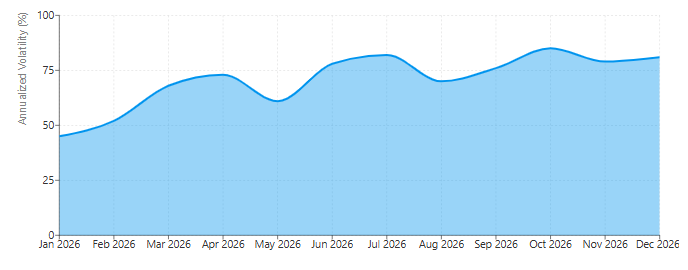
Expect XRP's 30-day Realized Volatility to remain high, between 60 and 80% Annualized, through 2026 from a Volatility Forecasting perspective. This is almost twice the volatility of Bitcoin, making XRP one of the highest Beta coin investments.
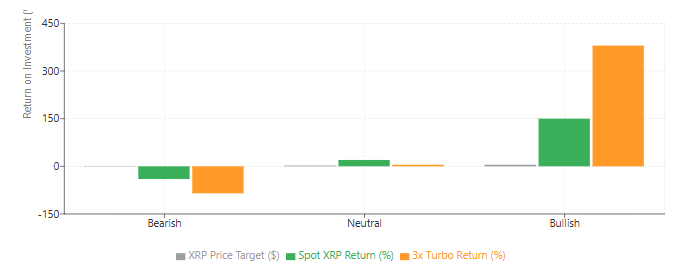
Investors need to evaluate the potential outcomes of XRP, through a scenario analysis in late 2026, as follows:
-
A bullish outcome would see XRP breaking through $3.50 when large institutions adopt XRP, with a rally up to $5, providing 3x to 10x returns on Turbo products. However, the potential volatility would spike up to 100%+ Annualized.
-
In the neutral position, XRP would trade in the $2 to $2.80 range, likely to see choppy trading and driven by news events, but where turbo products may show losses due to decay, however spot holders would likely do very well while leveraged trading will be difficult.
-
From a bearish scenario standpoint, macro-economic fears of recession, or crypto regulation elsewhere, would push XRP down to $1.20; thereby knocking out turbo longs and effectively providing massive profits to those in inverse turbo and other short products.
More clarity does not necessarily equate to greater stability. More clarity generally results in more interest and, therefore, more capital, which, in turn, results in more volatility. If a trader is trading turbo products, then volatility is the trader's friend; however, the trader must ensure they are on the correct side of the trade.
Final Thoughts: Is XRP Turbo Right for Your Trading?
XRP Turbo products have a high-profit potential, but they are tools designed for a specific type of trader in a specific set of circumstances. They are not superior or inferior to spot XRP or CFDs, they are additional types of investments designed for different goals.
XRP Turbo compounds everything - gains, losses, fees, risks, emotions. They require an active trader with strict discipline and willingness to accept that all of the capital may be lost. If you cannot accept that fact, do not trade XRP Turbo products.
Most traders would benefit more from trading XRP CFDs because they provide a superior balance of leverage (when necessary), flexibility in adjusting positions, cost transparency, and professional-level risk management tools. No more knockout triggers closing a position when it’s most vulnerable. No volatility decay negatively impacting a trader's position in a sideways market.
Regardless of which products you choose to invest in, do not risk more than you can afford to lose completely. Position sizing will matter more than any entry price. Having a plan will matter more than having a strong belief. The market does not care what you think; it only cares about the price movement.
Ready to trade XRP with professional tools and transparent pricing? Open a demo account at Tradewill.com and practice your strategies risk-free before committing real capital.
Disclaimer: The content of the blog does not represent any position of Trade W, does not serve as any trading-related decision advice, and does not endorse any third-party.