
 Trade W
Every trader eventually runs into the same fork in the road, and the question rarely has a clean answer. Should you buy assets and let them sit for years, or should you chase price movements every single day? The debate around long-term investing versus day trading has only gotten louder in 2026, fueled by record retail participation across US stocks, forex pairs, and crypto markets, plus a macro backdrop that keeps swinging between rate cuts, AI-driven equity rallies, and sudden bouts of volatility. Add cheap platform access and easy leverage into the mix, and you get millions of people staring at the same question without a textbook answer waiting for them.
This guide breaks the decision down properly. It covers what each strategy actually involves, how the risk and return profiles compare side by side, the mistakes beginners make most often, and how you can figure out which path suits your personality, schedule, and capital. There is no universal winner here. The right strategy depends entirely on who you are and what you are trying to build.
What is long-term investing?
Long-term investment strategies involve purchasing an asset (most commonly ETFs or index funds) and subsequently holding onto the asset for multiple years (as opposed to simply holding on to an asset for a few days). This strategy relies on one really powerful mechanical force: compounding returns. Once you begin reinvesting your returns back into your investment year after year, the growth accelerates in such a way that it feels slow until it starts to speed up extremely quickly. If you've ever wondered whether $5,000 could realistically turn into $1 million, all of the mathematics for that opportunity comes down to compounding, not to good fortune or good timing.
Investors who are in it for the long haul often choose investments like the S&P 500 ETF or individual blue-chip stocks or investment vehicles that track the entire stock market. Once they've made their investments, they seldom make many trades. They will only trade infrequently. Their emotional involvement with their investments is also comparatively low because they don't have to spend the time checking the candles on their charts, nor do they have to worry about paying transaction costs, because they're not continuously having to pay the cost of establishing their trades (spreads/higher commissions for short-term trades).
One of the biggest challenges that a long-term investor will face is patience. Most long-term investors will go through at least one bear market over the course of their investment and will experience drawdowns from time to time, but over the span of an investment period (generally a period that will exceed 10 years), long-term investors can expect to be rewarded by the growing trend of the market over time.
When considering long-term investing, there are several key metrics that should be analysed. Key metrics include CAGR (compound annual growth rate), which measures the growth in an investment's value over time, and beta, which is a measure of an investment's volatility in relation to the overall market.
Investors have to deal with the impact of inflation on inflation-adjusted returns of their investments, long-term bear markets, and opportunity costs from having their capital tied up in one place rather than pursuing higher-return investments. Long-term investors may think of their investments as similar to growing a garden. You water your garden on a schedule (weekly), you do not dig up your garden every week to check the growth of the roots, and you do not really know how much your garden has produced until the end of the growth season.
What is day trading?
Day trading completely changes this approach. Instead of holding on for years, Trading now means that you will open and close trades within minutes or hours instead of days or weeks, to take advantage of small price discrepancies over short periods of time (e.g. EUR/USD) or small movements during the same day on other exchanges (e.g. BTC and ETH) or from one hour to another in the case of NASDAQ stocks. If you would like to learn more about how to do this, please read the ultimate guide to forex day trading, which explains how to do this in detail and provides examples and practical guidance for how day traders will take advantage of these opportunities via step-by-step day trading strategies for 2026.
Technical analysis is often used in day trading to make trades based on signals from price movements and patterns created by candlesticks, levels of support and resistance, and momentum indicators, etc. The other main tool traders use to trade is leverage, which is often utilised to turn smaller price action signals into a more meaningful return, but can also turn an otherwise small movement into an equally large loss. Spreads, commissions, and overnight swap fees chip away at profits, which is exactly why cutting trading fees and commissions matters so much for anyone trading actively.
The risks of day trading are well established and are real. Some examples include emotional decisions due to overtrading or from stopping after a string of losses, and the high failure rates that daily active traders experience, especially for new traders. Day trading is very similar to selling items on the street at a market every hour, versus starting and building a business.
Long-term investing vs day trading: the core comparison
Here's where the two strategies diverge in ways that actually matter for your wallet and your sleep schedule.
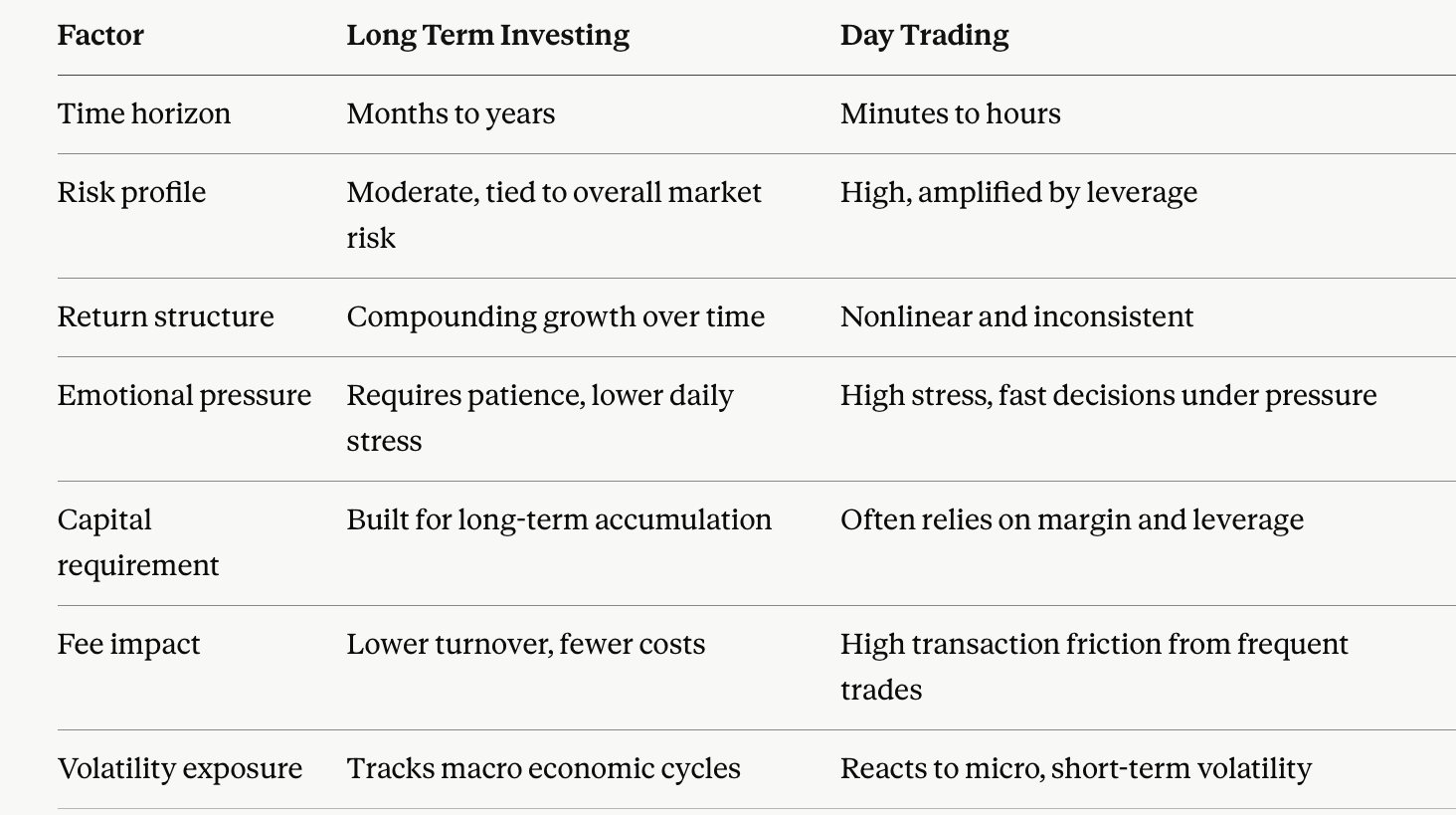
The main distinction here is between risking over the long-term and making money while taking risks in a very short period of time. The first option takes advantage of the upward drift of the markets over long periods of time. The second method attempts to make money from small movements in the price of a security and uses techniques such as leverage, technical indicators, and patterns of liquidity to achieve such profits, which can be successful for some traders and cause others to lose all their capital.
Long-term investing is similar to owning a business for a long time and watching the value compound. Day trading is similar to having a booth at a busy market where you constantly buy and resell items on an hourly basis. Because of the high skill ceiling and the high burnout rates with day trading, many people who enter day trading will not last very long due to a lack of success.
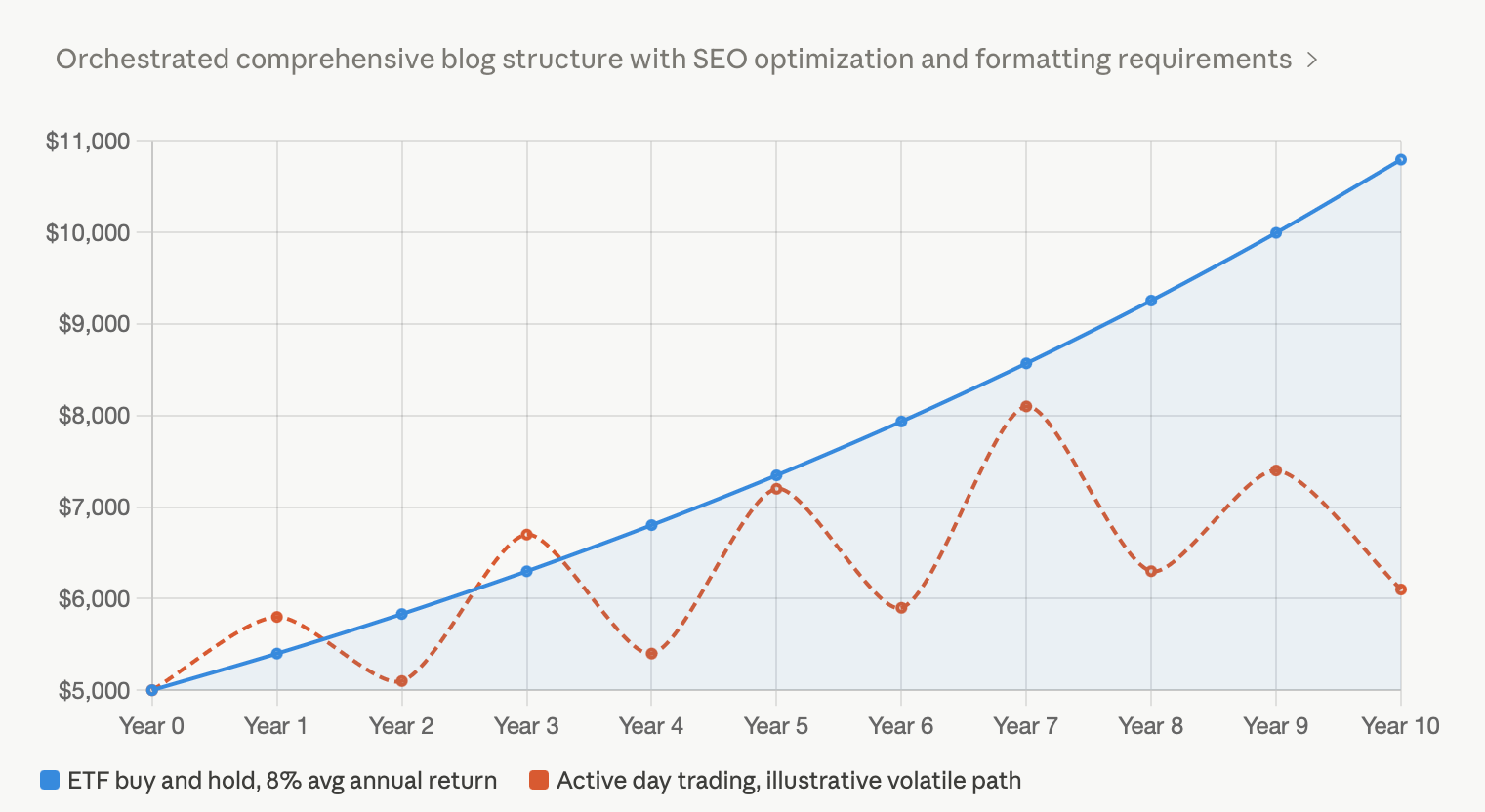
Capital growth, side by side
The chart above shows this very clearly with an example of building capital from a $5,000 starting balance over a period of 10 years. A buy-and-hold ETF with an average annual return of 8% will grow to about $10,795 after 10 years, with no manual transactions being made regarding the shares of the ETF. An account that uses trading methods may produce profits during individual segments of time but tends to produce a choppier and less predictable result when all costs, fees, and emotional errors are taken into consideration over a full 10-year period. Because neither path is guaranteed and the visual difference between the two methods can be significant, this is why many financial advisers will often recommend the more boring buy-and-hold strategy for their clients.
Pros and cons of each strategy
Neither approach is purely good or purely bad. Each comes with trade-offs that suit different people.
Long term investing pros
-
Compounding returns that accelerate the longer you hold
-
Lower day-to-day stress since you're not glued to a screen
-
Potential for passive income through dividends and reinvestment
Long term investing cons
-
Returns build slowly, which tests patience
-
Full exposure to market downturns and bear cycles
Day trading pros
-
Faster profit opportunities when executed well
-
Flexibility to act on short-term opportunities across multiple markets
-
High engagement for traders who genuinely enjoy active analysis
Day trading cons
-
High failure rate among beginners
-
Emotional burnout from constant decision-making
-
Leverage can magnify losses just as easily as gains
Which strategy should you choose?
The way to choose a strategy comes down to risk tolerance, liquidity, and how much time you can dedicate to the market. To achieve that goal, there are ways to ask yourself to narrow down those three parameters.
Are you naturally patient or do you get restless waiting for something to happen? Do you have a job that takes most of your time so you do not have much chance to look at charts, or do you have more flexibility in your job and can look at charts anytime you want? Would you like to watch a position go against you without worrying about it, or do you worry about it when it starts to go against you? Is your money for growing over many years, or is your money for actively investing and reinvesting? And honestly, what is your current technical skill level, beginning level or advanced enough to know chart patterns and order flow?
Bearing in mind, this is about growing a business at a slower pace over many years or being in a fast-paced business that requires your attention daily. Some people are able to work in a fast-paced environment, others need a lot of time to get there. Most every guy we see on TV is able to work in a fast-paced environment, but it has taken them many years of experience to get there.
Common mistakes beginners make
Multiple patterns occur repeatedly with novices regardless of the method they select. Overtrading is a typical example of novice traders, particularly among day traders, where their decision-making ability is negatively affected due to the emotional pressures of needing to take action. Newer traders frequently have unrealistic expectations regarding how quickly they will be able to profit from trading and become disenchanted with trading when the markets do not respect their time frame for success. Another opportunity to lose money is neglecting to pay attention to the impact of transaction costs. While small transaction fees may seem minor, they accrue at the same rate as any profits would. Many newbies also participate in revenge trading, where the person tries to make up for losses immediately by increasing the size of their next trade to higher levels of risk.
Revenge trading typically leads to the person digging a deeper hole instead of filling it. Skipping proper risk management, like ignoring bid-ask spread costs or position sizing, sets traders up for outsized losses. And copying strategies from forums or trading signal services without understanding the logic behind them rarely ends well, since strategies that worked for someone else's risk tolerance and timeframe may not fit yours at all.
How to start either strategy
Simple is good for a start, but for some structure helps. The first step in finding an appropriate broker for trading will help to determine what type of assets you would like to trade: stocks, forex, or cryptocurrency. After you find the right broker, open an account using a demo account. Take some time to practice trading with the demo account until you feel confident enough to invest real money. Opening a demo account is a great way to prevent yourself from making mistakes that could have easily been avoided had you opened a demo account before placing a trade with real money.
After you have created a practice account using a demo account, create a risk management plan to use prior to placing your first real trade. Always establish stop-loss orders and position sizing rules prior to making a trade. Additionally, utilizing a charting platform such as TradingView or an execution platform such as MT4/MT5 is essential to performing your analysis and executing trades. Long-term investors can use a standard ETF broker which is sufficient for basic investment needs. Finally, the last step is to invest small amounts of capital until you have demonstrated that your strategy is consistently profitable before moving to larger amounts.
This is also a good moment to revisit the basics that often get skipped. Concepts like cost averaging, why blue chip stocks earn a place in long-term portfolios, and how capital efficiency shapes returns over time all matter more than most beginners realize before they start trading actively.
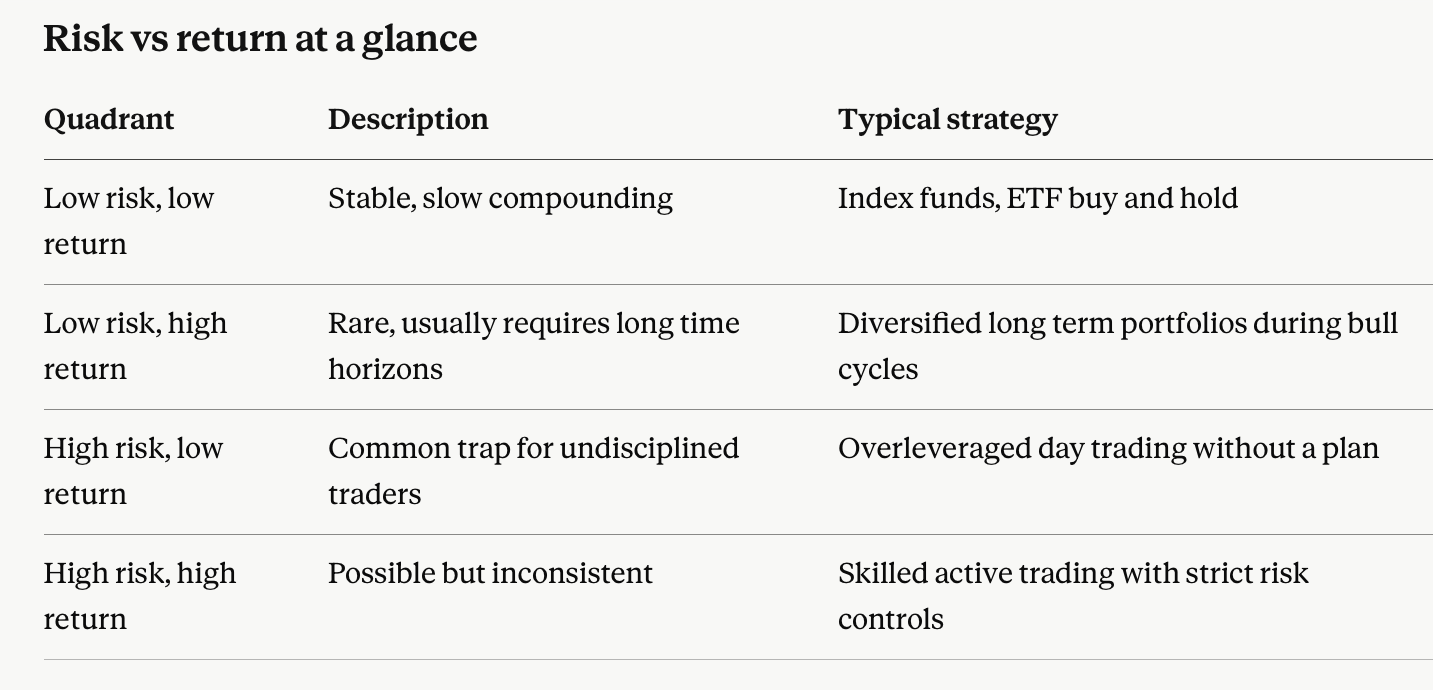
Conclusion: building your personal investment decision framework
The topics here are far too complex for there to be one definitive “best” option, and anyone who tells you there is one is trying to sell you something. What it all boils down to is the pure discipline and forthright assessment of the time frame that you are individually comfortable with, and how calm you can remain when problems arise. If the least amount of hassle and a passive investment type of approach is most important for you, then you should invest long-term in exchange-traded funds (ETFs) using diversified investments as the best method to achieve those goals. If you want to actively trade, then if you are willing to put forth the time and effort it takes to actually learn the algorithmic and quantitative approaches that are necessary for success, you can find short-term trading to be successful; however, this method takes significantly more effort, time, and risk ahead of time than long-term investing does. In fact, many long-term traders do well with both investing strategies by creating a solid core long-term portfolio (which will allow them to benefit from compound interest) and then allocating the residual amount of money they've decided is acceptable to use as an active trading account (allowing them to have fun chasing potential short-term trading opportunities without risking their future financial existence on one form of investment).
Start building your strategy with real tools, not guesswork. Open a Tradewill account today and trade smarter across forex, stocks, and crypto, all from one platform built for both patient investors and active traders.
Disclaimer: The content of the blog does not represent any position of Trade W, does not serve as any trading-related decision advice, and does not endorse any third-party.