
 Trade W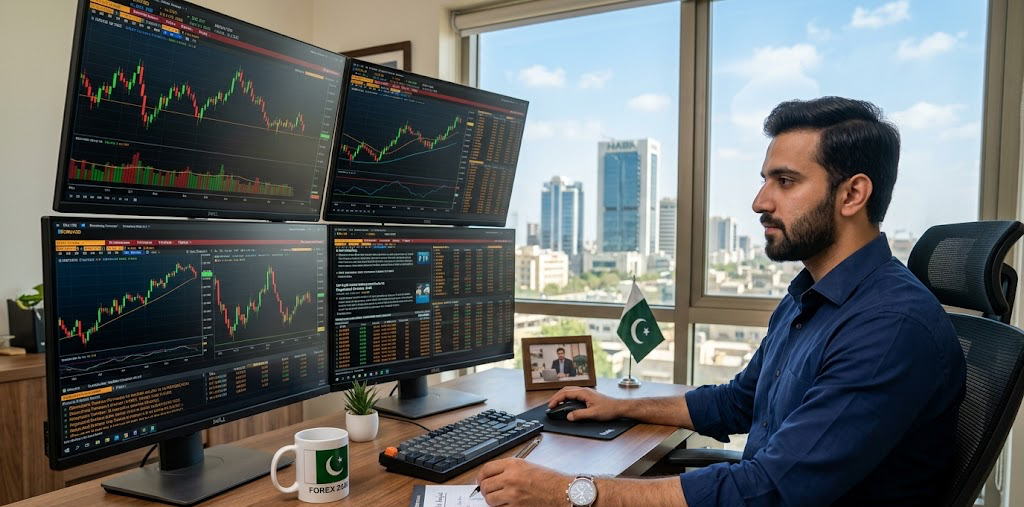
The best forex brokers are those licensed by top-tier regulators such as the FCA, ASIC, or CySEC, operating in Pakistan, offering competitive spreads, providing deposit and withdrawal methods that comply with SBP guidelines, and supporting MT4/MT5 platforms as well as Islamic accounts. Always verify a broker's registration with the relevant regulator before investing your first rupee.
Introduction
When selecting a provider of foreign exchange services, it is important to look beyond the low trading spreads advertised by brokers. In addition to reviewing a broker’s marketing materials, you should consider three factors that will have a greater impact on your experience than the size of a spread: Is it legal to trade forex in the country where you live? What protections are in place for your funds through a credible regulatory authority? Will your deposits and withdrawals be processed efficiently, or are delays likely due to payment processing issues?
Traders in Pakistan operate within a very different regulatory environment from traders in countries such as the United Kingdom or Australia. Most global lists of the best forex brokers do not account for these differences and, therefore, do not accurately reflect which brokers provide the best trading experience for residents of Pakistan.
This comprehensive guide to finding the best forex brokers available to Pakistani residents in 2026 uses a transparent and objective methodology to evaluate the top 10 brokers. Here you will find a comparison table covering five categories, an explanation of how we rate brokers, an answer to the question of whether forex trading is legal in Pakistan, a dedicated section covering the realities of deposits and withdrawals from foreign currency accounts under the SBP's Foreign Exchange Control regulations, and a practical checklist to help you make an informed decision based on the information provided.
If you are new to forex trading, this guide also includes a separate section that provides a basic overview of how forex trading works. If you already have a foundational reading financial statements and market structure, you can use this guide to quickly gather the information you need and make a decision.
When experienced forex traders decide to switch brokers, the first question that comes to mind is, Where are my funds held, and how can I get them back? From the perspective of a first-time trader in Pakistan, the more pressing question is often, If something goes wrong with my funds, is there anyone I can speak to? This article provides answers to both of these questions.
Top Forex Brokers in Pakistan (2026): At a Glance
As a trader based in Pakistan, you will want to compare brokers and verify their ability to legally provide services to you. Below is a comprehensive list of criteria that you can use to compare brokers, including their regulatory status, minimum deposit requirements, spreads offered, and whether they accept traders from Pakistan. The following table contains an explanation of each column to help you compare brokers effectively.
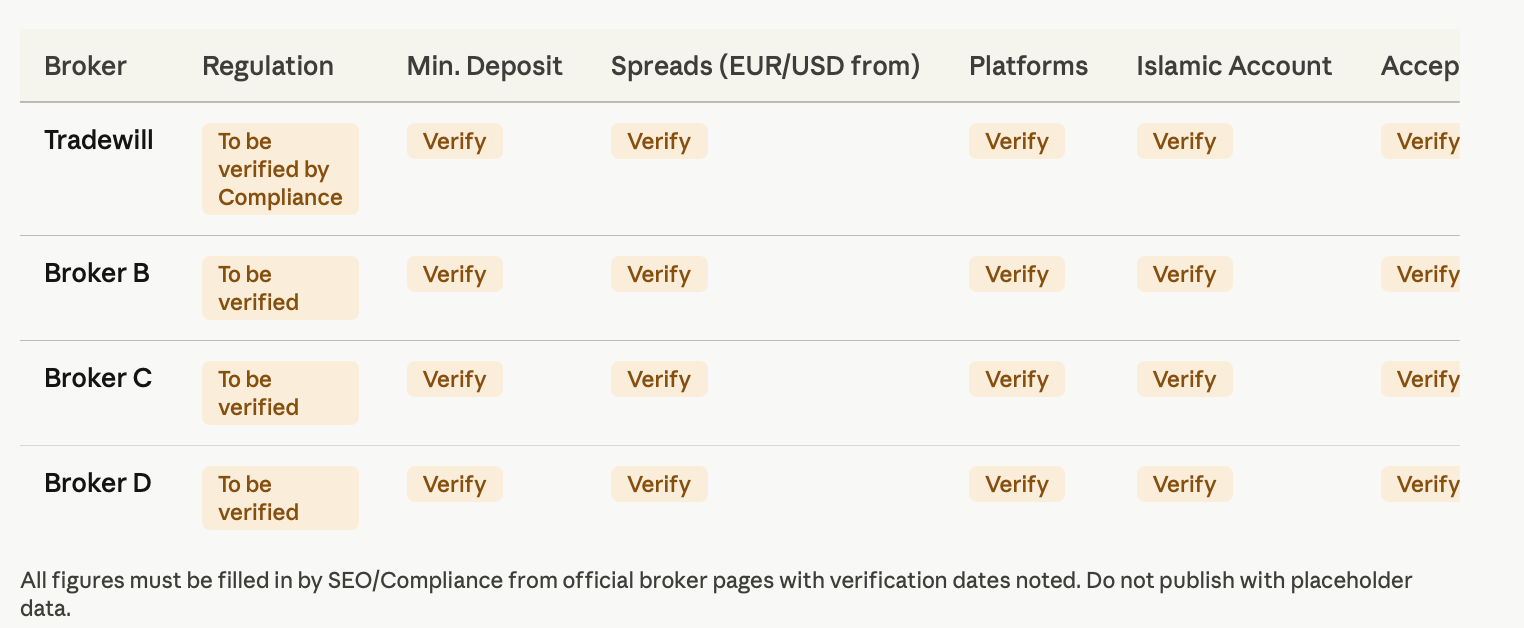
After Compliance has completed this table, the Best For section will show how we rank each broker based on several key categories. These include overall broker selection, which takes into account regulation and deposit security; the best option for beginners, based on the lowest minimum deposit, availability of a demo account, and ease of use of the mobile app; the best ECN or raw-spread account, based on spread and commission structures; and the best MT5 offering, based on platform features, available timeframes, and the range of instruments available across both MT4 and MT5. Below are comparisons of the other brokers included in our rankings and an explanation of how they were rated.
Before depositing funds with any of the brokers listed above, it is advisable to open a free Tradewill demo account and test your chosen platform. This allows you to trade in a risk-free environment while determining which account type best suits your needs.
Is Forex Trading Legal in Pakistan?
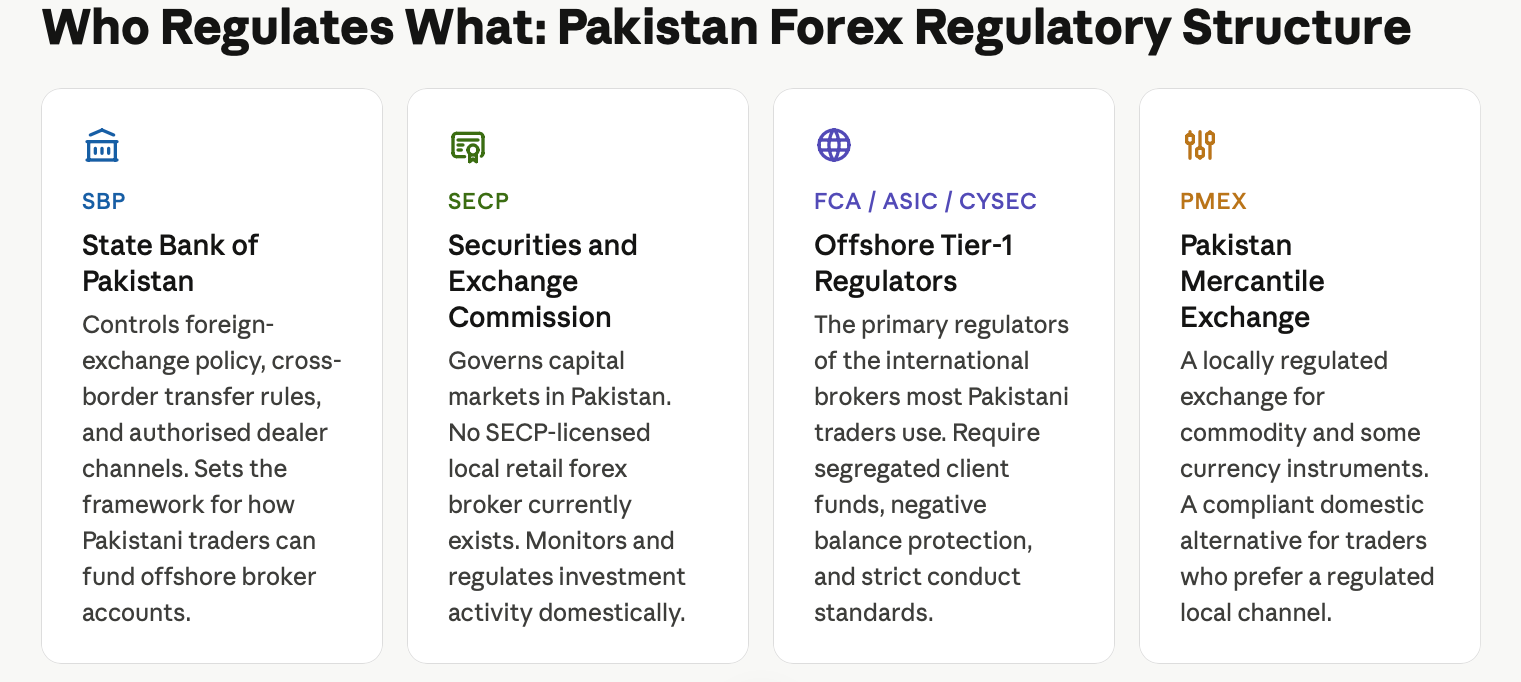
Forex trading is legal in Pakistan, but it must be conducted within the framework established by the State Bank of Pakistan (SBP), which imposes significant restrictions on how individuals can transfer funds to foreign forex broker accounts. The Securities and Exchange Commission of Pakistan (SECP) regulates the country's capital markets; however, there are currently no licensed retail forex or CFD brokers operating within Pakistan. As a result, Pakistani traders typically use offshore brokers regulated by major authorities such as the FCA (United Kingdom), ASIC (Australia), or CySEC (Cyprus), and must fund their accounts through authorised financial institutions.
The primary legal risks arise from two activities: using ghost brokers, which are unregulated brokers that do not hold the required licences, and funding trading accounts through informal money transfer systems such as hawala or hundi networks. Both practices remove many of the legal protections that would otherwise be available when trading with a properly regulated broker and funding an account through authorised banking channels.
The Pakistan Mercantile Exchange (PMEX) offers regulated products for certain commodities and currency-related instruments within a recognised legal framework. These products may be considered as an alternative or complement to trading with offshore-regulated retail forex brokers.
Laws and regulations are subject to change. Always verify the latest requirements and guidance with the SECP and the SBP before making any decisions. The information contained in this article is not intended to constitute legal advice, and any conclusions drawn should be verified against current official documentation.
You may want to approach forex trading in Pakistan from an old-school point of view. Forex is a product that can be traded through a legitimate and regulated broker, but, like an open road, you can only drive in your lane. Regulated dealers operate through banks and have all the legal documentation required for all transactions. If you veer into hawala, you also put yourself and your financial future at risk, and you will likely be breaking the law as well.
How We Ranked the Best Forex Brokers
To compensate for this potential bias, we will openly disclose our methodology and rank all brokers (including Tradewill) from the same set of objective criterion. The ranking of Tradewill on the list represents their actual performance against those criterion, and not because of any ulterior motives.
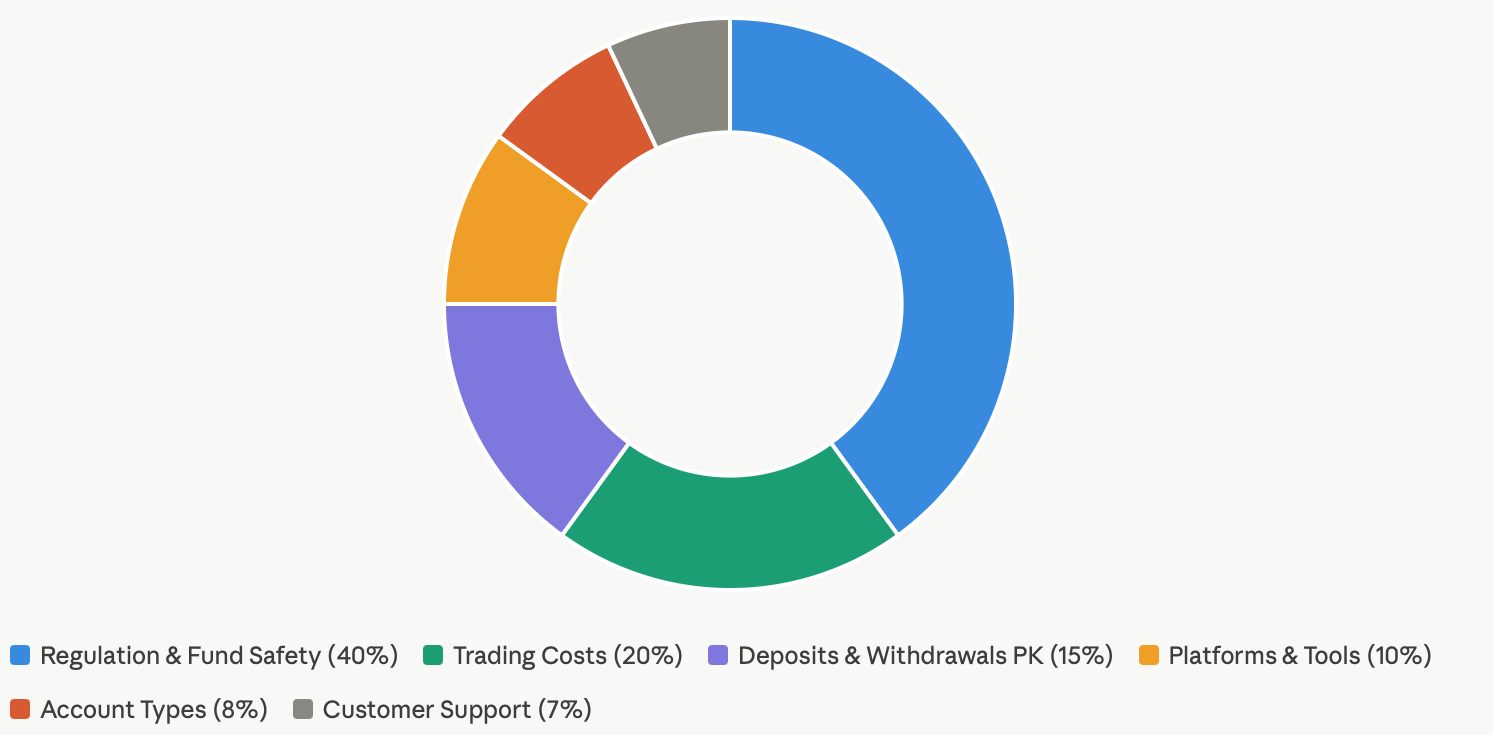
We have ranked our criteria in terms of relative weight as follows: First and foremost, we prioritise Regulatory Compliance and Safety of Client Funds, since your money is not important if it is not safe. Here, we examine where the broker is regulated, what tier it falls under, whether client funds are kept in segregated accounts, and whether negative balance protection is available. The second priority is Trading Costs, which includes spread costs, commission costs, and swap costs for both standard accounts and ECN accounts. The third priority is Depositing and Withdrawing domestically from Pakistan versus depositing and withdrawing internationally in general, since most of the problems experienced by Pakistani traders today are due to finding a method of deposit or withdrawal that actually works reliably in Pakistan. The remaining criteria include trading platform quality, account types available (including Islamic accounts), and customer service.
The data used for this review is collected from official broker websites, regulator websites, and verified independent user experiences. Where data is not verifiable through the listed sources, it has been marked For Compliance pending confirmation.
Thoroughly Reviewed Investment Brokers
The investment brokers below are evaluated using a strict format that includes a single-line description of their business model, statistics that demonstrate their operational capability, a short list of pros and cons, and a description of the types of clients who are likely to benefit from their products and services. Each broker listing must be confirmed by Compliance prior to publication. Specific details that still need to be confirmed include contract size, minimum initial deposit, and whether they accept Pakistani clients.
Tradewill
Company Description: still needs verification before publishing
Regulatory License: needs to be filled in from regulatory authority website once verified
Initial Deposit: needs to be filled in
Minimum Spreads: needs to be filled in
Available Platforms: needs to be filled in
Islamic Accounts Available: needs to be filled in
Funds Transfers Available to and from Pakistan: needs to be filled in
Pros: To be confirmed from verified documents
Cons: To be confirmed from verified documents
Transacting with Tradewill using the ECN account type would work best for individuals who are looking for very low spreads and are comfortable paying a commission on each transaction. New traders would benefit from the features attractive to beginners once verified by Compliance and would be able to start with a demo account prior to making any investment with real money.
Broker B, C, and D will follow the same format described above, and each item will be completed with support from the Compliance team.
How to Choose a Forex Broker in Pakistan
This checklist is the practical version of everything discussed above. Run through it before opening any account, regardless of which broker you're considering.
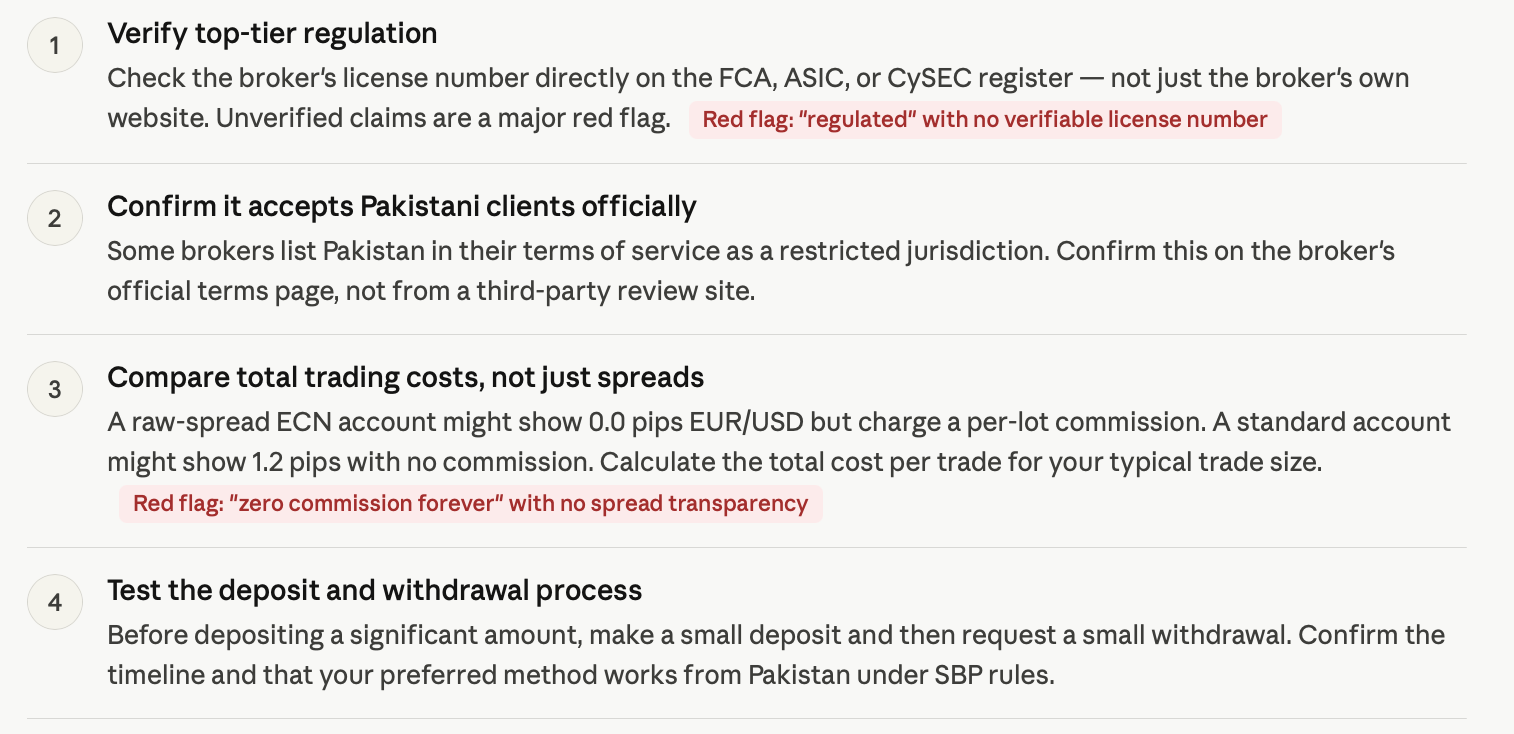
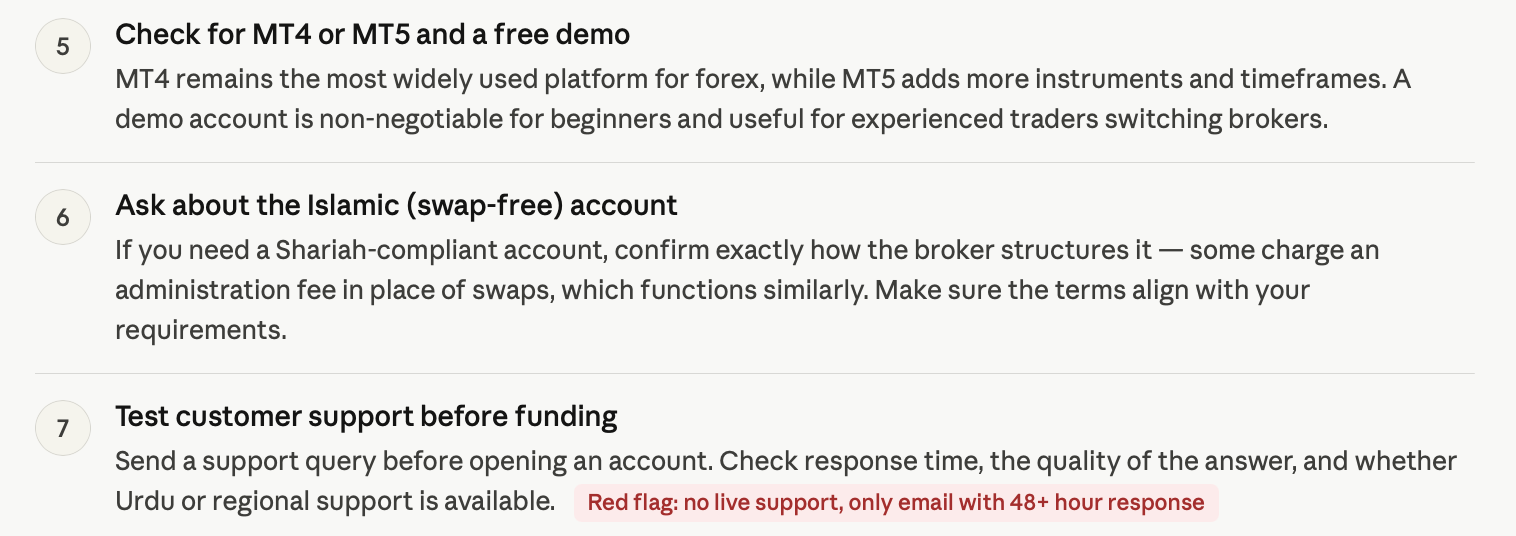
An advanced trader will verify that the broker's licence number appears on either the FCA or ASIC register to confirm its credentials, and will also make a small withdrawal before transferring larger amounts of money into their trading account. A beginner trader will start with a demo account and then add some funds to it. Before moving to a live account, they will attempt to withdraw some of that money. Using both methods will provide practical ways to check whether or not the broker is legitimate.
For a broader introduction to risk management concepts that apply across all asset classes, the fundamentals don't change much between brokers.
Deposits and Withdrawals in Pakistan: The Real Picture
The most important part of the section on trader comparison articles is the area that broker comparison articles tend to overlook. For Pakistani traders, it is especially important to understand that there is a significant amount of friction involved in transferring funds to an offshore forex broker due to the regulatory framework governing such transfers, which exists in part to protect Pakistan's foreign exchange reserves. There are many factors, in addition to any unethical behaviour on the part of a broker, that may cause delays in withdrawing funds.
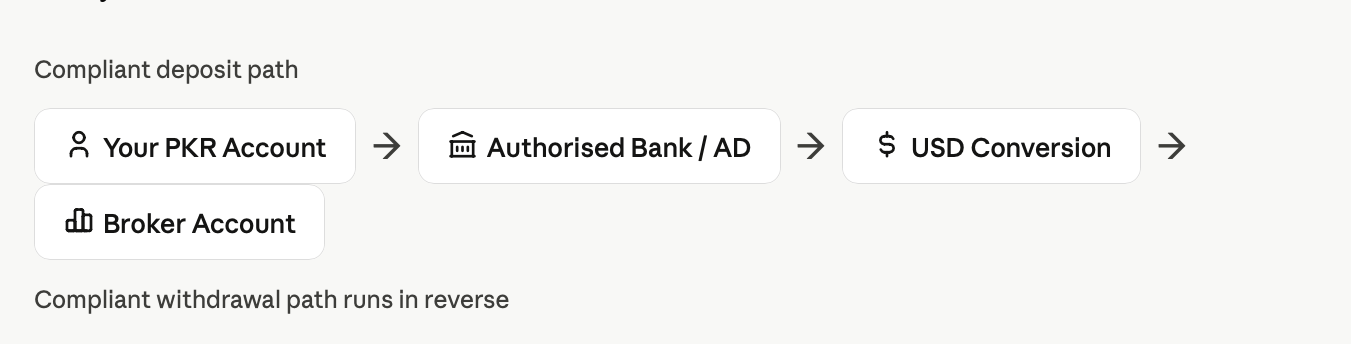
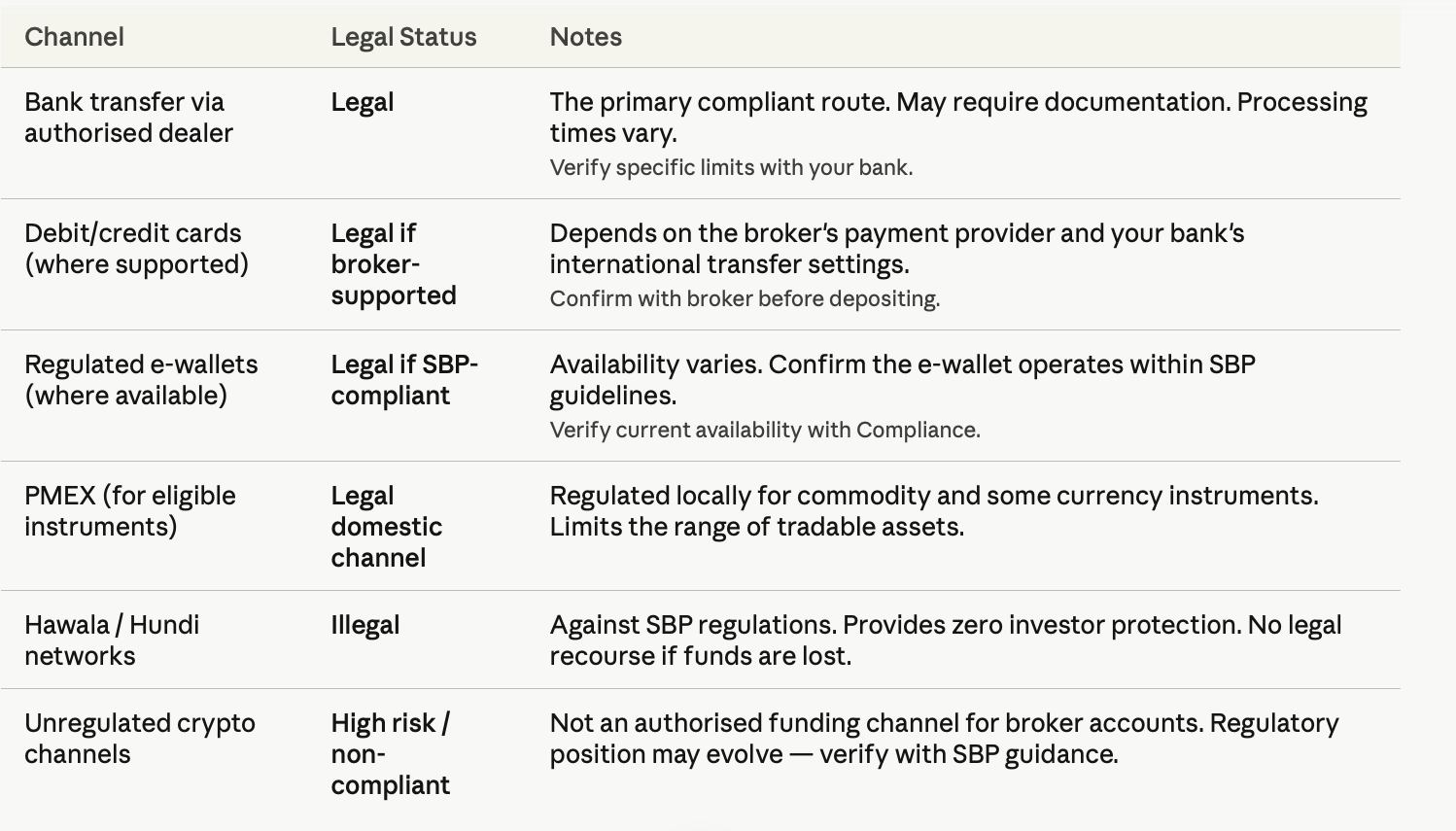
Some of the main reasons for withdrawal delays include compliance with KYC requirements, the timing of payment service provider processing cycles, potential SBP reviews of funds and foreign exchange regulations related to cross-border transfers, and even calendar timing.
To minimise withdrawal delays, you should complete your KYC documentation before making your first deposit, conduct a test withdrawal as soon as possible after opening your trading account, and document every deposit and withdrawal for both tax and compliance purposes. Although this level of caution may seem excessive in a business context, it represents a minimum standard of compliance when operating legally.
Before publishing this section, Tradewill must ensure that Compliance confirms the specific deposit and withdrawal methods available to Pakistani clients, the typical processing times for transfers to Pakistan, and any fees that may apply to withdrawals.
Trading Costs, Leverage, and Account Types
It’s much more important to understand what you are actually paying to trade and how much you are at risk from leverage than it is to focus on a broker’s advertised numbers. Many traders look primarily at the EUR/USD spread; however, the total cost will vary greatly by account type and is more important than the spread alone.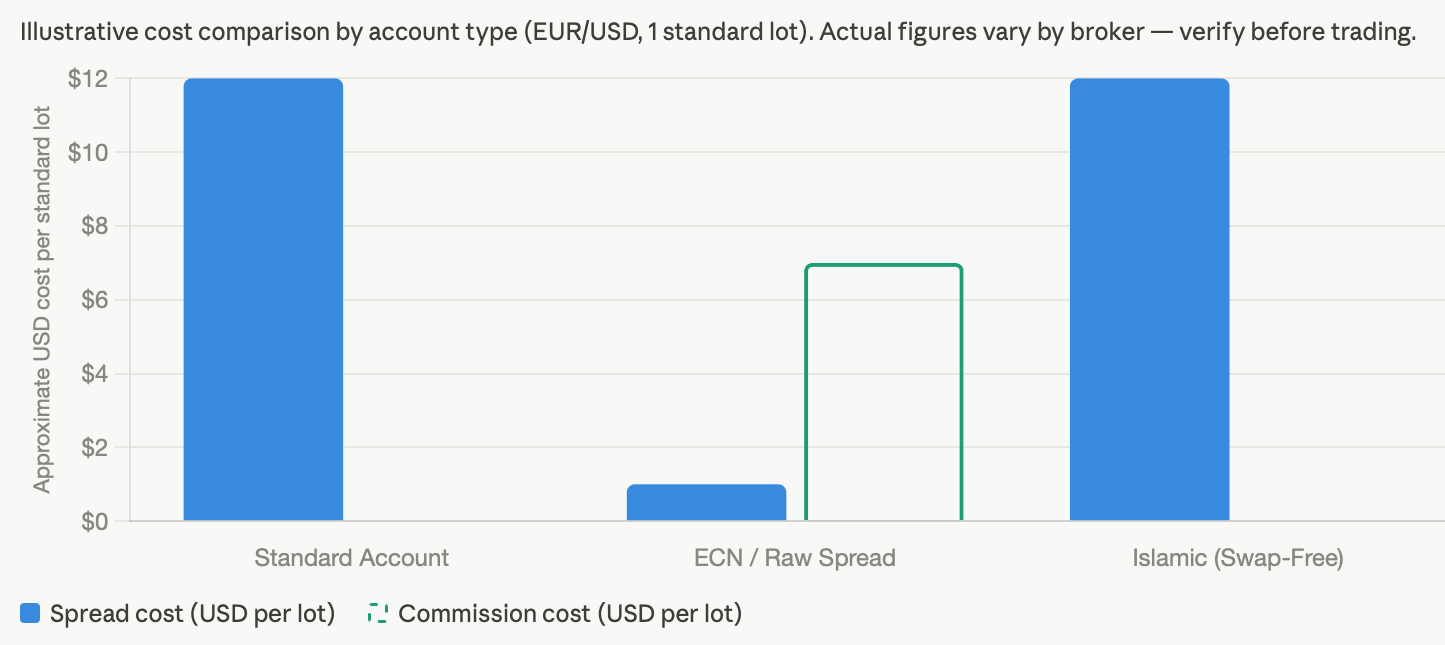
An individual who is a scalper trading dozens of times daily will place more value on the total cost of trading per lot than on the spread plus commission of a raw account. They may find the raw account cheaper overall than a standard account, even though there is a commission cost per trade. A swing trader holding positions for five or six days or weeks is more concerned with swap charges, since these accumulate over time and can significantly reduce profits on longer-term trades. If you want to understand how carry trade strategies use interest rate differentials, understanding the importance of swap fees becomes essential to the strategy.
Islamic accounts do not have swap fees, as they typically charge either flat administrative fees for holding positions overnight instead of swap charges, or use an account structure compliant with Shariah law. If you are looking for an account without swap fees, the key questions to ask the broker about the Islamic account are: does it apply to all instruments (forex or other commodities) you plan to trade, does it charge administrative fees, and does the account structure adhere to the rules set by a recognised Shariah body? A simple checklist on a broker’s website will not be enough to answer these questions.
Another important topic is leverage. Many offshore brokers allow very high leverage ratios, such as 1:200, 1:500, or even higher. However, high leverage is a double-edged sword. With leverage of 1:500, you can lose your entire margin with a 0.2% move in the opposite direction of your position. New traders should start with low leverage, ideally 1:10 or 1:20, until they understand risk management tools like stop-losses work in practice.
Risks and Safe Trading
Forex and CFD trading are very risky. There is a possibility that your capital could be completely lost. Additionally, if a broker is not regulated, you will likely have no legal recourse if a problem arises. That fact should be the main focus of this article, as it is by far the most critical point.
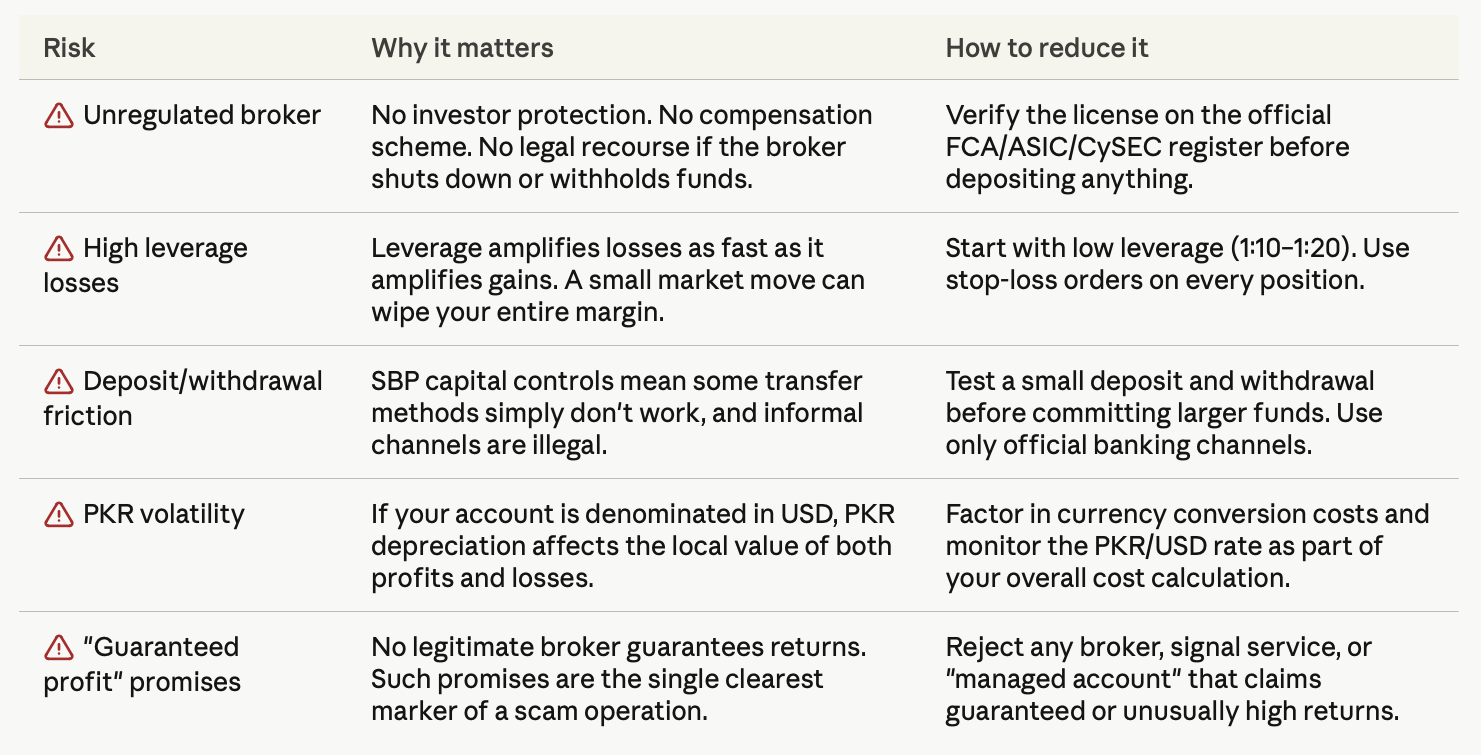
Traders who are consistently profitable size positions in a way that a losing streak cannot lead to a complete loss of their trading account. Likewise, these traders never deposit funds through unofficial channels due to the compliance risk. The potential benefits of speed or convenience do not outweigh the risks associated with these funding methods.
If a broker is pushing you to make a rapid deposit, offering limited-time bonuses, or only allowing you to fund your trading account via cash, informal crypto channels, or a third party, it is not a good broker and you should consider walking away completely. You can read more about how to spot and avoid ghost broker traps in practice you actually fund any account.
FAQ
Is forex trading legal in Pakistan? Yes, forex trading is legal in Pakistan, but it is tightly regulated. The SBP oversees foreign-exchange activity and restricts funding to offshore brokers, while the SECP governs capital markets. No SECP-licensed local retail forex broker currently exists, so most traders use top-tier offshore brokers and fund through legal banking channels only.
Which forex broker is best in Pakistan? The best broker for you depends on your specific needs, but the strongest candidates are regulated by the FCA, ASIC, or CySEC, officially accept Pakistani clients, offer low total costs (not just low spreads), support reliable deposits and withdrawals from Pakistan, and provide MT4 or MT5 alongside an Islamic account option.
Is forex trading banned in Pakistan? No, it is not banned. The activity is legal but operates within a strict regulatory framework. Problems arise specifically when traders use unregulated platforms or fund accounts through illegal informal channels. Using a top-tier regulated broker and official banking channels keeps you on the right side of Pakistani law.
How do I deposit or withdraw with a forex broker from Pakistan? The primary compliant route is a bank transfer through an authorised dealer, converting PKR to USD through official channels. Some brokers also support debit/credit cards and regulated e-wallets. Always confirm which methods are officially supported for Pakistani clients before sending funds, and test a small withdrawal first.
Why are forex withdrawals sometimes delayed in Pakistan? Delays commonly result from KYC verification requirements at the broker, processing windows at the payment provider, and SBP's scrutiny of cross-border transfers. Completing your full verification before depositing, using supported methods, and keeping records significantly reduces the risk of delays.
Do forex brokers in Pakistan offer Islamic accounts? Yes, many international brokers offer Islamic or swap-free accounts that remove overnight interest charges to comply with Shariah principles. Confirm the exact structure with the broker, including whether an administration fee replaces the swap and whether the account covers all instruments you intend to trade.
How are forex profits taxed in Pakistan? Forex income in Pakistan is generally treated as taxable business income and should be declared to the Federal Board of Revenue (FBR). Tax treatment depends on your individual circumstances and income level. This is not tax advice — consult a qualified local tax professional for guidance specific to your situation.
What leverage can Pakistani traders use? Locally regulated channels apply lower leverage limits; offshore brokers may offer significantly higher ratios. Higher leverage increases both the potential gain and the risk of large, fast losses. Beginners should use low leverage and always trade with a stop-loss in place.
Can beginners trade forex in Pakistan? Yes, beginners can trade forex in Pakistan, but they should start with a regulated broker that offers a demo account, a low minimum deposit, and educational resources. Practise on the demo first, use very low leverage, and risk only money you can afford to lose completely. For foundational concepts, our guide on candlestick patterns for smart trading decisions is a practical starting point.
What is the difference between SECP regulation and offshore regulation? The SECP regulates Pakistan's domestic capital markets but doesn't currently license local retail forex brokers. Offshore regulators like the FCA, ASIC, and CySEC oversee the international brokers most Pakistani traders use, and top-tier offshore regulation carries strong fund-safety standards including segregated client accounts and negative balance protection.
How can I avoid forex scams in Pakistan? Only use top-tier regulated brokers and verify the license number on the official regulator's register. Never trust promises of guaranteed profits, never deposit via informal channels, and never respond to pressure to fund quickly. Test a small withdrawal before committing significant funds to any new broker.
What is the minimum deposit for forex trading in Pakistan? Minimum deposits vary widely across brokers and account types, ranging from very small amounts to several hundred dollars. Always confirm the current minimum on the broker's official page, as promotional minimums can change, and a low minimum deposit shouldn't be the primary reason to choose a broker.
Is MT4 or MT5 better for forex trading? Both are reliable. MT4 is simpler and remains the most widely used platform for forex trading specifically. MT5 adds more instruments, timeframes, and analytical tools, making it more suitable for traders who also want access to stocks or commodities. Many brokers offer both — start with the one that matches your current trading style. For a comparison of price action and technical analysis approaches that work across both platforms, the fundamentals apply regardless of your choice.
What should Pakistani traders look for in a broker? Prioritise regulation and fund safety above everything else, then look at deposit and withdrawal reliability for Pakistani clients specifically, total trading costs, platform quality, suitable leverage options, Islamic account availability if needed, and responsive customer support. Fast withdrawals and clean KYC processes matter more than a marginally lower spread.
What are the risks of trading forex from Pakistan? The main risks are market and leverage risk (losses can exceed your initial deposit), broker risk (unregulated platforms offer no protection), deposit and withdrawal friction under SBP capital controls, and the currency risk of holding a USD-denominated account while your income is in PKR. For a structured overview of how leverage and margin interact in practice, that context is worth building before you open a live account.
Conclusion
The criteria for choosing a forex broker in 2026 can clearly be defined according to this hierarchy: regulatory authority and security of funds; reliability of deposits and withdrawals; all costs associated with trading; features of the trading platform.
First, you should demo-test a broker. Then, you should independently verify the broker's licensing with the appropriate authorities. Finally, you should make a small deposit or withdrawal with the broker to confirm that the processes are working smoothly with your banking institution and payment methods before increasing your deposit or withdrawal amounts.
Trading in forex and CFD's carries a very high level of risk; therefore, it is possible to lose money on any trade. You should only use bank channels in compliance with your jurisdiction and maintain complete records and documentation for each transaction. You should also seek qualified advice regarding your tax obligations associated with your trading activity in Pakistan.
This article does not constitute financial, legal, or tax advice, and all information referenced must be verified with official government sources, as regulatory requirements change frequently.
Tradewill.com gives you a regulated environment, transparent costs, and a full-featured demo account to practice before you commit real capital. Open your Tradewill demo today, compare the live trading conditions yourself, and make your decision with real data in front of you.
ข้อจำกัดความรับผิดชอบ : เนื้อหาในบทความไม่ได้แสดงจุดยืน หรือ ความคิดเห็นของ Trade W ไม่ได้เป็นการแนะนำการลงทุน และ ไมได้เป็นการรับรองบุคคลที่สามแต่อย่างใด