
 Trade W
The vast majority of retail forex traders fundamentally misunderstand leverage. Most view it as a tool for increasing profits by controlling larger positions with less capital. In reality, if you examine how institutional trading desks and proprietary trading firms use leverage, you will find that professional traders primarily view it as a risk-management tool. They use leverage within clearly defined risk parameters and as part of a structured trading plan established before entering the market. One of the biggest distinctions between retail and professional traders is that retail traders often have a higher probability of losing money because they lack a structured approach to risk management. Professional traders, by contrast, develop their trade plans before entering the market and possess the knowledge and experience necessary to navigate both technical and fundamental market conditions.
In practice, many retail traders lose money not because they are unable to identify market direction correctly, but because they are structurally overexposed before the trade is even executed. For this reason, understanding the relationship between leverage and forex trading is essential to developing a sound understanding of forex derivatives and how they relate to risk exposure. A trader must first understand the role of derivatives before they can fully appreciate the risks associated with trading currency pairs. It is also helpful to understand the mechanics of margin, bid-ask spreads, and how execution costs compound over time, as these are common blind spots for retail traders. A solid understanding of these concepts can help traders better protect themselves from the risks associated with leveraged forex trading.
Leverage Is a Risk Amplifier, Not a Trading Feature
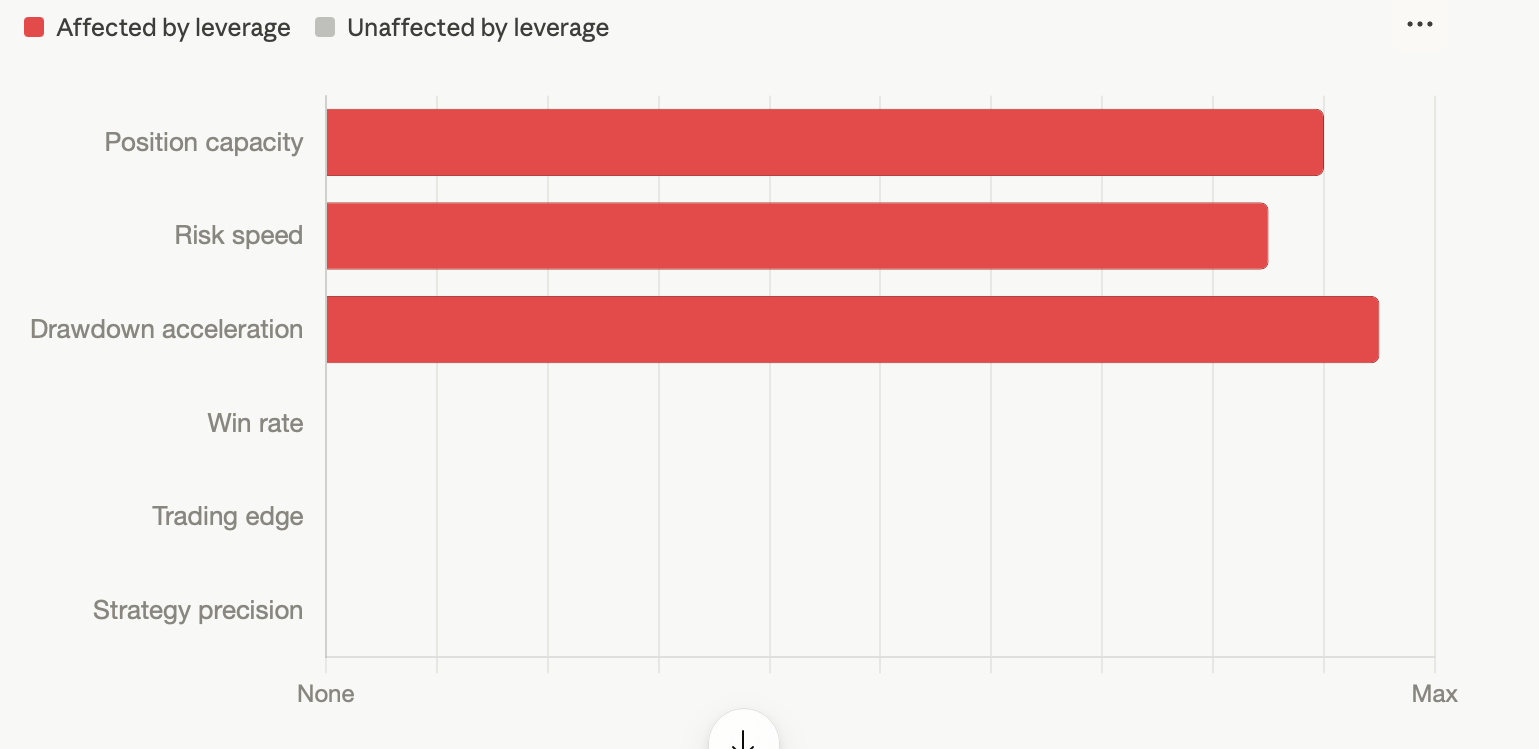
Let’s examine what leverage actually does without the marketing language that often surrounds it. In its simplest form, leverage serves three functions. First, it lowers the margin requirement, allowing you to open a larger position while committing less capital as collateral. Second, it increases your theoretical maximum market exposure, which is not the same as increasing your actual profit potential. Third, it accelerates the rate at which drawdowns reduce the equity in your trading account. Most traders do not fully understand this third function until they experience it firsthand.
What leverage does not do is improve your trading edge, increase your win rate, or make your strategy more accurate. The only direct effects of leverage are an increase in position size, an increase in the rate at which you can lose money, and an increase in the speed at which drawdowns reduce your account equity. Proprietary trading firms and institutional risk managers view leverage as an allowable ceiling of exposure for a trading account. Once you begin to think about leverage in this way, the appeal of 1:500 leverage changes. Rather than appearing to be an opportunity, it becomes structurally unsafe.
The Margin Mechanics Nobody Explains Properly
Most explanations for leverage in educational content fail to mention this; margin is not just collateral that you must use to open a position; margin interacts with floating losses and volatility (this includes floating profits) so that, even if you are correct about your trade direction, if floating losses increase or volatility causes your account level to drop below the broker's forced liquidation threshold, your trades will still be automatically closed before the price comes back to your intended target.
The margin level calculation is, however, very simple; it is: equity/actual used margin (not total used margin) = margin level as a percentage of available balance (equity value); when the ratio falls below the broker's stop-out point (each broker has its own stop-out point); at this point, the broker will close all of your trades and send you an email informing you that you have been liquidated.
To add to the problem, the margin calculation is based on the amount of equity that you have compared to the number of trades that you currently have open. Each tick that goes against your trade is counted as a floating loss; therefore, each tick that goes against your trade decreases your equity and, consequently, your margin level (because of the drop in equity).
To elaborate on volatility; if volatility spikes at any time during your trade and causes your margin level to fall below the broker's stop-out point (even for just a few seconds), you will be out of the trade before the volatility has finished and the price has reversed.
Therefore, the reason that correct traders still blow accounts is because they are not so much worried about how accurate their predictions are, but rather because of a structural disconnect between being right and surviving long enough for the price to move in their favor. If you want to dig into how breakeven calculations and margin thresholds interact in live trading conditions, that framework directly informs how you should think about position sizing before any trade goes on.
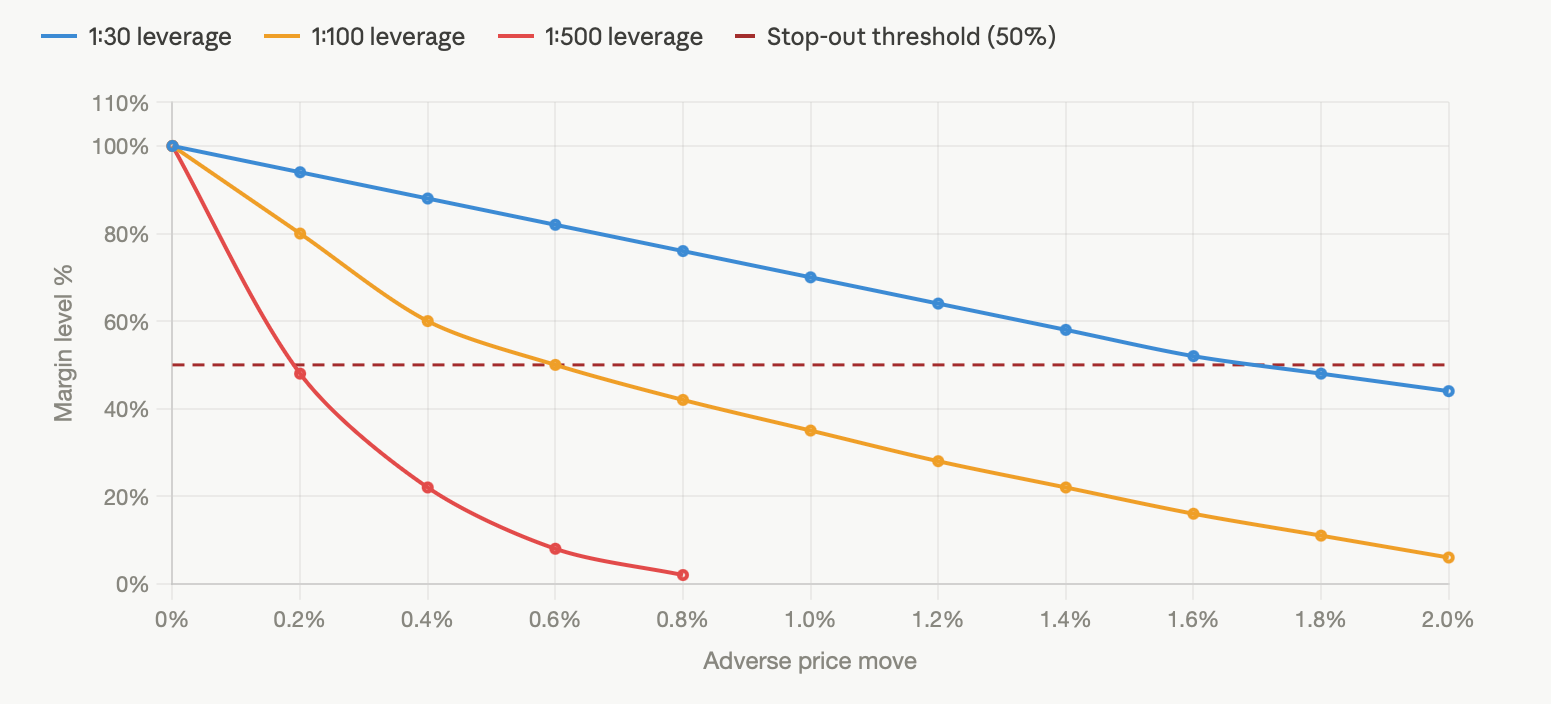
The chart above shows what happens to margin levels during a volatility event across three common leverage ratios. At 1:500, a trader can hit the stop-out threshold on a move that amounts to less than half a per cent of adverse price action. Most intraday volatility on major pairs exceeds that routinely.
Why 1:500 Feels Safer But Destroys Accounts
High-leverage trading is an example of cognitive biases due to the perception created by high levels of leverage. While the trader might not see the use of high-leverage as a risk, the reality is that they are exposed to significantly more risk than if they had not been given the use of high-leverage.
When traders use high-leverage, they tend to inflate their lot size or position sizes through increased leverage without even realising they are doing it. Since their margin is so low to control large trades, traders don’t see a difference between a large position and a small position.
The psychological barrier that normally prevents a trader from taking on too much risk is removed, thus the trader has no real consideration of how much their capital is exposed on trades. For example, with $50 margin controlling a $25,000 trade, the trader no longer has a tangible link between capital risked and trade size.
Finally, when trading with high-leverage, the discipline used to manage losses before entering into trades diminishes because the method for controlling losses through the use of margins is different than the size of the actual trades.
High leverage, while not making traders engage in these behaviours, removes the obstacles that exist to prevent these behaviours. Understanding how volume and market activity work alongside position sizing gives you a clearer picture of when large exposure creates compounding risk rather than compounding opportunity.
How Broker Leverage Actually Works: Regulation vs. Marketing
The variation in leverage alternatives among brokers is more a reflection of provincial conditions, incentives to grow their client base, and regional regulations surrounding retail trading than anything based on the best practices of trading.
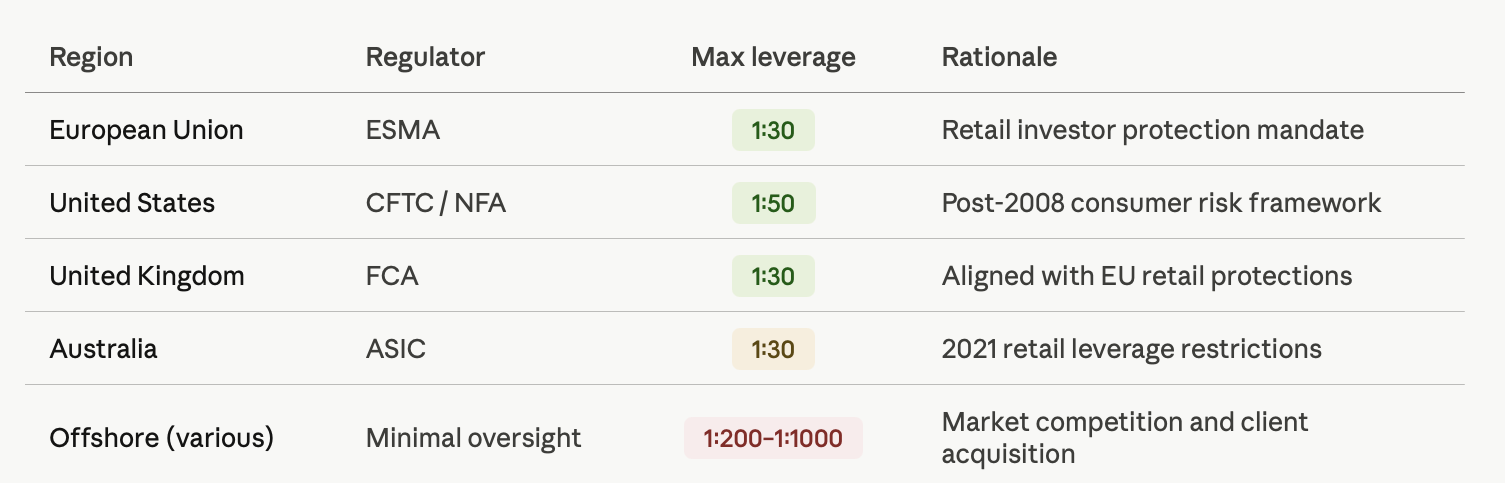
Regulated brokers within the United States and Europe typically provide lower leverage as a result of regulations that have been imposed after reviewing retail trading data demonstrating that high leverage is systematically detrimental to the successful trading of retail investors.
Conversely, brokers located offshore typically advertise 1:500 or 1:1000 leverage based on their incentive to increase the number of accounts opened by creating financial incentives (that risk harming their clients) to encourage them to open more substantial accounts.
As such, whenever evaluating brokers based on their advertised leverage ratios, leverage is the last, and least important, metric to use.
In fact, relevant to your actual trading survival, other factors, such as margin structure, stop-out policy, and quantitative easing and central bank policy effects on currency pairs, matter far more for actual trading survival than whether your broker offers 1:30 or 1:500.
The Only Variable That Actually Controls Risk: Position Sizing Per Volatility Unit
When you disregard the noise associated with leverage figures, a much less complicated and more effective method than you might expect is employed by professional traders. The opening question for establishing position size for institutional traders isn’t, “What’s my leverage?” It is rather, “What do I risk per unit of market movement from existing capital?”
This all leads to a practical example. Let’s say your account has $1,000 of capital and you’re willing to risk 1% of your account balance per trade. Therefore, the maximum risk that you can take on any given trade is $10. Let’s say that the currency pair that you’re trading has a daily volatility range of around 1.5%. As a result, the placement of your stop losses, your lot size, and your leverage ratio all stem directly from the $10 risk ceiling. Once the position size has been developed based on volatility and the risk percentage, leverage is simply a result of that decision rather than an independent factor.
This is the reason many experienced traders will often refer to leverage as being mostly irrelevant once the position sizing framework has been established correctly. They aren't incorrect in that respect. Unfortunately, the majority of retail traders never create a position sizing framework prior to doing anything with leverage and ultimately find themselves in the situation of establishing leverage first and then determining a position size, which flips the logic on its head.
For anyone building out a complete risk management approach, understanding how carry trades, interest rate differentials, and yield interact with position holding costs changes the calculation for how long you can hold a leveraged position without the cost structure working against you.
Why Accounts Actually Fail: A Behavioural Model
Account failure is almost never a single catastrophic event. It's a pattern that builds across multiple trades in a way that individually seems manageable but collectively becomes fatal. The four-stage account death spiral looks consistent across trading styles and asset classes.
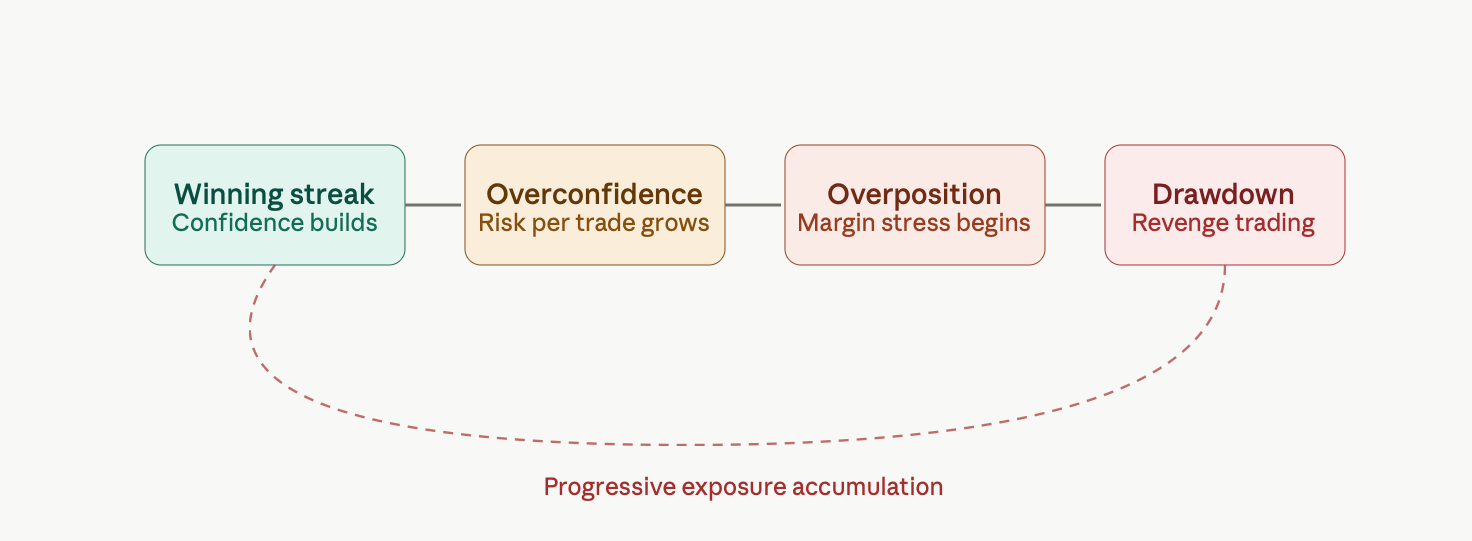
Streaks of wins lead to too much confidence. Too much confidence leads to inflated positions. Inflated positions lead to margin risk. When one adverse volatility event occurs, it creates a drawdown that may seem unfair, which triggers revenge trading. Continued cycles through this pattern will erode capital at a quicker pace due to larger position sizes on each cycle.
Accounts do not die from one bad trade; they die from the repeated cycle of trading to recover the last loss. Position sizes continue to increase with each cycle.
The volatility mispricing aspect is extremely important here because most retail traders tend to ignore news releases and economic reports and are only concerned with whether their technical setup is sufficient. But understanding how FOMC meeting minutes and monetary policy decisions create short-term volatility spikes is directly relevant to whether your leveraged position survives through the event window.
Optimal Leverage by Trading System
The framing of "what leverage should I use as a scalper versus a swing trader" is a little misleading, but it's worth addressing because it's how most people ask the question.
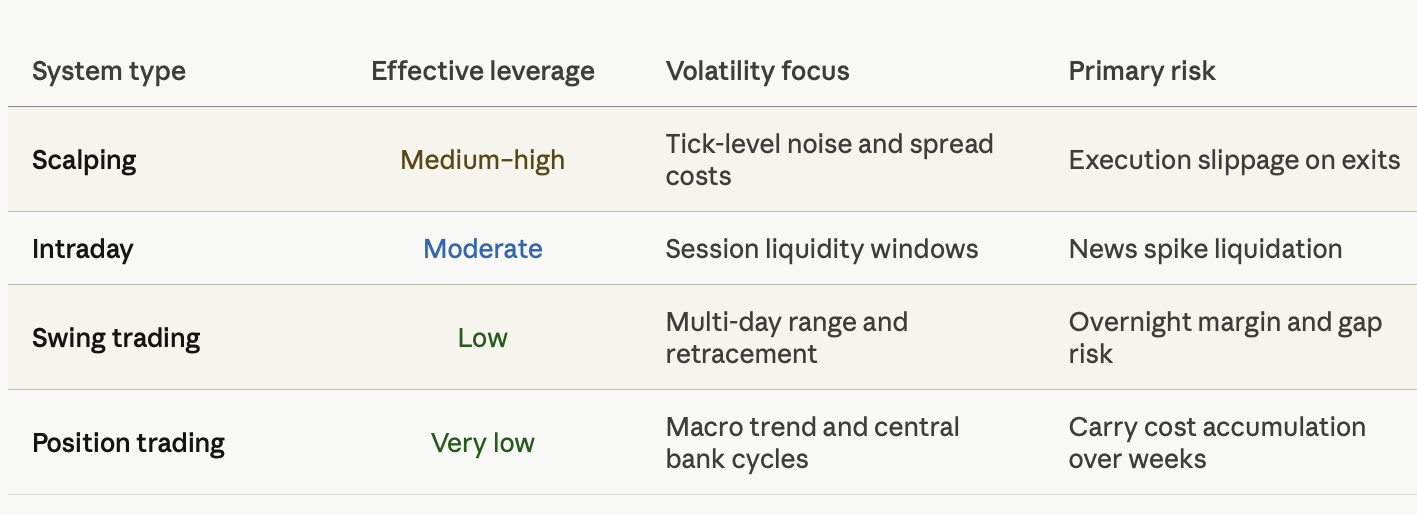
The most important factor in all of the above-mentioned considerations is not the label of the trader's style, but their volatility exposure on a per-trade basis. A scalper who uses very tight stops on a highly liquid pair will be able to use far more leverage than an intraday trader holding positions through a news release with a loose stop, due to the fact that volatility is measured per unit of time with respect to the margin buffer. Also, the volatility per unit of time of each market will determine how much leverage can be safely used given one's risk parameters.
Price action trading and understanding how trendlines, channels, and reversal patterns relate to entry precision directly affects stop-loss placement, which directly affects how much exposure you're actually carrying at any given leverage level. Having more precise and tighter entries allows for tighter stop-losses, resulting in the ability to trade larger position sizes without increasing your dollar risk.
The Contrarian Truth: Lower Leverage Traders Survive, Not Because They're Smarter
Most educational resources about using leverage fail to emphasize that lower leverage doesn’t improve one’s system; it does not improve entry accuracy, exit precision, or market-reading accuracy. All it does is reduce the likelihood that an account will be wiped out due to structural failure before one’s edge has time to compound.
Strategies fail largely because they cannot be executed under pressure. The vast majority of execution pressure is created by leverage. When you have positions that are large relative to your account, each adverse tick creates a psychological response that pulls the trader away from their systematic behavior (widening stops, moving entries, closing trades early, revenge trading after losing trades), and while high leverage does not cause any of those behaviors, they are almost always exhibited during periods of high leverage.
The key to remaining in the trading business is staying in the game until your edge has had an opportunity to statistically demonstrate itself, not having a higher win rate than other participants. Understanding how black swan events and extreme volatility can eliminate accounts that would otherwise be profitable reinforces why low effective leverage creates the kind of structural durability that allows long-term participation.
So what is the best leverage for forex trading?
There is not a single answer to this question for everyone's situation. The amount of leverage you can use will vary depending on how large your account is, the volatility of whatever you are trading, how far your stop-loss will be each time, and how often you place new trades.
For example, if a trader uses a $50,000 account and places wide stops on a low-volatility trade, they will be able to use a much different amount of leverage (maximum) than a trader with a $500 account trading a high-volatility market with tight stops, although both may have an equal ratio of leverage to margin.
There is, however, one constant across all accounts and strategies. This is the question that really helps determine what type of leverage to use: At what amount of leverage can I keep my margin stress below the point at which I deviate from my trading plan? If you determine this correctly, then the amount of leverage you use will be lower than the maximum that any broker will allow.
Visit Tradewill.com. Run your numbers through Tradewill's risk calculator first, not after the margin call email shows up in your inbox.
ข้อจำกัดความรับผิดชอบ : เนื้อหาในบทความไม่ได้แสดงจุดยืน หรือ ความคิดเห็นของ Trade W ไม่ได้เป็นการแนะนำการลงทุน และ ไมได้เป็นการรับรองบุคคลที่สามแต่อย่างใด