
 Trade W
Brokerage firms have traditionally competed on superficial aspects such as bonuses, flashy advertising, and aggressive spiff offerings in order to secure trader accounts. However, this paradigm is rapidly changing. Nowadays, traders are much more educated and will read bid-ask spread breakdowns before they sign up with a broker, and they will calculate how commissions eat into profits before making any trades. As a result, the way that brokerages market themselves and compete within the industry has changed; they have shifted their entire competitive strategy from using temporary gimmicks or promotions of relatively little value to developing long-lasting relationships with their clients built around trust.
The shift from promotional and gimmicky styles of advertising to developing trust-based relationships has taken a long time and is not simply a cosmetic change; it is a structural change within the brokerage industry. Brokerage firms used to thrive on confusion and complexity, but are now being exposed by traders who know exactly what they are looking for. The brokerage firms that will survive the coming decade will be those that demonstrate their commitment to trust through execution, as opposed to those that purchase their clients' attention through promotional tactics or gimmicks.
Why Trust Is Replacing Marketing as the Core Competitive Logic
The previous brokerage model for expanding the number of customers was based solely on acquiring new customers (volume). The typical broker would create artificial incentives (welcome bonuses, referral programs, and aggressive selling techniques) to entice customers into opening an account and depositing money into that account, without regard for whether those customers received fair treatment after making their initial deposit. This worked very well in the past because customers did not know what to look for; however, this no longer works.
Three major forces are responsible for this change. The first major force is that traders are much more knowledgeable about the marketplace than they were five years ago. Traders understand concepts such as forex demand zones and institutional buying pressure, and brokers are now expected to execute trades in a way that reflects that level of market expertise rather than working against it. The second major force is that all major financial regulatory bodies have increased their scrutiny of how brokerage firms disclose information regarding their services and the costs associated with using them. The third major force is that many online communities now post execution data, screenshots of trade slippage, and spread comparisons, allowing information regarding a broker's reputation to be shared almost instantaneously and much faster than any advertising or marketing budget could achieve.
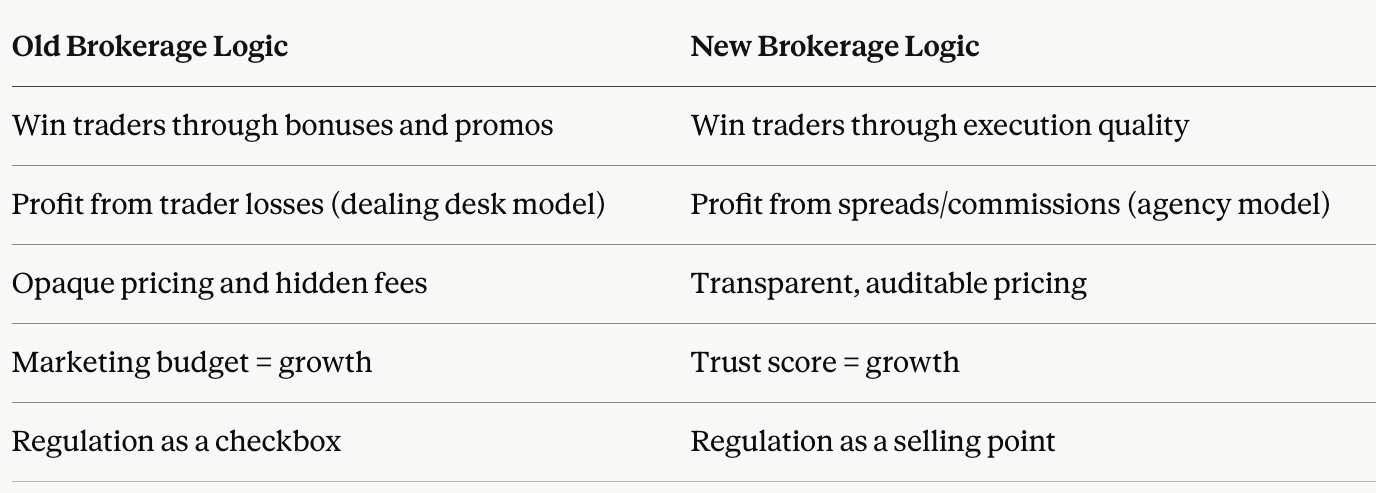
Trust is professionalism built on executing with integrity, following the regulations of the jurisdictions in which you trade, and having your trades priced according to the market. Essentially, it means that you can sleep soundly knowing that your trades are being executed at the best available prices without anyone attempting to manipulate them against you. More and more brokers are beginning to adopt this approach; they are shifting from the traditional broker model of using large bonuses to attract clients to using the ECN model, which executes trades without relying on clients losing money for the broker to make money.
The Old Brokerage Model: Marketing-Driven and Conflict-of-Interest Systems
To find out where the future of the brokerage industry is headed, it is useful to take an honest look at its past. The brokerage industry's previous method of doing business, known as the legacy brokerage model, was not primarily about what was best for traders; it was about how much it cost to acquire clients and retain them.
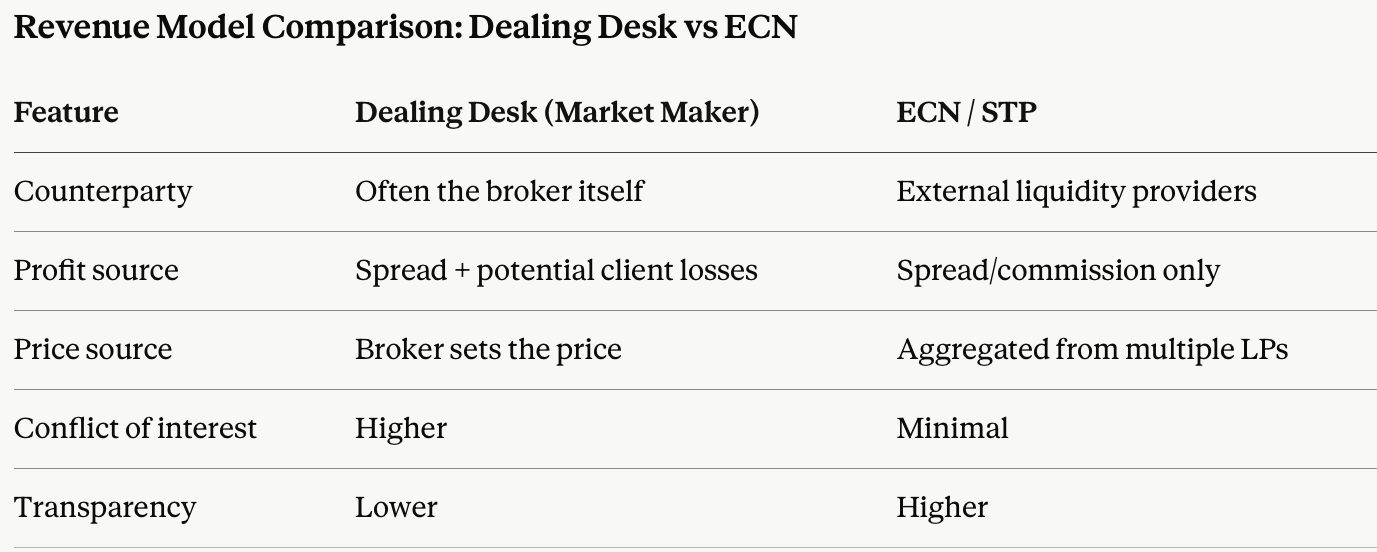
Brokerages also faced many structural challenges. Traders were attracted to new brokers through bonus-driven systems; however, many of them did not understand the conditions they had to meet before they could withdraw their free money. Spreads often widened for traders after high-volatility news releases without prior notification, and traders frequently found discrepancies when comparing their actual fills with the values presented in bid-ask spread guides. Many brokers operated as dealers, taking the opposite side of their clients' trades, which created an obvious conflict of interest because if a client lost, the broker often profited from the same trade.
Additionally, market maker internalisation exacerbated many of the problems described above because, instead of routing orders to true liquidity providers, brokers processed trades internally and effectively took positions against their clients. This practice is not considered illegal, but it created a structural misalignment that caused traders to actively avoid such brokers by learning how the bid price actually works and understanding what an acceptable fill should look like.
The Current Market Shift: Regulation, Transparency, and Trader Sophistication
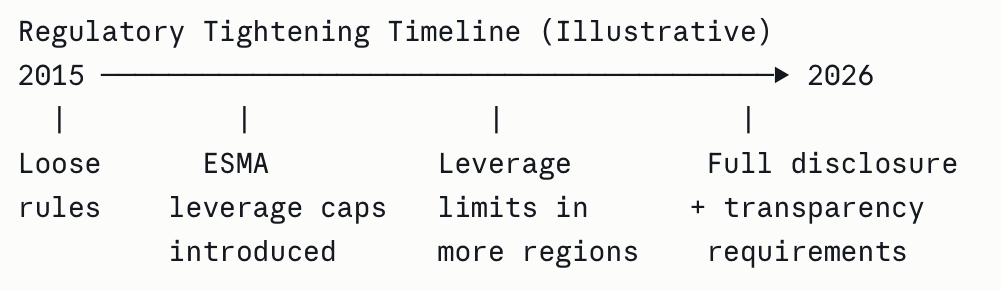
The current transformation of the financial system is not a passing fad; it is a major shift. Regulators such as the Financial Conduct Authority, the Australian Securities and Investments Commission, and the Dubai Financial Services Authority have imposed greater restrictions on brokers through increased regulations regarding disclosures, leverage limits, and advertising. Brokers are now required to provide clear terms and conditions for bonus allocations and cannot hide the catch for their customers as easily as they did before.
At the same time, traders have also become smarter in their approach to trading. Newer traders today who are learning about technical analysis also have access to information regarding overbought and oversold conditions and how to use those levels to take advantage of price action trading. As a result of this educational trickle-down from institutional traders to retail traders, retail traders now expect the same level of service from brokers that institutional traders receive.
Brokers now have to offer ECN or STP trading accounts by default rather than as premium or value-added services. In addition, liquidity aggregation, where a broker uses multiple liquidity providers and passes along only the best available market rate to its customers, has gone from being a marketing tool for brokers to becoming an industry standard.
The Future of Brokerage: Trust as the Core Competitive Advantage
The current state of the market shows that execution quality is replacing the impact of marketing budgets as the new battleground, meaning that marketing dollars are losing their power to influence how traders make decisions. A broker can spend an enormous amount of money on advertising, but if it experiences significant slippage (the difference between the expected price of a trade and the actual price at which the trade is executed) or if its spreads are subject to significant variations, then all the funds spent on advertising will no longer provide the broker with long-term trader retention.
Transparency is also no longer a differentiator; it is now the expected standard in the marketplace. Traders assume they can see exactly how their orders were filled (execution price) and how those orders flowed through the market (liquidity path). If a broker cannot clearly answer these questions, it is losing business before it even has the opportunity to close it.
With the implementation of AI-driven liquidity aggregation, this trend is accelerating. Smart order-routing systems now scan a variety of liquidity sources in milliseconds and automatically select the best price for execution; this is the same type of institutional infrastructure that was historically available only to hedge funds and banks. This presents further challenges for brokers, who are now facing increasing scrutiny from traders regarding the impact of AI's growing influence on market behavior, and it is now up to brokers to demonstrate that their AI capabilities are working for traders rather than against them.
Brokerage as Financial Infrastructure: The Hidden Market Layer
Brokers should not be perceived solely as providers of services, but as an underlying framework. A broker actually provides access from wherever you are on your computer to the vast pool of capital participating in the interbank market.
Typically, this framework works as follows: you place an order; your broker sends it to the appropriate liquidity provider; the order may be filled through multiple liquidity providers before finally reaching the interbank market, which is where true price discovery takes place. This framework is crucial because it explains why two brokers can provide slightly different quotes for the same currency pair at the same time. Understanding this framework should also provide insight for traders studying currency pair correlations for hedging, since the flows of different currency pairs are often interconnected.

While relying on a single Liquidity Provider (LP), brokers are able to use multiple LPs at once to execute trades. This is an important distinction because it reduces the risk of failed trades during extremely volatile times due to increased execution odds and results in tighter, more consistent pricing.
The Anatomy of Trust: How Brokerage Trust Is Built and Measured
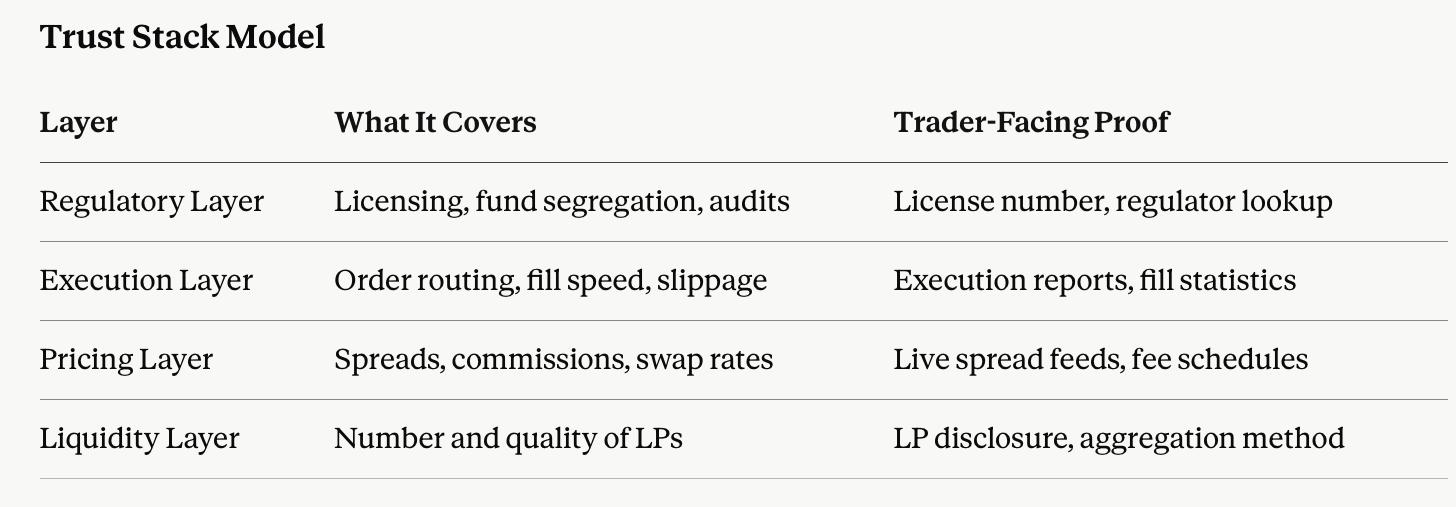
When people talk about trust, it might sound like an idea until you break it down into parts that can be counted. Trust is much more like a scorecard than just a feeling. Pricing transparency is when a trader knows exactly what they will pay in the form of spreads and commission; there are no hidden costs (i.e., excess costs added to the original price) in the fine print. Execution quality measures how often a trader's order gets filled at or close to the price they expected; slippage and fill rates are the two parts of execution quality.
Conflict neutrality measures whether or not the broker has any incentive or ability to profit when your trade ends up losing. Regulatory assurance ensures that the broker operates under legitimate regulation regarding client funds being held separately from their own and being regularly audited for compliance.
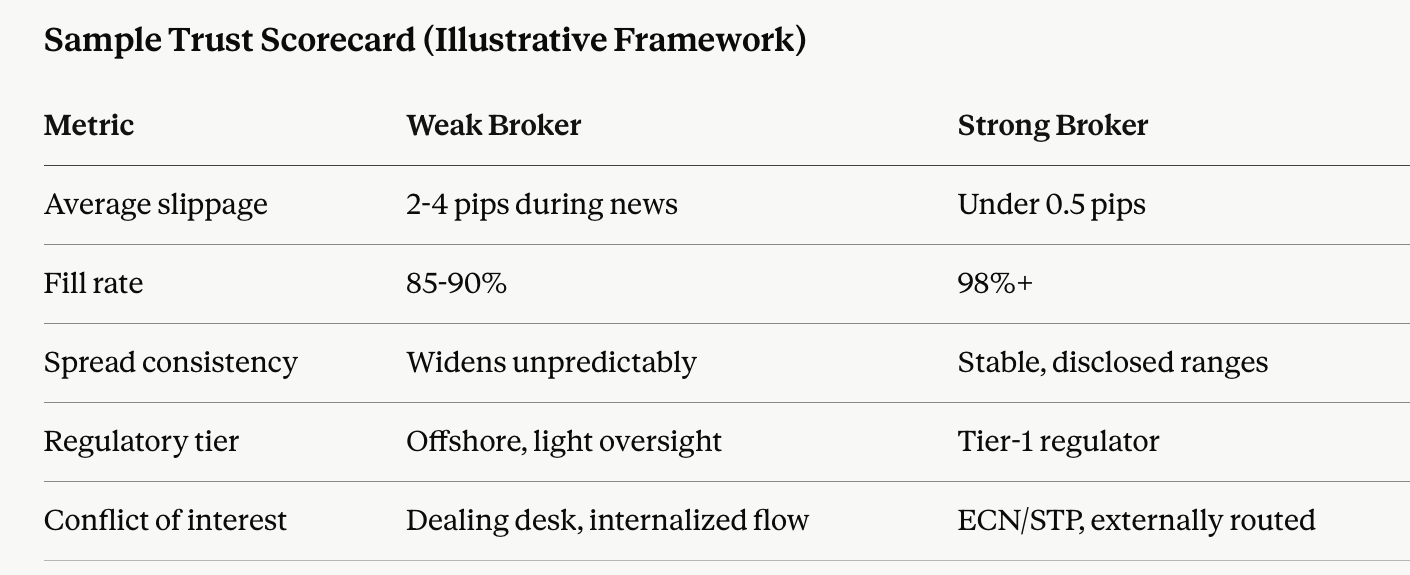
When forex divergence patterns are examined through different methods, like checking for instances of divergence or using Bollinger Bands strategies, it is also expected that they will have examined the broker's selection process using a similar level of detail. Those brokers who can pass scrutiny at this level will be the ones with numbers that support how popular they are.
The Hidden Mechanics of Execution: What Happens When You Trade
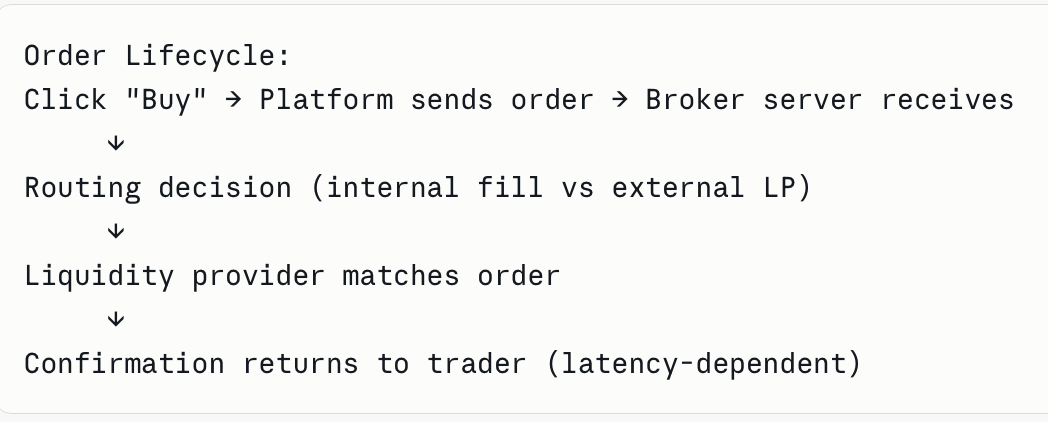
Most traders never see what happens in the few hundred milliseconds between clicking "buy" and seeing a filled order. That gap is where execution quality actually lives.
When an order is placed, it travels from the trading platform to the broker's servers, and from there, it either gets matched internally or routed out to a liquidity provider. Liquidity fragmentation, where pricing differs slightly across providers, means the broker's aggregation logic determines whether a trader gets the best available price or just an acceptable one. Latency, even at the millisecond level, can be the difference between a fill at the requested price and a fill several pips away during a fast-moving market.
Why Legacy Brokers Still Exist: Market Psychology and Market Inefficiencies
With everything I've said, the obvious question is why we still see brokers using bonuses and conflict-driven incentives to attract new customers. The honest answer has to do with human psychology as much as it does with market structure.
Retail traders, especially novice ones, are drawn to upfront incentives such as bonuses. A bonus may sound attractive and genuinely entice you at the time of opening your account, even though the terms associated with that bonus make it difficult to cash out later. There are also other driving factors that lead to brokers operating in regulatory arbitrage markets. Some brokers find themselves operating in lightly regulated jurisdictions where there are minimal disclosure requirements. They also continue to run promotional campaigns because their acquisition cost pressure requires them to use the tactics they know how to grow their businesses.
Finally, information asymmetry supports all of the preceding factors. A trader has not researched the orders they want to place or order types and execution strategies that will be selected; therefore, a novice trader does not know what questions they should ask before depositing money with a broker. This information gap continues to close; however, it has not yet been completely closed. This is the main reason why brokers that are considered legacy continue to get new accounts even though they have high levels of churn.
The Future Standard of Brokerage: What "Good" Will Mean
The future definitions of what constitutes a "good broker" are becoming increasingly well defined and simpler to quantify than ever before. The day that hidden pricing is used as a sales tactic will soon give way to its use as a basic requirement for any broker. Another area that will no longer be viewed as an "added benefit" but rather as "standard" is execution transparency. Traders will now have access to their fill data via the internet and be able to compare it against a variety of market performance benchmarks.
Liquidity disclosure (i.e., brokers providing information regarding who they connect with and how they route orders) will become a regulatory requirement, as opposed to something brokers voluntarily disclose. AI fairness algorithms (designed to evaluate whether a broker's own execution algorithms exhibit bias or manipulative activity) will be developed as a new layer of self-regulation. Brokers that build their platforms with compliance as the foundation will be able to distinguish themselves from those that continue to grow on the back of short-term growth strategies, or by bolting on compliance after the fact.
Conclusion: From Brokers to Trust-Based Financial Infrastructure
For years, the brokerage business has focused on using aggressive marketing approaches to compete for business; however, this is now coming to an end. Traders have access to the necessary technology, data, and community support to validate any of the claims made by a broker and are using these resources to completely redefine what a competitive advantage looks like in this industry.
The role of a broker is evolving from simply being a service provider to more closely resembling a part of the financial infrastructure: an invisible link that connects retail traders to global liquidity. Brokers that understand and adapt their entire model around executing orders with integrity instead of relying solely on marketing hype will lead the way in changing the definition of how trust is established in the brokerage industry over the next 10 years.
Visit Tradewill.com and stop guessing whether your fills are fair. See Tradewill's execution data for yourself before you place your next trade.
ข้อจำกัดความรับผิดชอบ : เนื้อหาในบทความไม่ได้แสดงจุดยืน หรือ ความคิดเห็นของ Trade W ไม่ได้เป็นการแนะนำการลงทุน และ ไมได้เป็นการรับรองบุคคลที่สามแต่อย่างใด