
 Trade W
Forex brokerages that are regulated by an appropriate regulatory authority such as the FCA, ASIC, or CySEC must be licensed and are subject to minimum capital requirements, as well as compliance rules ensuring they treat clients fairly and provide clients with the right to seek redress for losses against their broker for breaches of these rules, something unregulated or offshore brokers cannot provide.
This listing will not only show you how to compare different brokers against one another but also contains all the relevant details to clearly identify the regulation that applies, the license information for each brokerage, and how to verify that regulation has been issued by the governing body prior to opening an account with that brokerage. If you are not familiar with what forex trading is and how it works, in general, then this could serve as a primer; however, if you are searching for specific brokerages to use in your forex trading, you may already be at a more advanced stage and are looking to evaluate brokers based on your individual needs. Understanding how broker fees and commissions apply is an important part of the selection process when determining which type of account or broker you may want to use.
The risk of loss while trading commissions and fees is significant, and the majority of retail traders who use leverage lose money.
Quick Comparison Table: Regulated Forex Brokers (2026)
Ranks are based on regulatory authority, investor protection, and cost of trading. Spreads are based on the average EUR/USD spread for a standard account as of May 2026. Last updated: May 2026.
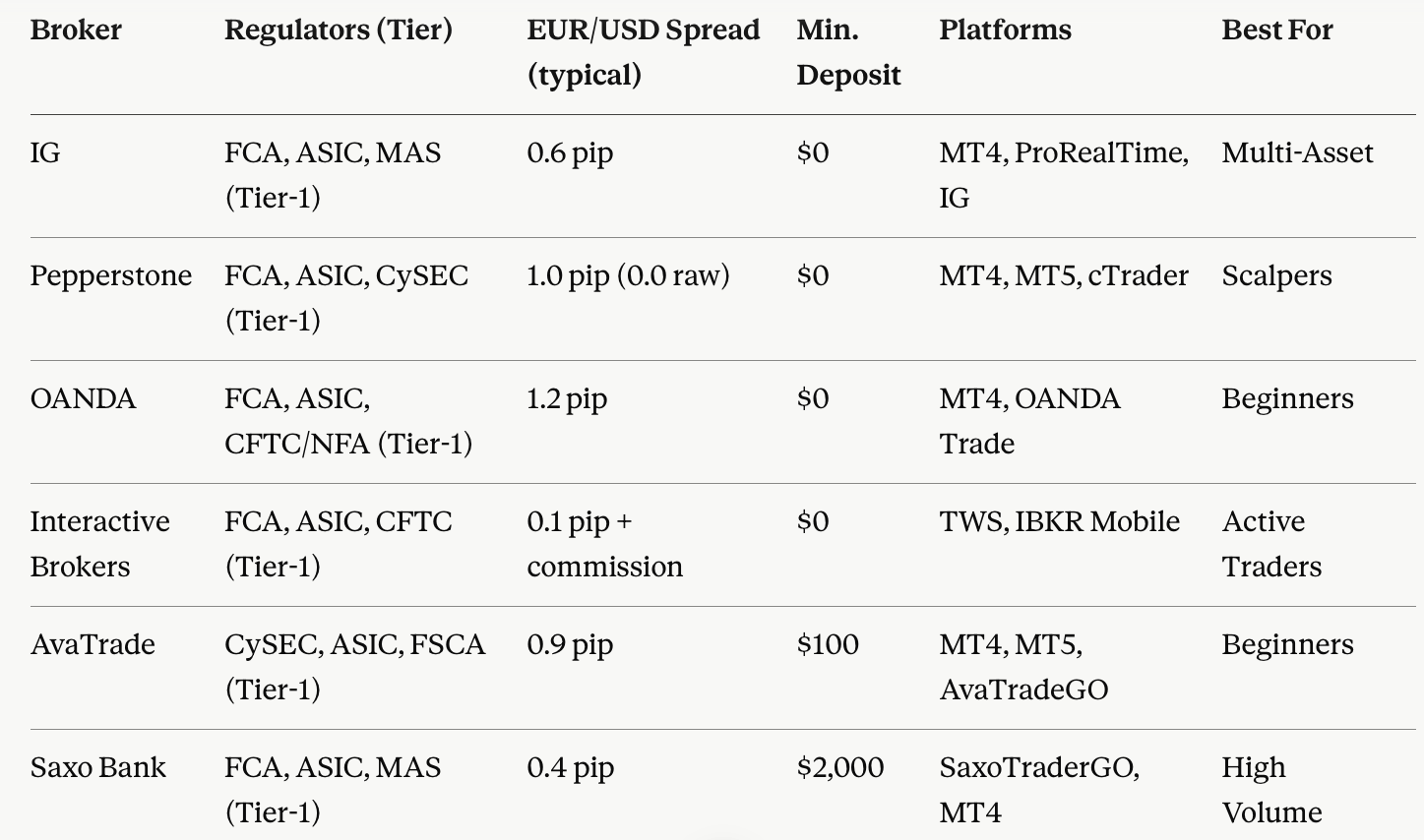
If you are new to this area, look at the columns for Min. Deposit and Best For. This will give you a clearer indication of who these brokers are and why they have been ranked in this manner.
The spreads mentioned are variable in nature and are for information purposes only. However, please refer to each broker’s own documentation listed on their website, which will detail any commission and leverage terms that may apply to that particular broker.
You do not have to commit just yet. Take a risk-free demo trial with Tradewill to determine execution conditions during live market hours before opening a live account with real money.
Top Regulated Forex Brokers: Individual Reviews
IG: Best for Multi-Asset Trading with Tier-1 Coverage
IG Markets Limited is one of the most heavily regulated brokers in the world and is authorized by the FCA (UK), ASIC, and MAS. For customers with a standard account, the spread on EUR/USD is approximately 0.6 pips with no minimum deposit required and full access to the MT4, ProRealTime, and IG platforms. All traders looking to trade forex, indices, commodities, and equities from one place while maintaining regulatory credibility will find IG to be a good fit.
Advantages: Covers many different jurisdictions, offers a broad range of markets, and provides a strong selection of research tools.
Disadvantages: The platform may be confusing for beginner traders to use, and if you do not trade for two years, an inactivity fee will be charged.
Pepperstone: Best for Low-Cost EUR/USD Scalping
Pepperstone The three Tier-1 regulatory authorities for Pepperstone are ASIC (Australia), CySEC (Cyprus), and the FCA (UK), giving it an extensive footprint in Europe, the UK, and Australia.
On its Razor account, EUR/USD spreads start at 0.0 pips plus a round-turn commission of $6 per lot, whereas standard accounts generally have spreads around 1.0 pip without commission. If you need help understanding how to read forex spreads and calculate your real cost per trade, you may refer to this breakdown when evaluating how Pepperstone operates.
Advantages: Authentic ECN execution; extensive Tier-1 regulatory licenses; cTrader available alongside MT4 and MT5.
Disadvantages: The commission structure associated with the Razor account means that, in most cases, you will only save money on the Razor account when trading more than 0.7 lots per trade.
OANDA: Best for Beginners with No Minimum Deposit
OANDA The two OANDA companies – OANDA Europe Markets Limited (FCA ref #583153) and its US entity – are regulated at the highest level (CFTC and NFA in the US), meaning retail forex trading firms operate under strict rules governing how they handle clients and conduct business.
The lack of a minimum deposit to open an account with OANDA highlights its commitment to accessibility for traders of all experience levels. OANDA offers a standard account type where the average spread on EUR/USD is approximately 1.2 pips, and it operates a proprietary web-based trading platform that is widely considered user-friendly for beginner traders.
In addition, OANDA provides an extensive library of educational materials in collaboration with third-party providers, such as Tradewill's guide to forex day trading.
Advantages: No minimum deposit, Tier 1 regulation across multiple jurisdictions, and an easy-to-use platform for beginners.
Disadvantages: Spreads on standard accounts are generally wider than ECN-style accounts, and client leverage for US-based clients is capped at the CFTC and NFA maximum of 1:50.
Interactive Brokers: Best for Active and Institutional-Level Traders
Interactive Brokers LLC is regulated by CFTC, SEC, etc. Their tiered commission of $0.08-$0.20 per 1,000 units of currency, with the amount depending on your volume (the number of units traded), makes IB genuinely attractive for day traders. EUR/USD has some of the best spreads available at approximately .10 pip, but the Trader WorkStation (TWS) has a very steep learning curve. When you understand the different execution models like ECN vs STP, etc., you’ll understand that trading volume is what gives IB its advantage with its direct market access execution method.
Advantages: Tier 1 regulation is present across many jurisdictions, active traders get industry-leading spreads, and you can access equities, options, and bonds with one account.
Disadvantages: TWS does not work well for beginners and low volume traders will not fully benefit from the commission tier structure.
AvaTrade: Best for Beginners Who Want MT5 Access
AvaTrade CySEC (licence 347/17), ASIC, and other regulators allow AvaTrade EU Ltd to provide traders with a secure, reliable, and complete trading solution. It has a minimum deposit of $100, making it an accessible entry point for traders getting started in online trading.
The EUR/USD spread is approximately 0.9 pips on standard accounts with no commissions, and the AvaTradeGO mobile application is designed for users who prefer to trade on mobile devices.
Advantages: A wide range of platforms including MT4, MT5, and AvaTrade’s proprietary application, strong regulatory oversight across multiple jurisdictions, and an extensive Education Centre.
Disadvantages: Inactivity fee after 3 months without trading activity and a minimum deposit requirement of $100 (excluding micro accounts).
Tradewill: Best for Low-Deposit Entry into Multi-Asset CFD Trading
This comparison was created by the publisher (Tradewill) to reflect the true nature of the companies compared to each other without any editorial justification for being placed in this area. Tradewill has an FSA Seychelles (offshore) license; therefore, Tradewill has no Tier-1 compensation under either FSCS or ICF.
The minimum amount required to open an account is just $10 and it also provides a great opportunity for traders wanting to try different types of CFD trading across many types of assets.
Advantages: Minimum entry deposit ($10), merchant access through the MT5 platform, trade forex, indices, and commodity assets.
Disadvantages: As your accounts will be governed by an outside country with no access to Tier-1 compensation through FSCS/ICF rules, you need to determine your requirements against the level of protection offered by the Tier-1 entity where you may be considering using them to trade. Once you open an account at Tradewill, we keep your funds in segregated accounts and all retail clients are offered negative balance protection. See how Tradewill handles client fund safety.
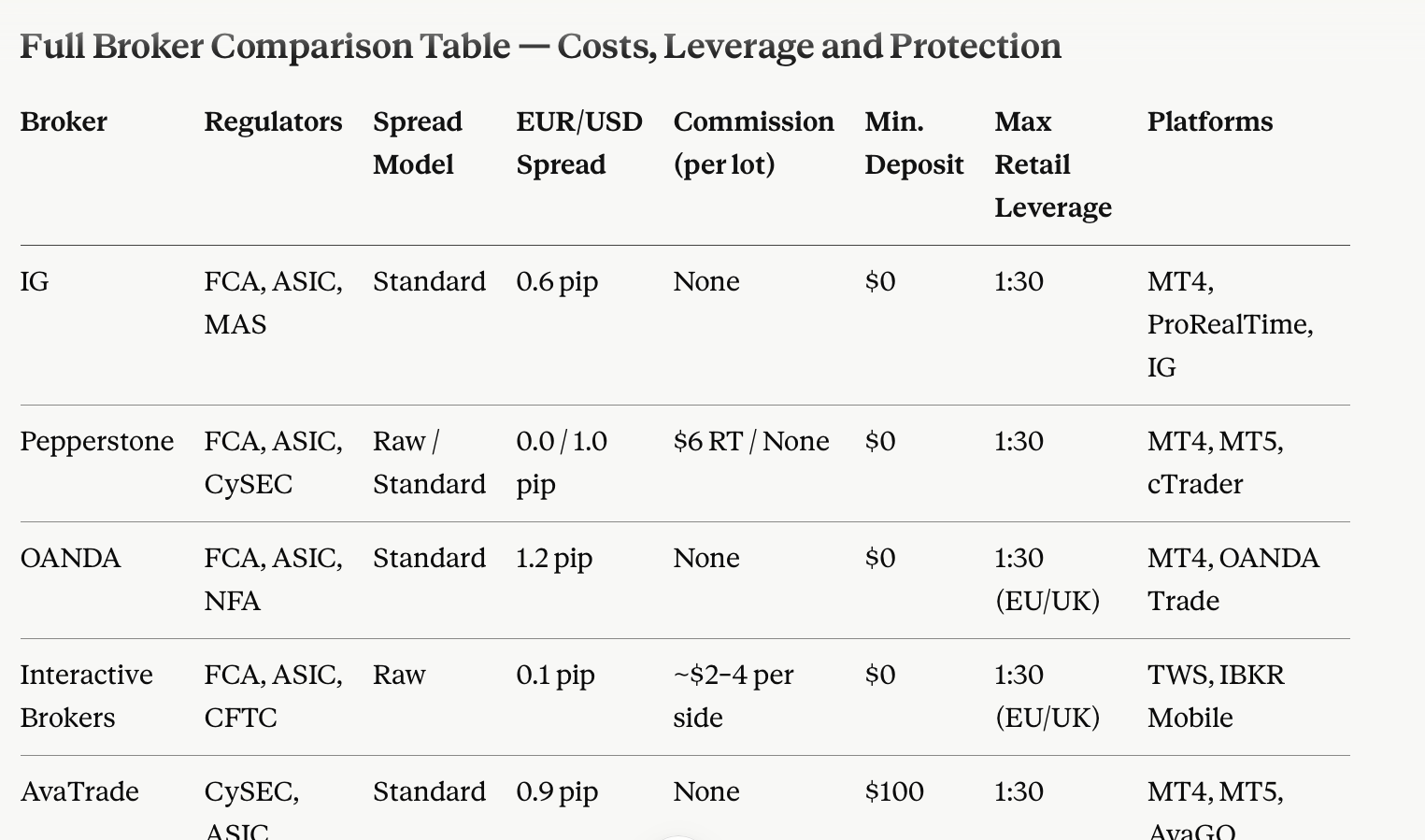
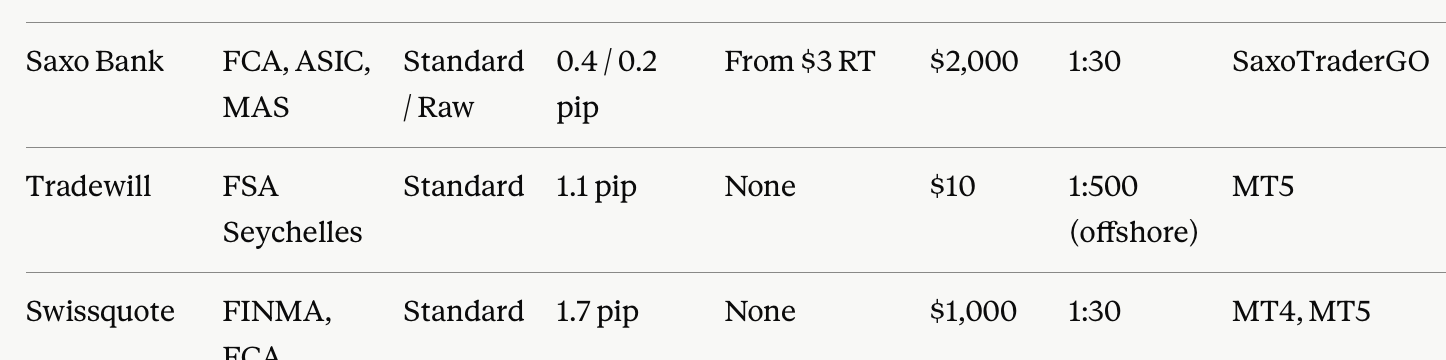
You pay lower spreads on Raw accounts but you have to pay a per-lot commission on each trade. So your total cost per trade is the amount of commission paid and the amount of spread converted to the size of your trade, not just the amount of spread used alone. The point at which a raw account with a 0.0 pip spread and $6 round trip commission becomes cheaper than a standard account with a 1.0 pip spread is approximately when your total number of lots traded is about 0.6 or higher. If you trade less than 0.6 lots, you could be better off using the standard account. In terms of leverage, if you are trading forex (FX) and are located in the FCA/ASIC/CySEC jurisdiction, there is a retail limit of 30:1 for major pairs.
Conversely, Tradewill offers retail leverage of 500:1 but does so from its offshore FSA-registered entity, which does not provide any type of insurance coverage such as is typically provided under Tier-1 regulatory regimes for comparable accounts. The quoted spreads for EUR/USD as reported by major market makers will vary according to market conditions and will be different from those quoted by other brokerage firms.
Trading at a high level of leverage will amplify both a trader's potential profit and potential loss. A low cost for a spread does not equate to a low overall cost per trade.
How We Evaluated These Brokers
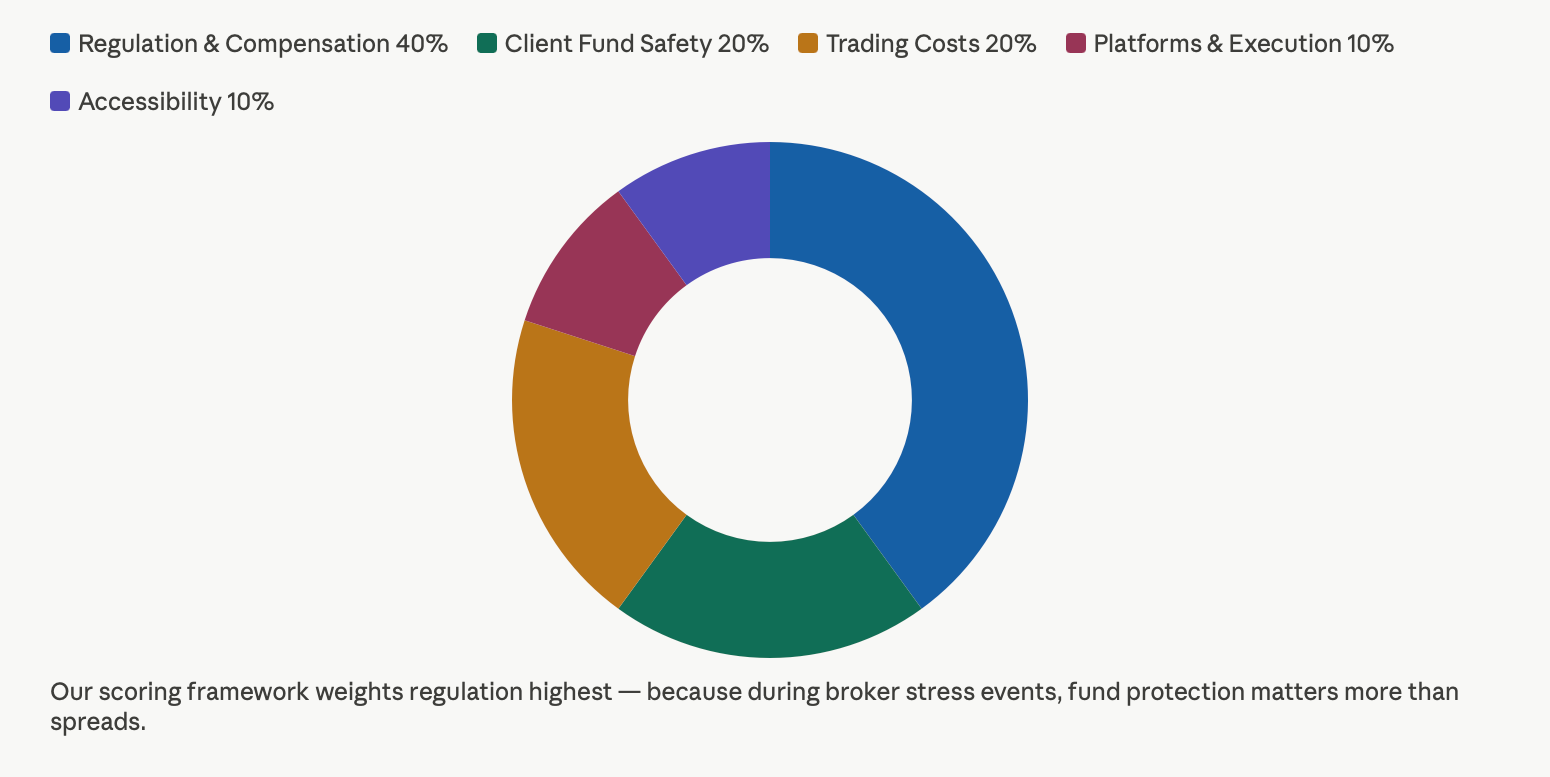
We use scores of brokers based on what protects you and costs you to lose money – not based on claims of marketing or affiliate income. Each broker on our list was rated in five categories and each category was assigned a weight based on the things that are important to retail traders, taking into account the way the major broker stress events actually occurred in the last decade.
The chart above sets out how we arrived at our score across the five categories. Regulation and compensation accounts for 40% of our overall score, and this is because, if your broker goes out of business or mismanages your funds, the recovery of your funds is dependent upon the regulatory framework that was in place at the time of their bankruptcy, not the spreads they had on their trading. Client fund safety (20%) includes all items pertaining to client funds, and we always look for segregated client accounts, protection from negative balances, and capital adequacy when assessing a broker. Trading costs are allocated 20%, and we assess this in a consistent manner using the typical EUR/USD spread of a standard account plus the per-lot commission for May 2026. Platform and execution quality accounts for 10% and are determined by the availability of MT4/MT5, whether they are set up as ECN or STP, and how quickly traders are executed when placing an order. Lastly, the final 10% relates to how accessible each broker is to traders, based on minimum deposit requirements, quality of mobile apps, and availability of educational materials.
We obtain our data from various sources, including official regulatory registries, broker websites, and third-party industry data providers. Each license number was confirmed against the following sources: FCA Register, ASIC Connect, CySEC Register, and NFA BASIC databases. The last update was in May 2026, and these comparisons are updated quarterly.
Important Note: Tradewill produces this comparison. We (Tradewill) are one of the brokers listed above and are positioned based on our actual regulatory status and product characteristics, not as a result of any editorial preference by Tradewill.
Please note that rankings are for guidance only and not considered financial advice. Always check current terms directly with each broker prior to opening an account.
Why Regulation Matters for Your Money
Regulations are important because they establish the legal framework to safeguard your money if the broker goes bankrupt, acts improperly, or mismanages your funds. Since the global foreign exchange market is estimated to be worth approximately $7.5 trillion on a daily basis as of January 2023 per the Bank for International Settlements, it is not uncommon for there to be a lack of outside regulation to ensure unregulated players behave responsibly.
The three methods that provide this protection include:
Segregated Client Funds: Brokers must keep your money in personal bank accounts that are completely separated from their company’s operating bank accounts. If the broker goes into bankruptcy, your account will be held in a fund that creditors cannot access. Think of it like having your own separate storage unit at a self-storage site. The broker has a key for this separate storage unit, but they cannot use or access anything stored inside it.
Negative Balance Protection: Negative balance protection guarantees that your account will never be negative, regardless of how extreme the market is moving against you. If you have a market execution where a trade moves against you so violently that the stop-loss is skipped, you will not receive a negative balance. The broker will absorb any losses beyond what was deposited except for your negative balance. Negative balance protection is required across the FCA, ASIC, and CySEC jurisdictions for retail accounts because of previous volatile market events. Seeing how risk management works in practice further illustrates why this is such an important protection.
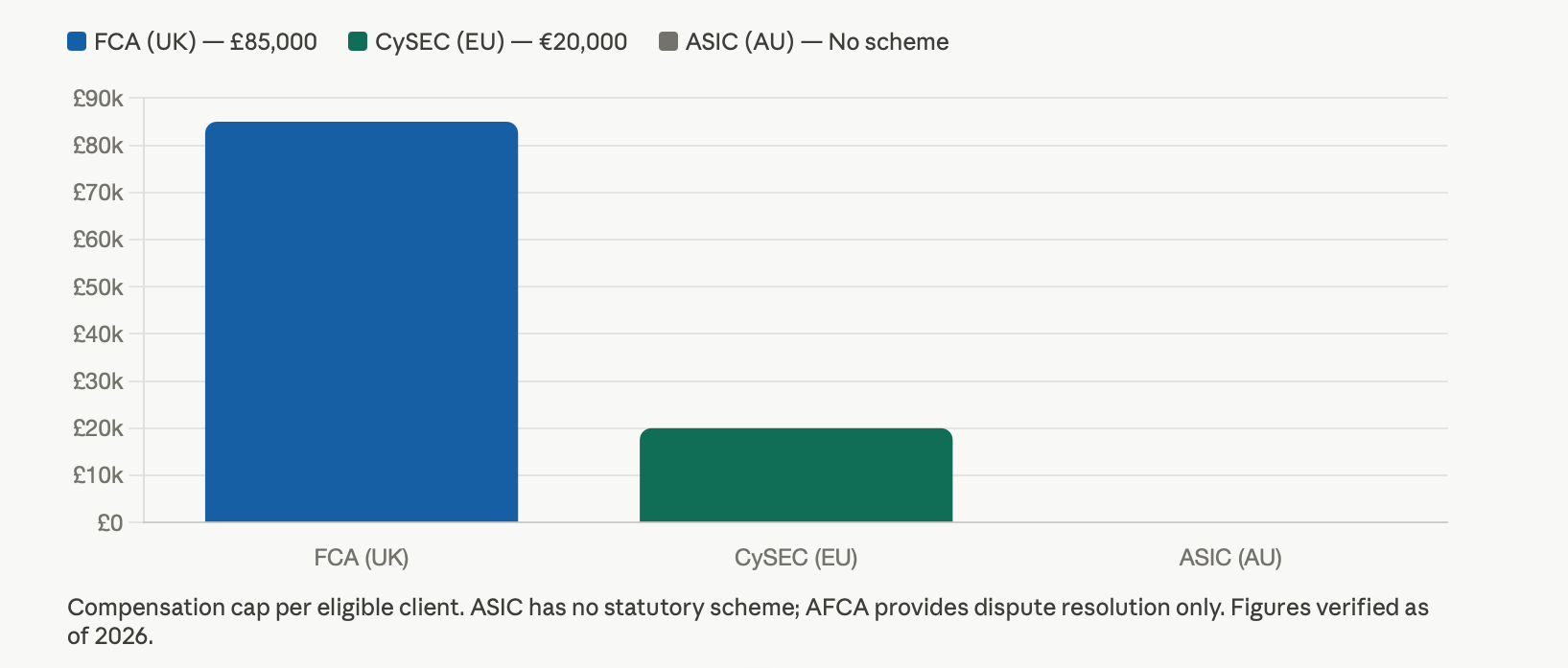
Compensation Schemes: These are the last-resort means of recovering funds in the case of broker failure, despite any of the aforementioned protections. The UK Financial Services Compensation Scheme (FSCS) will provide a maximum payout of £85,000 to eligible depositors if the broker fails. The Cyprus Securities and Exchange Commission (CySEC) provides compensation up to €20,000 to investors in the European Union through the Investor Compensation Fund (ICF). The Australian Securities and Investment Commission (ASIC) has no statutory compensation scheme; however, mandatory fund segregation and AFCA (Australian Financial Complaints Authority) offer alternative methods of providing protection.
According to the chart at the beginning of this section, each of these forms of compensation differs in amount. This difference in amounts can create significant differences in the ability for you to recover funds from an insolvent broker.
In conclusion, while regulations are designed to minimize the risk associated with trading, they are not a guarantee. Even though you should be dealing with a fully regulated Tier 1 broker, you can still lose money in the forex market, and you are still not protected from poor trading decisions or making poor trades.
FCA vs ASIC vs CySEC: Which Regulator Protects You Most?
The three regulators listed below are classified as Tier-1 regulators. All of them operate from major financial capitals of the world, all have strict enforcement procedures, all require brokers to hold minimum levels of capital, and all require brokers to segregate client funds.
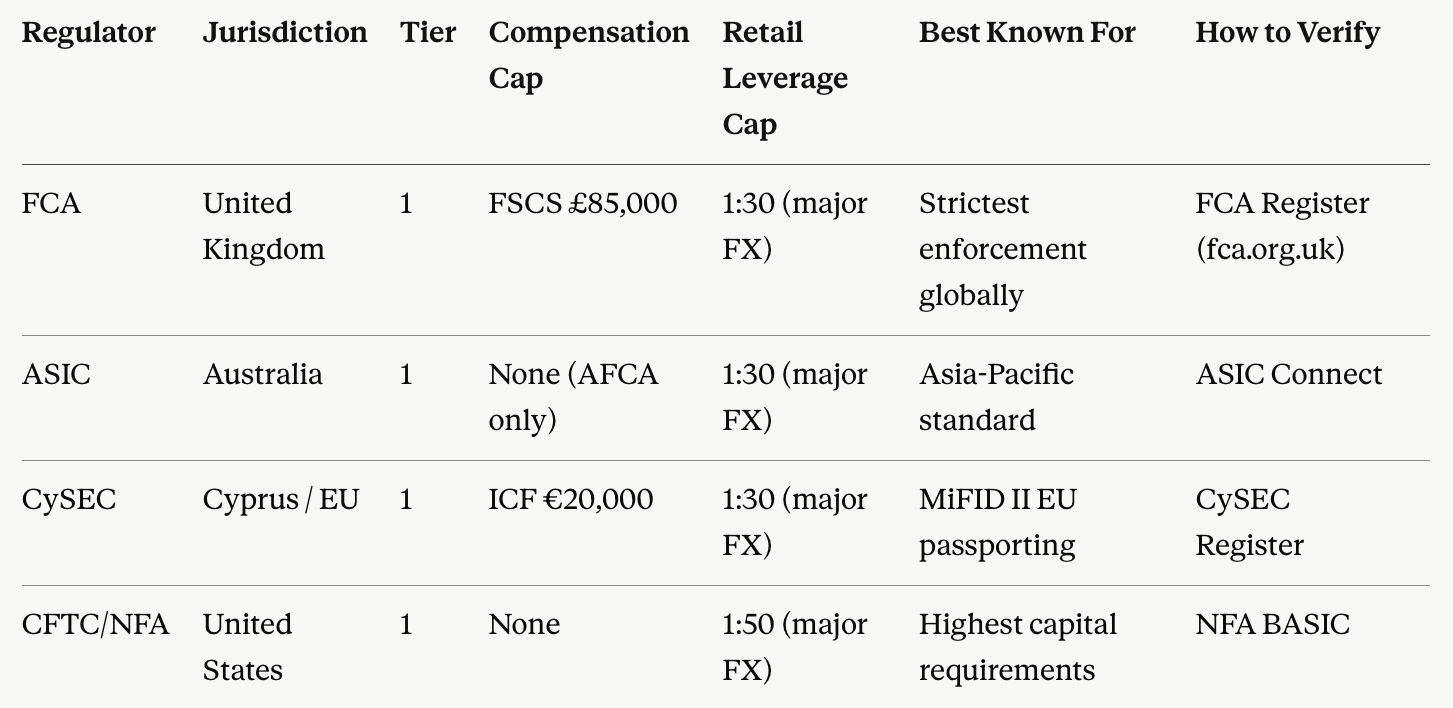
However, the three regulators differ greatly in the level of compensation they provide their clients and the scope of markets and regions that are covered. For example, the FCA is generally accepted as the most strictly enforced regulator in the world for retail forex. The FCA also offers FSCS protection (through the UK government) up to £85,000 for any eligible client if a broker regulated by the FCA fails. In addition, FCA-related enforcement actions against non-compliant brokers are incredibly well known on a global scale.
By comparison, ASIC is also well respected as a regulator within Australia and the Asia Pacific region but does not provide a statutory form of compensation. Therefore, if the broker you trade with is governed by ASIC and it fails, you must rely on the AFCA dispute resolution service or the capital buffers of that broker to recover any funds owed to you.
CySEC is between the two regulators when it comes to compensation. The ICF provides compensation up to €20,000, and MiFID II includes passporting rules that allow brokers regulated in one European Union member country (i.e., Cyprus) to conduct business throughout the entire European Union under one regulation.
CFTC and NFA requirements typically require brokers in the US to hold a minimum of $20,000,000 in capital; therefore, US forex regulations require much higher capital than regulators in other parts of the world. However, there is no single avenue for retail forex clients to obtain compensation for losses incurred due to broker failure.
The regulator that is best suited for you, the trader, depends greatly on the country you live in and your risk tolerance. A trader who tends to be risk averse will usually trade with a broker regulated by the FCA since it has the highest level of compensation available from FSCS.
It is important to understand that while some brokers have high levels of compensation offered to clients, this does not guarantee that you will make a profit from your trades; making a profit from trades is dependent on the trading decisions you make.
The Same Broker, Different Entity: The Trap Most Traders Fall Into
Depending on which legal entity your account is opened under, you may have a completely different level of legal protection from that broker. This point is one that most forex comparison websites do not explain clearly enough.
The diagram above illustrates how one broker brand has multiple legal entities in different parts of the world or regions. For example, a large broker may have an FCA entity in the UK, a CySEC entity in Cyprus, and an offshore entity registered in Seychelles or Belize. When you complete the onboarding process, you are automatically linked to one of these entities based on where you live and sometimes the amount of leverage you want to trade. If you live outside the UK and the EU and you want to open a high-leverage account, there is a very high probability that you are being redirected to an offshore entity, which will not be protected by FSCS or ICF but will have the FCA and ASIC logos displayed on its site.
This has huge implications for you as a trader wanting to trade at 1:500 leverage. You often will have an account at either a Seychelles or Belize entity, and they are both totally separate legal entities from the broker’s FCA entity. Hence, if the offshore entity goes belly up you will not be protected by FSCS. Again, you are dealing with the same logo but a different set of rules.
Before you deposit any funds into an account, you must do three checks against your account agreement document:
-
Verify that the full legal entity name is on the account agreement, this will be the legal entity name, not the broker brand.
-
Verify which regulatory agency is listed and find the license number with them on their public regulatory registry.
-
Verify that the compensation scheme listed applies to your account entity and is not just a reference to some other part of the business.
How to Verify a Forex Broker's Regulation Yourself
The above flowchart depicts the five-part process. Here is an explanation of each step:
Step 1: The broker's legal entity name and licence number. Look for these at the bottom of the broker's website (footer), in their terms and conditions, and in account agreement documents. Copy down only the legal company name, which is the name of the legal entity, not just the name under which they market themselves.
Step 2: The official regulator's database. There are four main databases to check: FCA Register, ASIC Connect, CySEC Register, and NFA BASIC. Do not rely on a broker's regulated by symbols; check the actual regulator database.
Step 3: Searching for the licence number. If you use the brand name to find the broker, you may retrieve several similar or even cloned companies. The licence number refers to a specific legal company, so it is always better to search by licence number than by brand name.
Step 4: Confirm the legal entity name, authorisation status, and permitted activities. Confirm that the company is legitimate, that it is authorised to deal with you as a retail investor in forex and/or CFDs, and that the broker does what it claims to do. If the broker is a regulated entity that has limitations on what it can offer, such as being restricted to specific products, but markets itself as a full-service retail broker, this should be a major red flag.
Step 5: Check the regulator's warning list. FCA, ASIC, and CySEC each maintain an updated list of entities that have been the subject of warnings. Many clone firms advertise using a domain name that closely resembles that of a legitimate firm and use the valid licence number of that firm. If a firm you are researching has a licence number and appears to operate under two different domains, you should also check both licence numbers and both domains.
If you are unable to locate a broker on an official register within two minutes, stop your investigation, consider it a major red flag, and do not make any financial payments.
Common mistakes people make are: searching by the brand name instead of the actual licence number; failing to check the permitted activities; and ignoring the regulator's warning list. Clone firms intentionally use legitimate licence numbers because they want you to trust them.
Clone firms often use legitimate firms' licence numbers while disguising their identity through a different domain name. Always confirm both the company name and the exact domain name.
Key Factors When Choosing a Broker
When selecting a broker, you need to assess how their actual capabilities align with your trading style rather than focusing on what they advertise.
Regulation and compensation are always the most important considerations. Weak investor protection cannot be offset by bonuses or tighter spreads. Therefore, the second factor to consider is client fund security. Client fund security consists of segregated accounts, negative balance protection, and adequate capitalisation.
Understanding your trading costs will help you select the most appropriate broker, and these costs will depend on how you trade. For instance, a scalper who places 20 trades per day will be concerned with the difference between a 0.1 pip spread and a higher spread, whereas a swing trader may not be. The reason is that a scalper executes many trades each day, causing transaction costs to accumulate much more quickly than for someone who trades only once or twice per week.
As such, you must learn how to read and interpret financial costs properly so that you can select the right broker.
The quality of the trading platform and trade execution will also affect your ability to enter and exit positions at your desired prices.
MT4 is the most widely used trading platform for the forex market and for running Expert Advisors. However, the MT5 trading platform offers a wider range of asset classes and order types. An in-depth MT4 vs MT5 comparison is available that highlights the differences between the two platforms.
Broker account type compatibility with your trading style is another important consideration. You should determine whether the broker's account type is suitable for your strategy. For example, a scalper needs an account with raw spreads and fast execution, a swing trader should review overnight swap rates before placing trades, and a beginner trader should prioritise a reliable mobile app and easy access to customer support.
When you are ready to deposit or withdraw funds, you should verify the minimum withdrawal amounts, processing timeframes, applicable fees, and available payment methods before making any transaction. Customer support and educational resources should be the final considerations, not because they are unimportant, but because they become relevant only after the other criteria have been satisfied.
In the case of scalping, a trader may benefit more from sub-second order execution and raw spread pricing than from access to research tools. On the other hand, if you are a beginner, you should start with a demo trading account before moving to a small live account funded only with money you can afford to lose. If you incur losses during your first month of live trading and do not generate a profit, you should view that first month as part of your education and not expect to earn income from it.
Leverage should be matched to your risk tolerance rather than selecting the maximum leverage offered by the broker. The maximum leverage available in a demo account could easily result in your account being wiped out during a single news event when trading with real money.
Common Mistakes That Cost Retail Traders Money
Before considering leverage, you should ensure that the brokerage company is regulated. Using an offshore broker with high leverage can result in greater potential losses and lower levels of investor protection. Therefore, it is important to conduct due diligence on the company's regulatory status before proceeding with an evaluation of whether its leverage levels match your risk profile.
Not verifying which legal entity you are trading with is a frequent and costly mistake in retail forex. Many investors believe they are protected by the FSCS simply because they see an FCA logo on a broker’s website. Always check the company name listed in the account agreement to determine which legal entity you are actually dealing with.
Many investors fall into this trap when they see an attractive no deposit bonus promotion. The majority of these promotions carry trading volume requirements that are so substantial that it can be very difficult to withdraw any profits earned from the bonus. Always read and understand the full terms and conditions before deciding to open an account based on the advertised bonus amount.
It is also beneficial to understand the withdrawal process before funding your account so that you do not experience delays or additional fees when requesting withdrawals.
You should also take advantage of demo trading before trading with real money. This allows you to develop and practise risk management strategies without incurring financial losses while gaining market experience.
Many beginner traders view leverage as an advantage because it allows them to control larger currency positions. However, they often fail to consider that leverage also magnifies potential losses. Account blowouts frequently occur immediately following major news events, not because the wrong execution venue was chosen, but because the leverage used was inappropriate for the trade's risk profile and the market moved significantly against the position.
When comparing spread costs to determine which broker offers the lowest trading costs, comparing a 0.0 pip raw spread account with a $6 round-trip commission should not automatically lead you to conclude that it is less expensive than a 0.9 pip standard account when trading small position sizes. Always calculate the total trading cost, including both spreads and commissions, before comparing brokers and opening an account.
Leverage can accelerate financial losses for inexperienced traders who are still working to establish a consistent and effective trading methodology.
Frequently Asked Questions
Which forex brokers are regulated?
Regulated forex brokers are firms licensed by authorities such as the FCA, ASIC, CySEC, or CFTC. They must hold client funds in segregated accounts, meet capital requirements, and follow fair execution standards.
Are regulated forex brokers safer?
Generally yes. Regulated brokers provide segregated funds, negative balance protection, and access to compensation schemes where applicable. Trading risk still exists and losses remain possible regardless of regulatory status.
How can I verify a forex broker's regulation?
Find the broker's licence number and search it on the relevant official register — FCA Register, ASIC Connect, CySEC Register, or NFA BASIC. Confirm the legal entity name and "Authorised" status are an exact match.
Which forex regulator is the most trusted?
Tier-1 regulators including the FCA, ASIC, CySEC, BaFin, MAS, FINMA, and CFTC/NFA are the most respected. The FCA is widely regarded as the most stringent in terms of enforcement and compensation coverage.
Can regulated forex brokers still fail?
Yes. Regulation reduces risk significantly but doesn't eliminate it. If a broker fails, compensation depends on the applicable scheme — FSCS in the UK up to £85,000, ICF in Cyprus up to €20,000, and nothing statutory under ASIC.
What is the difference between FCA and ASIC regulation?
Both are Tier-1 regulators with 1:30 retail leverage caps and mandatory fund segregation. The FCA provides FSCS compensation up to £85,000 per eligible client, while ASIC has no statutory compensation scheme and relies on AFCA dispute resolution.
What does Tier-1 regulation mean?
Tier-1 refers to regulators in major financial centres with strong enforcement standards and capital adequacy requirements — FCA, ASIC, CySEC, BaFin, MAS, FINMA, and CFTC/NFA.
What is negative balance protection?
It prevents retail trading accounts from going below zero. If extreme market volatility causes losses beyond your deposited balance, the broker absorbs the deficit rather than charging you for it.
What is a segregated client account?
A bank account holding client funds completely separately from the broker's own operational money — meaning client funds can't be used to pay broker expenses or liabilities even if the firm becomes insolvent.
Are offshore forex brokers safe?
Some offshore brokers operate legitimately, but they generally carry lower capital requirements and weaker investor protection, and they're not covered by Tier-1 compensation schemes like FSCS or ICF.
Do regulated brokers offer MT4 and MT5?
Most do. MT5 is newer with more asset classes and order types, while MT4 remains the standard for forex and automated Expert Advisors. Understanding which platform suits your strategy is worth doing before you commit to a broker.
Can US residents use FCA or ASIC regulated brokers?
Generally no. US residents must use CFTC-registered, NFA-member brokers. Most FCA, ASIC, and CySEC brokers do not accept US clients due to regulatory restrictions.
How often should a broker comparison list be updated?
At least quarterly. Regulation status, spread pricing, and trading conditions change frequently — always check the "last reviewed" date before relying on any comparison including this one.
What should I check before depositing money?
Verify the legal entity name, the licence number on the official register, confirm withdrawal terms and timelines, and check that negative balance protection applies to your specific account type.
Conclusion
When choosing a regulated forex broker, the first step is to establish its regulatory status. The second step is to check that the broker’s legal entity and licence number match what is listed on the official register. The third step is to compare fees and platforms according to how you intend to trade. By following these three steps, you can avoid the vast majority of errors that retail traders make when selecting a broker.
While the above comparison table, as well as all other comparison tables, is valuable, it is always advisable to verify the current regulatory status of each broker before sending them any funds. Regulatory status can change, business entities may merge or be acquired by another entity, and compensation limits may be amended. The regulatory information contained herein has been verified and is current as of May 2026. However, a direct check of your chosen broker will always provide the most up-to-date information.
The next step is to set up a demo account with your chosen broker and trade in that account under live market conditions. You should also validate the withdrawal process with a small amount of money before transferring a larger amount of capital.
Ready to start trading with proper risk controls in place? Open a Tradewill account today — minimum deposit of $10, MT5 access, and segregated client funds from day one. Create your account →
Forex and CFD trading carries a high risk of loss. Only trade money you can afford to lose. The majority of retail investor accounts lose money when trading leveraged products.
ข้อจำกัดความรับผิดชอบ : เนื้อหาในบทความไม่ได้แสดงจุดยืน หรือ ความคิดเห็นของ Trade W ไม่ได้เป็นการแนะนำการลงทุน และ ไมได้เป็นการรับรองบุคคลที่สามแต่อย่างใด